
Gulf allies question US security role as war on Iran drags on: WashPo
 7 Min Read
Gulf states are growing increasingly frustrated with Washington over the prolonged war on Iran, prompting some US allies to question American security guarantees and seek more diversified defense partnerships.
-
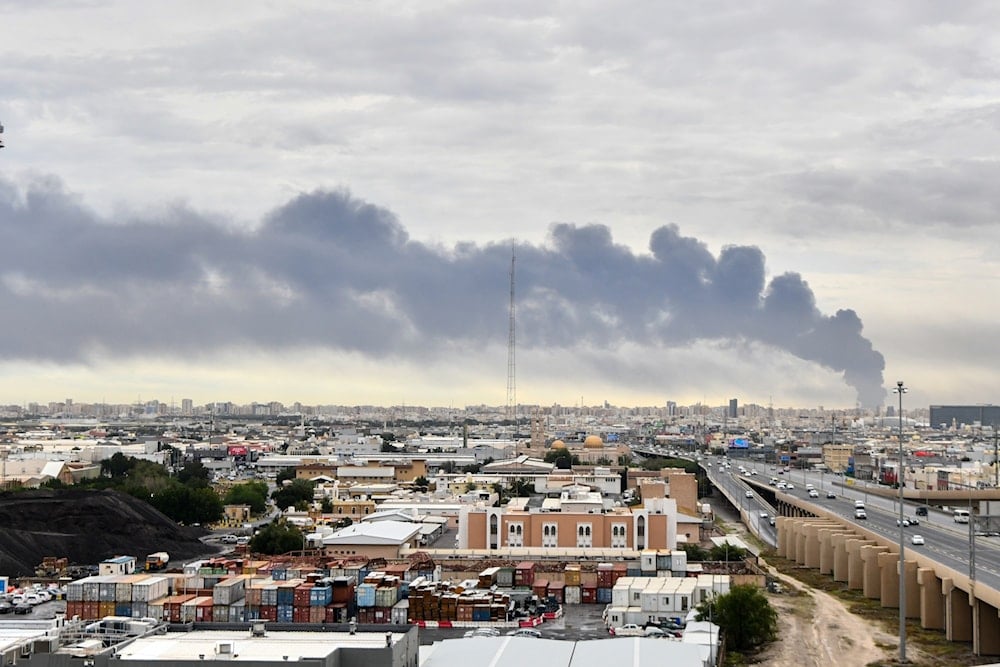
Smoke rises from Kuwait International Airport after a drone strike on fuel storage in Kuwait City, Kuwait, Friday, Wednesday, March 25, 2026 (AP)
Frustration with Washington is mounting across the Gulf as several US-allied governments grow increasingly concerned over President Donald Trump's handling of the war on Iran and his failure to secure a diplomatic settlement, The Washington Post reported, citing Arab and Western officials.
Officials told the newspaper that Saudi Arabia, the United Arab Emirates, Qatar, Kuwait, and Bahrain have become increasingly dissatisfied with Washington after months of conflict, repeated US threats against Tehran, and unsuccessful attempts to reach an agreement.
Some governments are even beginning to reassess the value of hosting major US military facilities, although analysts cited by the newspaper said a fundamental break with Washington remains unlikely in the near term.
“Trump started this war,” one Gulf official said, “and we are paying the price.”
Anger toward Washington hits highest level
The official said regional anger toward Washington had reached its highest level since the United States and "Israel" launched their war on Iran in February.
Despite those tensions, Gulf governments remain deeply reliant on the United States for weapons, intelligence, and military support. Qatar and Bahrain host major American bases, while Washington remains a central security partner for several monarchies in the region.
However, governments are increasingly exploring alternatives and seeking to broaden their defense relationships.
A mutual defense agreement signed last week by Saudi Arabia, Turkey, and Pakistan was described by a senior European official as “a signal to the U.S.”
The three countries “are trying to diversify their security and defense partnerships,” the official said. “In their mind, the U.S. is not enough.”
The White House rejected suggestions that relations with Gulf partners were deteriorating.
A White House official said Trump “has extraordinary relationships with all of our Gulf partners.”
“The United States has been in regular contact with all of our regional allies since before Operation Epic Fury,” the official said. “Iran is more isolated than ever before as a result of its terrorist actions.”
Confidence in Washington declines
Regional frustration predates the latest diplomatic setbacks, according to analysts and officials cited by The Washington Post.
“There has been frustration from the get-go,” said Firas Maksad, director for the Middle East and North Africa practice at the Eurasia Group.
According to Maksad, Gulf governments believe they were “unnecessarily entangled” in a conflict that Washington is now struggling to bring to an end.
He added that Trump's Iran policy is frequently characterized among Gulf officials as “erratic” and “unpredictable".
Anna Jacobs, a fellow with the Arab Gulf States Institute in Washington, similarly said there had been “diminished trust” in the United States since the war began.
US allies increasingly believe Washington's “conduct in the region is making them less safe, not more safe,” she said.
A Western diplomat said the presence of US forces had long been accepted by Gulf governments primarily as a security necessity rather than enthusiastically embraced.
“It was more something that was a necessary evil,” the diplomat said. “Now, the necessity of it is being put in question.”
Saudi Arabia faces growing pressure
Saudi Arabia has been particularly affected by the prolonged war.
Alongside attacks from Iran and Resistance groups in Iraq, the kingdom has faced strikes by Yemen's Ansar Allah movement against energy infrastructure and shipping routes.
With the Strait of Hormuz closed by Iran during the early stages of the war, Riyadh has increasingly depended on Red Sea export terminals to move its oil.
Ansar Allah has meanwhile sought to disrupt shipping through the Bab al-Mandab, increasing pressure on another strategically important maritime corridor.
According to officials cited in the report, the positions of several Gulf governments toward the conflict have also evolved.
Oman opposed the war from the beginning, while Saudi Arabia, the UAE, and Bahrain were initially more receptive to the prospect that a short confrontation could weaken Tehran.
“At the beginning of the war, they were — I don’t want to say, supportive — but honestly, they were not totally against the war,” the senior European official said.
The official said attitudes changed ahead of the first round of US-Iran talks in April, when it became apparent that the Iranian government would remain in place and Tehran would not immediately reopen the Strait of Hormuz.
Gulf concerns left out of US-Iran diplomacy
Trump's shifting rhetoric and repeated movement between threats and diplomacy have added to regional uncertainty.
“Even before all this back and forth with Trump, there was no clear strategy,” said Bader al-Saif, an assistant professor of history at Kuwait University.
Al-Saif also criticized the June memorandum of understanding between Washington and Tehran, saying it failed to address issues Gulf governments considered central to their security.
“The MOU was a joke,” he said.
According to al-Saif, the agreement did not adequately address Iran's ballistic missile program or its support for allied forces throughout the region.
“Those terms were not terms of our liking,” al-Saif said, “and that’s why it died out sooner than later.”
The White House maintained that Trump has consistently sought a diplomatic resolution.
Trump “has always been clear that his preference is diplomacy,” the White House official said.
“Unfortunately, Iran chose the path of violence by killing American troops, committing international acts of terrorism, and lashing out at its neighbors in the region — and the Commander-in-Chief ensured that they reaped the consequences of those decisions.”
Gulf remains dependent on US despite anger
For now, Gulf governments have few realistic substitutes for their longstanding security ties with Washington.
One Gulf official acknowledged that despite mounting frustration, governments in the region remain constrained by their dependence on US military capabilities.
“Whatever we do,” he said, “we cannot say no to the United States.”
Douglas Silliman, a former US ambassador to Kuwait and Iraq, said frustration with Washington was clearly evident during a recent visit to the region.
At the same time, he said resentment toward Tehran was also increasing because of continued attacks on infrastructure and Iran's refusal to reopen the Strait of Hormuz.
Silliman described the regional mood as “kind of this odd contradiction of being mad at the United States for starting the war and being dependent upon the United States” for intelligence, weapons and military supplies.
The economic consequences could become more pronounced if the conflict continues into the autumn, when the Gulf normally hosts major international conferences, sporting events, festivals and investment gatherings.
Saudi Arabia's Future Investment Initiative in late October could provide an early indication of whether international executives and officials remain willing to travel to the region amid continued instability.
Meanwhile, daily life has largely resumed in Kuwait despite continued Iranian drone and missile attacks, according to al-Saif.
“We have been through worse,” he said, referring to Iraq's 1990 invasion of Kuwait. “We handled the occupation. We can handle this.”
Nevertheless, he said the current confrontation cannot continue indefinitely.
“A quick end is obviously something we want,” he said. “The Gulf War was much more straightforward than today.”
Read more: How US security guarantees became a strategic liability in the Gulf


