
Hegseth's Army testosterone testing plan draws medical criticism
 7 Min Read
Medical experts warn the Pentagon's plan lacks sufficient scientific basis and could lead to overdiagnosis, infertility, and other health risks.
-
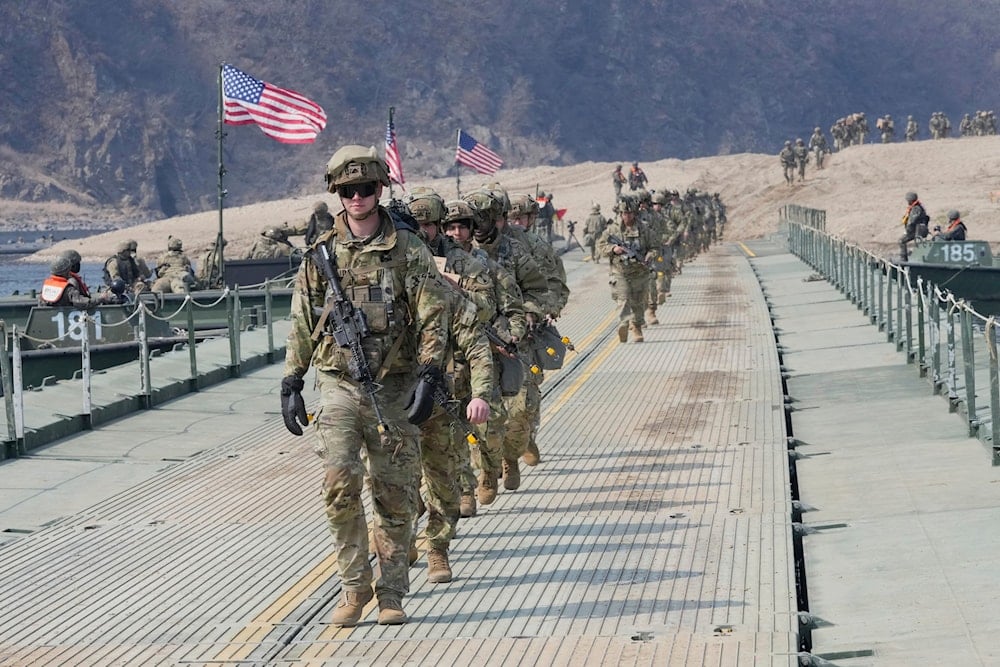
US Army soldiers cross a floating bridge on the Imjin River during a joint river-crossing exercise between South Korea and the United States as a part of the Freedom Shield military exercise in Yeoncheon, South Korea, March 20, 2025 (AP)
US Secretary of War Pete Hegseth has announced plans to introduce routine testosterone screening for military personnel over the age of 30, drawing criticism from health specialists who warn that the policy could lead to unnecessary diagnoses and potentially harmful treatment, The Hill reported.
The testing will be incorporated into the military’s periodic health assessments, with troops found to have low hormone levels potentially offered testosterone replacement therapy, commonly known as TRT.
Hegseth has presented the measure as an effort to improve troops’ health, physical performance, and combat preparedness.
“This initiative, it’s not about artificial enhancement; it’s about restoring and optimizing your natural capabilities, protecting your longevity, ensuring you have the biological foundation required to sustain and fight,” Hegseth said.
“We owe our warriors the absolute best medical care in the world. And this program delivers on that obligation.”
'Operate at absolute best'
In a video announcing the policy, Hegseth said the program would ensure service members “have the right testosterone levels to operate at [their] absolute best because it’s well-established science that as we age, testosterone levels often naturally drop.”
Medical specialists, however, argue that routinely testing healthy and physically active personnel without symptoms is not supported by established clinical guidance.
Derek Griffith, director of the program for research on men’s health at the University of Pennsylvania, noted that low testosterone affects only around 2% of the male population.
That figure, he said, does not “suggest that this is a major problem” among military personnel, who are generally younger and more physically active than the wider population.
“I don’t fully understand,” Griffith said of the Pentagon’s decision. “I don’t know what they’re seeing or what data they’re using to say ‘this is where we need to really focus and put our energy.’”
Griffith also questioned the decision to begin routine screening at the age of 30.
“It’s not what’s usually a major issue for healthy men,” Griffith said. “I imagine for most active-duty military, they’re pretty much at a healthy weight. So I would be curious what percentage they’re expecting to identify who have low testosterone and would be in need of a treatment.”
Experts warn of overdiagnosis
Testosterone levels vary widely between individuals and can change throughout the day, typically peaking in the morning.
The hormone’s normal range in men is generally considered to be between 300 and 1,000 nanograms per deciliter, making isolated test results difficult to interpret without accompanying symptoms.
The Endocrine Society advises against routinely testing men who do not display symptoms associated with testosterone deficiency, such as low energy or loss of muscle mass.
Joel Heidelbaugh, a clinical professor of urology at the University of Michigan, described the Pentagon’s proposed approach as “probably a little bit aggressive.”
Routine screening, critics say, could lead healthy service members to be classified as having a medical condition and encouraged to begin treatment they may not need.
Although testosterone therapy can benefit patients with a medically confirmed deficiency, specialists say its long-term advantages for otherwise healthy men remain unclear.
Fertility and health concerns
One of the most established consequences of testosterone therapy is reduced sperm production, creating a potential fertility risk for younger service members who may wish to have children.
Griffith said this concern should be taken seriously when considering treatment for military personnel in their 30s.
Adriane Fugh-Berman, a professor in Georgetown University’s Department of Pharmacology and Physiology, warned that testosterone treatment carries a range of additional risks.
“Testosterone even in low doses increases heart problems, kidney problems, infertility and fractures, which hardly seems like a good way to keep soldiers in fighting form,” Fugh-Berman said.
“Hegseth’s remarks seem to imply that testosterone increases longevity, and there is no evidence for that. It shrinks testicles, too. How manly is that?” she added. “It’s ridiculous to screen a population for a questionable condition which has a treatment with unproven benefits and proven risk.”
Low testosterone can be associated with health conditions including diabetes, cardiovascular disease, osteoporosis, and depression. Experts argue, however, that the Pentagon should focus more attention on broader causes of illness and premature death among men, including cancer, hypertension, alcohol misuse, and mental health disorders.
Masculinity takes center stage
The initiative comes as traditional masculinity and physical strength have become increasingly prominent themes within US President Donald Trump’s administration.
Hegseth, a former National Guard officer and television presenter, has repeatedly appeared in social media videos exercising alongside troops, lifting weights, and performing pushups.
He has also introduced stricter military fitness requirements that will require personnel to meet what he has described as a “male standard”.
Health and Human Services Secretary Robert F. Kennedy Jr. has similarly promoted testosterone therapy as part of his personal “anti-ageing protocol” and described falling testosterone levels worldwide as an “existential” threat.
Kennedy has frequently sought to emphasize physical fitness publicly, including appearing shirtless while exercising and filming himself riding an exercise bike inside a sauna with musician Kid Rock.
Researchers warn that the administration’s focus reflects a broader online culture in which ordinary experiences such as fatigue, stress, and changes in sexual desire are increasingly presented to young men as signs of hormone deficiency.
Brooke Nickel, a public health researcher at the University of Sydney, said the Pentagon policy “appears to be happening in tandem with mis- and disinformation about masculinity circulating on social media.”
“Young, healthy men are being told that common experiences like tiredness, stress or changes in libido are signs that something is medically wrong and that testosterone is the solution,” Nickel said in a statement.
Nickel added that testosterone levels exist across a broad range and that there is “little science to back the Pentagon’s decision to offer yearly routine screening for those over the age of 30.”
Political backlash
The announcement has also generated criticism from Democratic lawmakers, who accused Hegseth and other administration officials of promoting an exaggerated and contradictory image of masculinity.
Representative Becca Balint of Vermont said the policy “is indicative of the fact that there are so many people in this administration that have some weird, like, intense homoerotic feelings towards men while also being incredibly homophobic.”
Balint, who is openly gay, said she did not consider the homoerotic element itself unusual.
“The weird part is that they pretend that that’s not what it’s about,” she said. “And so, Pete Hegseth is like the example of this manly, manly, rugged, macho man.”
It remains unclear whether troops who fail newly introduced physical fitness tests and are later found to have low testosterone levels would be permitted to undergo treatment before being tested again.
Read more: Pentagon tightens grooming, fitness rules amid Hegseth discipline push


