
Hezbollah's comeback: FPVs, guerrilla tactics challenge IOF army - FT
 4 Min Read
Hezbollah remains capable of sustaining a prolonged confrontation, adapting its tactics and exposing the limits of "Israel's" ability to achieve a decisive outcome.
-
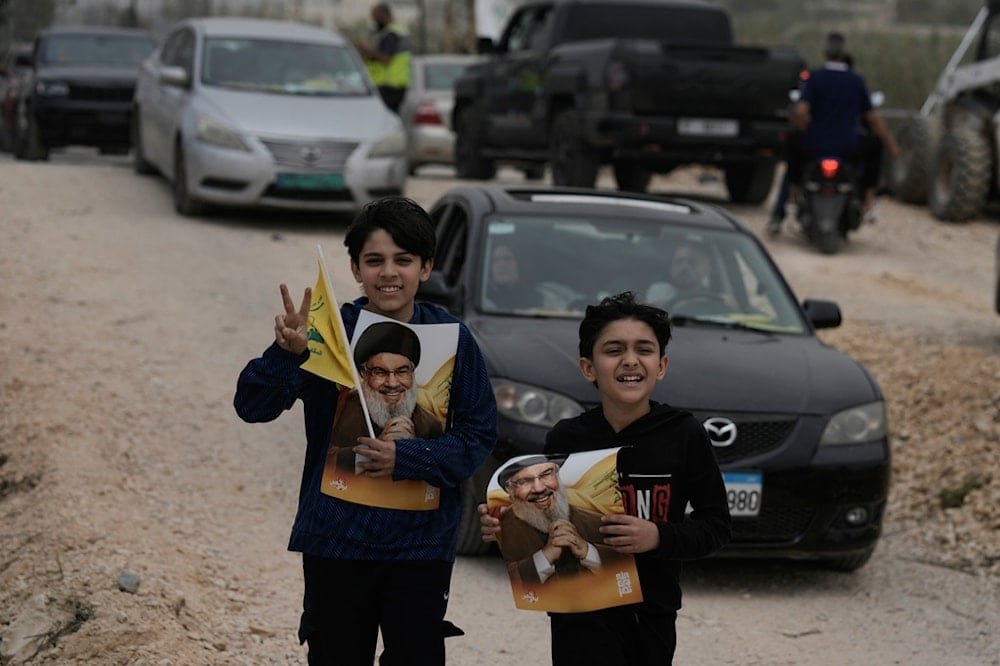
Displaced boys hold portraits of late Hezbollah leader, martyr Sayyed Hassan Nasrallah, as they cross on foot a destroyed bridge while returning to their villages on the second day of a ceasefire between Lebanon and "Israel" in Qasmiyeh, near Tyre city, southern Lebanon, Saturday, April 18, 2026 (AP)
Hezbollah continues to pose a sustained military challenge to Israeli forces, despite having suffered major losses in its 2024 war with "Israel", the Financial Times reported.
The report comes in contrast to earlier claims by Benjamin Netanyahu, who had told settlers in northern occupied Palestine that the group had been “crushed” following the previous round of fighting. More than a year later, Hezbollah's operations have resumed along the Lebanese border, amid continued Israeli attacks on the country despite a US-imposed ceasefire, which Lebanese officials and international observers say was repeatedly violated by Israeli strikes, incursions, and sustained aerial activity.
In early March, Hezbollah resumed its retaliation operations in response to persistent ceasefire violations and ongoing Israeli aggression on Lebanon that have long plunged the region into a prolonged cycle of hostilities concentrated in southern Lebanon. Israeli forces are currently operating within a so-called “security zone,” an area largely emptied of civilians by sustained bombardment and destruction.
While Lebanon has borne the heaviest toll, recording thousands of deaths among civilians and widespread destruction, Israeli forces have also faced sustained pressure. Hezbollah has carried out repeated attacks on Israeli troops using drones and indirect fire, maintaining the ability to strike northern Israeli settlements and disrupt military operations.
Assessment gap exposed
Israeli officials have acknowledged that the group’s continued operations contradict earlier battlefield assessments. “There’s a gap between how we finished [the 2024 war] . . . what we understood and thought, and suddenly we still find Hezbollah,” said Rafi Milo, head of the military’s northern command, in remarks cited in the report.
Milo noted that cross-border fire, including rockets and drones, remains an ongoing concern, though he stressed that such attacks were “not in very very large amounts, certainly compared to before the [2024] war."
According to the report, Hezbollah used the period following the 2024 ceasefire to regroup and adapt its military approach, anticipating further confrontation. The group reduced reliance on electronic communications, developed alternative supply routes, and reorganized into smaller, more flexible units capable of sustained resistance under pressure.
An Israeli military official described the shift in tactics, saying, “Hizbollah returned to what it used to be — a guerrilla force that tries to strike when it can, using hit-and-run tactics. It’s trying to go back to its old capabilities.”
Adaptive resistance evolves
At the same time, Hezbollah has expanded its use of drones, drawing on battlefield developments observed in the Russia-Ukraine war. Israeli troops operating in southern Lebanon have faced repeated attacks using explosive drones, including systems designed to bypass electronic countermeasures, underscoring the group’s ability to adapt technologically despite sustained strikes.
While Hezbollah has suffered significant losses since 2024, including damage to its missile arsenal and the loss of senior figures, it has compensated through decentralized operations, flexible command structures, and a persistent battlefield presence that continues to challenge Israeli forces.
Enduring stalemate
Still, Israeli officials agree that the group retains enough capability to sustain the fight and complicate efforts to restore calm in northern settlements. Prime Minister Benjamin Netanyahu acknowledged the limitations of current operations, stating, “I do not delude myself that this will come easily, nor do I think, and I say this honestly — the job is not done.”
Analysts cited in the report say that while Israeli forces have achieved significant battlefield gains, these have not translated into a decisive outcome. Hezbollah continues to exert influence on the ground, maintaining deterrence and demonstrating that it remains a central actor in the confrontation, raising concerns that the situation could evolve into a prolonged and costly war of attrition.
Read more: Resistance FPVs are Hezbollah's F-35s: Israeli officials


