
Hezbollah's low-cost drones pierce 'Israel's' multi-billion Iron Dome
 4 Min Read
Hezbollah’s use of low-cost FPV drones is exposing vulnerabilities in the Israeli occupation’s Iron Dome, as they are reshaping battlefield dynamics.
-
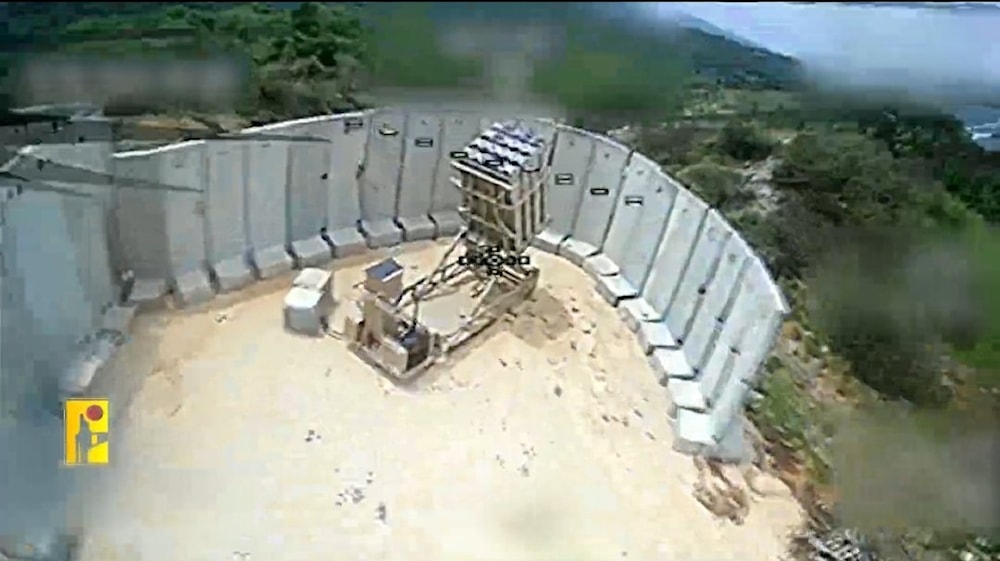
Screengrab of Hezbollah released footage of an operation carried out on May 18, 2026, targeting an Israeli Iron Dome launcher in the settlement of Shomera using an FPV drone (Islamic Resistance Military Media)
Small, low-cost FPV drones operated by the Islamic Resistance in Lebanon, Hezbollah have proven to be a formidable barrier and a serious impediment against the Israeli occupation’s advanced air-defense systems. This is fueling anxiety among Israeli military analysts over the effectiveness of the multi-billion-dollar Iron Dome against evolving drone warfare tactics, which looked powerless against a small aircraft that cost a few hundred euros, Deutsche Welle reported.
Recent footage published by Hezbollah appeared to show an explosive-laden drone directly striking an Israeli Iron Dome battery, as experts explain it as a symbolic demonstration of how inexpensive drones can penetrate high-investment defense systems.
The reported strike has intensified debate over the growing role of FPV (first-person view) drones in modern warfare, particularly fiber-optic variants that are difficult to intercept or jam using conventional electronic warfare systems.
#WATCH | The Islamic Resistance in Lebanon released footage of an operation, dated May 20, 2026, targeting an Israeli occupation military Namer vehicle, in the town of #Haddatha in South Lebanon, using an Ababil FPV drone.#SouthLebanon #Lebanon #FPVDrone pic.twitter.com/4LID0MK2yA
— Al Mayadeen English (@MayadeenEnglish) May 24, 2026
Hundred-dollar drones overwhelm billion-dollar interceptors
Since March, Hezbollah has expanded its use of FPV drones in operations against Israeli occupation forces, with Israeli media and analysts acknowledging rising casualties among soldiers from such retaliatory strikes.
Unlike conventional drones that rely on radio-frequency communication, newer fiber-optic FPV drones are controlled through physical cables unspooled during flight. This allows operators to maintain real-time control while avoiding electronic detection and signal jamming.
Military experts say the technology has already transformed the battlefield in the Russia-Ukraine war, where both sides have struggled to counter the growing use of fiber-optic drones despite deploying nets, gunfire, and improvised defenses, according to DW.
Analysts note that Hezbollah’s use of such systems demonstrates a significant evolution in its drone capabilities and highlights the limitations of the Israeli occupation’s current aerial defense architecture as it grapples with countering sustained barrages of low-cost, hard-to-detect threats, the German website added.
#WATCH | The Resistance in Lebanon published footage of a reconnaissance operation over the Israeli settlement of Shomera using FPV drones.
— Al Mayadeen English (@MayadeenEnglish) May 23, 2026
Such operations are used to identify and locate targets before launching drones or rockets at the designated target.#Lebanon… pic.twitter.com/v18g6ky2V9
Premium top-notch systems can barely keep up
Israeli defense analysts and technology experts have increasingly warned that highly expensive military platforms are vulnerable to relatively low-cost drone systems costing only hundreds of dollars.
DW quoted Neri Zin, managing director of Israeli defense technology company Axon Vision, as saying that modern militaries have been slow to adapt to the rapid transformation of drone warfare.
“A battle tank that costs tens of millions of dollars can suddenly be defeated by a $400 FPV drone,” Zin said in comments reported by international media.
The growing drone threat has reportedly pushed Israeli Prime Minister Benjamin Netanyahu to order the creation of a special project focused on countering drones, though he acknowledged that developing effective solutions would take a long time.
#WATCH | The Resistance in Lebanon published a video showcasing an operation targeting an Iron Dome radar system at the Kiryat Eliezer site in occupied Haifa using advanced missiles.#Lebanon #Hezbollah #AlMayadeen pic.twitter.com/EqoKiRjD3L
— Al Mayadeen English (@MayadeenEnglish) April 17, 2026
Pressure compounding on Israeli occupation
The increasing effectiveness of Hezbollah’s drone operations has added pressure on Israeli occupation military planners, especially as existing interception systems such as the Iron Dome were originally designed primarily to counter rockets and missiles rather than swarms of low-cost FPV drones.
Yevgen Korniychuk, Ukraine’s ambassador to the Israeli occupation, also criticized the limited Israeli interest in lessons learned from Ukraine’s battlefield experience with drones.
Israeli officials maintain that the occupation military is monitoring developments in global wars and working on new technologies, including AI-assisted detection systems, laser weapons, microwave defenses, and low-cost interception tools aimed at countering the expanding drone threat, directly proving that they are overwhelmed and scrambling to find sophisticated measures against what they deem unsophisticated.
Military experts say the challenge now facing advanced armies is economic as much as technological, as they are forced to weigh the cost of intercepting cheap drones using highly expensive missile-defense systems, according to Deutsche Welle.
WATCH | #Hezbollah releases footage of an operation carried out on May 18 targeting an Israeli Iron Dome launcher in the settlement of Shomera using an FPV drone. pic.twitter.com/hO8YSSkxdX
— Al Mayadeen English (@MayadeenEnglish) May 21, 2026
Read more: 'Israel' lacks defense against Hezbollah FPV drones: Israeli expert


