
How the war on Iran keeps driving global prices months later
 7 Min Read
The US-Israeli war on Iran has left a lasting economic shock, with five indicators showing how disrupted oil flows, fuel shortages, higher commodity prices, and rising food insecurity continue to pressure households and vulnerable economies worldwide.
-
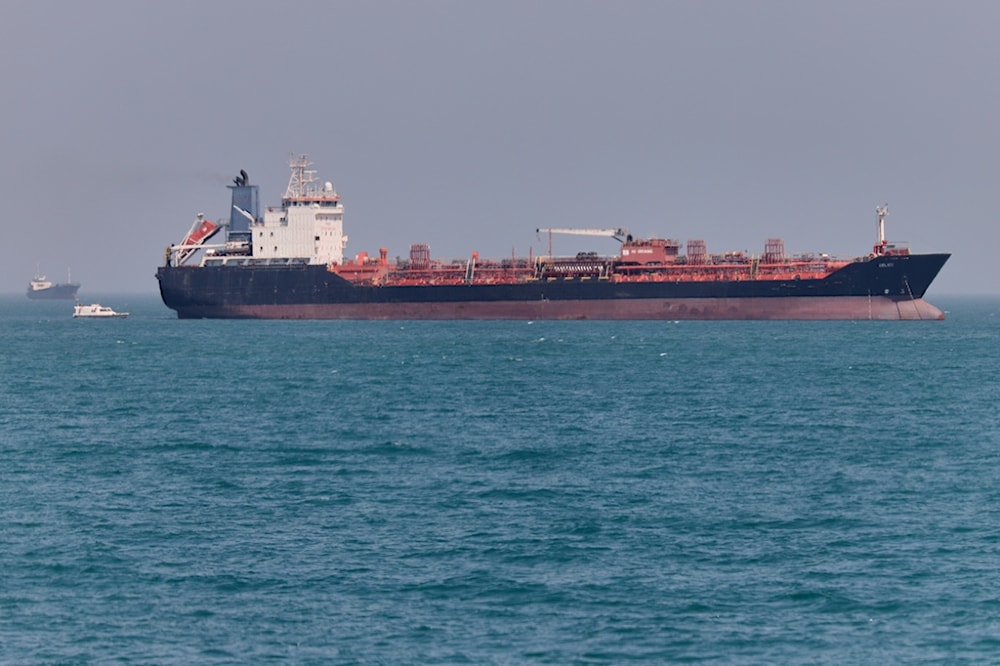
An oil tanker sits at anchor in the Strait of Hormuz off Bandar Abbas, Iran, Saturday, May 2, 2026 (AP)
Nearly four months after the United States and "Israel" launched their war on Iran, the fighting has entered a fragile diplomatic phase, but the economic aftershocks are still moving through global markets, according to a report by The Independent.
The report traces the lasting impact through five indicators: the disruption of oil flows through the Strait of Hormuz, the rise in fuel prices, jet fuel shortages, worsening commodity forecasts, and growing food insecurity in vulnerable countries. Together, these show how the war on Iran continues to raise costs for households, airlines, farmers, and debt-burdened economies far beyond the region.
Although Iran has lifted its blockade of the Strait of Hormuz under a temporary agreement with Washington, the disruption has already fed into global markets. Energy prices surged, transport costs rose, food and fertilizer forecasts worsened, and developing countries dependent on imported fuel and agricultural inputs are expected to face the heaviest burden.
Hormuz disruption shook global oil flows
The Strait of Hormuz, one of the world's most critical energy routes, became the center of the economic crisis triggered by the war. A major share of global energy supplies passes through the waterway, making any disruption there capable of reshaping oil prices, shipping routes, and supply chains.
During the height of the war on Iran, oil flows through the Strait were severely curtailed, forcing governments and companies to search for alternative supplies. The blockade sent energy markets into panic and pushed crude prices sharply higher.
The latest data shows a partial recovery. US Energy Secretary Chris Wright said this week that crude flows through Hormuz are now similar to pre-war levels, with around 20 million barrels of oil exiting the strait in a 24-hour period.
"I could say roughly 72 ships in the last 24 hours, and 20 million barrels of oil," Wright said. "We have normal flows today."
Still, shipping has not fully returned to normal. Many vessels are avoiding the main channel because of mine risks and are instead using routes closer to Oman or Iran under military escort. Full normalization could still take weeks.
Fuel prices pushed up household costs
The oil shock quickly reached consumers. Even as prices have eased since the temporary agreement, the war's impact had already moved through fuel markets, transport costs, electricity bills, and inflation.
Oil prices dropped after traffic through Hormuz resumed, with Brent crude falling back near levels seen before the US and "Israel" launched their attacks on Iran in late February. That marked a major shift from the peak of the crisis, when fears over prolonged disruption pushed prices sharply higher.
But the relief came only after months of pressure on households. Countries dependent on imported crude faced higher diesel and petrol prices, while businesses passed transport and energy costs on to consumers.
"The war is hitting the global economy in cumulative waves: first through higher energy prices, then higher food prices, and finally, higher inflation, which will push up interest rates and make debt even more expensive," said Indermit Gill, the World Bank Group's chief economist.
Jet fuel shortages strained airlines and Asia
The fuel crisis also hit aviation. Airlines faced a sharp rise in aviation fuel costs during the height of the disruption, adding pressure to an industry already dealing with debt, weak margins, and volatile demand.
In Asia, the impact was especially severe. Some countries faced pressure on jet fuel supplies, while China's decision to prioritize its domestic market added further strain to regional fuel availability.
The shortage disrupted air travel and increased costs for carriers, forcing airlines to absorb higher fuel expenses or pass them on through ticket prices. In some cases, the pressure extended beyond aviation, affecting restaurants, transport networks, and businesses dependent on cooking gas and fuel supplies.
The crisis showed how a disruption in West Asian energy routes could quickly reach daily life in countries far from the war zone.
Commodity forecasts worsened after the war
The economic impact has also extended beyond oil. Energy, fertilizer, food, and metal prices all rose as a result of the war and the disruption to shipping and energy infrastructure.
The World Bank has warned that energy prices are expected to rise sharply this year, while fertilizer prices are also projected to increase. Higher fertilizer costs threaten farmers' incomes and future crop yields, raising the risk of additional pressure on food markets.
These pressures are especially severe for developing countries that depend heavily on imported fuel and fertilizer. Higher import bills leave governments with fewer resources to spend on public services, while also worsening inflation and debt pressures.
For countries already struggling with limited fiscal space, the war has deepened existing vulnerabilities rather than creating a temporary price shock.
Food insecurity deepens in vulnerable states
The final and most severe impact is expected to be felt by poorer households and food-importing countries. Higher fuel and fertilizer costs raise the cost of producing, transporting, and buying food, placing additional pressure on people already struggling with basic expenses.
"The poorest people, who spend the highest share of their income on food and fuels, will be hit the hardest, as will developing economies already struggling under heavy debt burdens," Gill added.
"All of this is a reminder of a stark truth: war is development in reverse."
The burden is expected to fall hardest on vulnerable economies in Africa and Asia, where many states rely heavily on imported fuel and agricultural inputs. For households in these countries, even small increases in food and fuel prices can push families deeper into poverty.
Fragile deal leaves risks unresolved
The temporary agreement between Washington and Tehran has eased immediate fears of a prolonged energy blockade, but it has not resolved the wider political disputes surrounding the war.
US President Donald Trump said earlier this month that a preliminary agreement to end the war had been signed, while Iranian President Masoud Pezeshkian described the memorandum of understanding as an "important step" toward stopping the fighting. Both sides, however, have made clear that a permanent settlement has not yet been reached.
The agreement opened a 60-day window for further negotiations and allowed traffic to resume through the Strait of Hormuz. Washington has also agreed to waive sanctions on Iran for 60 days, allowing Tehran to sell oil and related products and receive payment for them.
But the framework remains disputed. Trump claimed this week that Iran had accepted indefinite nuclear inspections, saying, "Iran has fully and completely agreed to highest level Nuclear inspections long into the future (Infinity!!!)"
Tehran rejected that claim, saying its nuclear program had not been discussed in the way Washington described and that it had not agreed to invite International Atomic Energy Agency inspectors back into the country.
Lebanon remains another unresolved issue. Iran says the deal requires a halt to "Israel's" aggression on the country, while "Israel" has insisted it will maintain its occupation of southern Lebanon and continue acting against what it calls threats.
That leaves the global economy tied to a truce that has lowered immediate energy fears but has not erased the deeper risks. The war may have entered a diplomatic phase, but its costs are still being carried by ordinary people, poorer countries, and economies already weakened by debt, inflation, and food insecurity.
Read more: Iran limiting daily vessel passage through Strait of Hormuz


