
How Trump’s unofficial viceroy shapes Venezuela policy
 4 Min Read
Mauricio Claver-Carone has no official role in the US government yet wields significant influence over Washington’s approach to Venezuela’s political future.
-
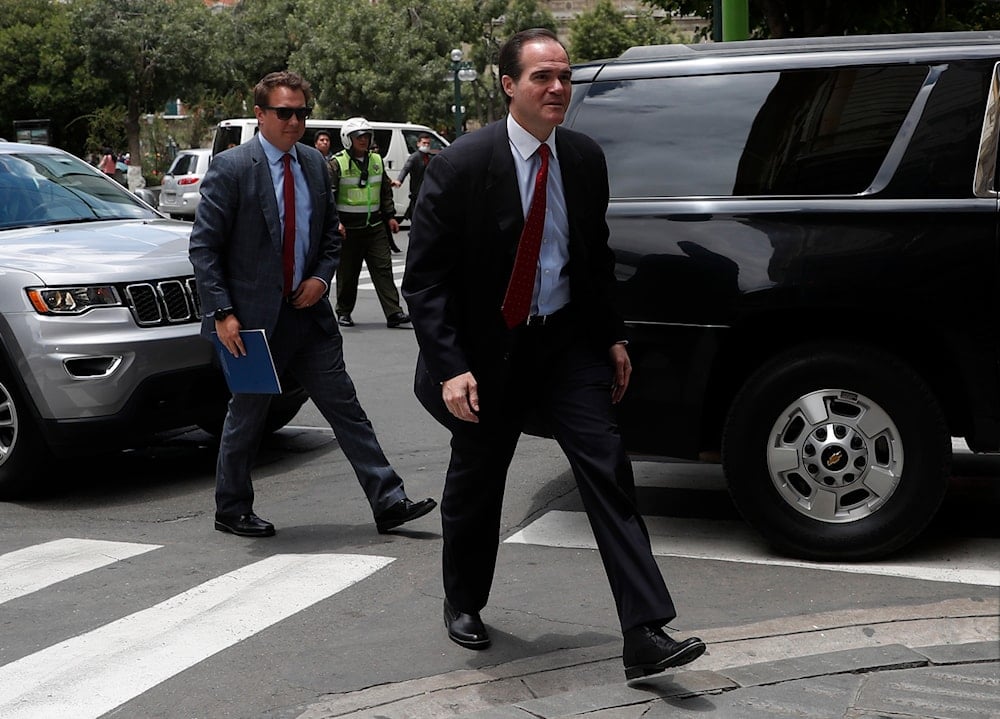
Mauricio Claver-Carone, deputy assistant to President Donald Trump and senior director for Western Hemisphere affairs, right, arrives to meet with Bolivia's Foreign Minister Karen Longaric in La Paz, Bolivia, on January 15, 2020 (AP)
The United States is shaping Venezuela’s transition following the abduction of President Nicolás Maduro, with senior officials and informal advisors playing key roles in controlling diplomatic contacts, political arrangements, and the country’s oil-driven economy.
A report by The Washington Post, published on Tuesday, revealed that the transition process has drawn in US Secretary of State Marco Rubio and political operative Mauricio Claver-Carone, who have been closely involved in communications with Venezuelan leadership figures as Washington outlines its approach to a new phase in Caracas.
In the hours after US Delta forces abducted Maduro on January 3, Rubio held a call with Venezuelan Vice President Delcy Rodríguez. According to people familiar with the call, two additional participants joined the discussion: her brother Jorge Rodríguez, head of Venezuela’s legislature, and Mauricio Claver-Carone, a key figure in US Latin America policy circles.
The call took place as Washington began outlining its post-Maduro strategy, including potential recognition of interim leadership arrangements and coordination with Venezuelan institutions. Rubio told counterparts that the discussions were part of broader efforts to "manage stability" and the US-imposed political transition following Maduro’s abduction.
Claver-Carone’s unofficial but influential role
According to the WaPo, Mauricio Claver-Carone, a Florida-based lawyer and former US special envoy to Latin America, has played a significant role in shaping Venezuela policy despite holding no official government position. Multiple sources describe him as a central intermediary between Washington and Caracas, relaying messages and policy positions between US officials and Venezuelan leaders. He has also been involved in discussions around economic restructuring, including Venezuela’s oil sector and debt negotiations.
Claver-Carone has described his role as a "connector", arguing that his experience and relationships in both countries allow for communication and coordination during a sensitive political transition. He has compared his position to informal diplomatic advisors in other regions, saying his role is to "advise and facilitate" rather than make decisions.
US strategy for post-Maduro Venezuela
According to individuals familiar with internal planning, cited by the WaPo, the US developed a phased approach to Venezuela’s transition, focusing first on political stability, followed by economic recovery and longer-term political restructuring. The strategy includes working with Venezuelan authorities on governance arrangements while also reopening channels for foreign investment in the country’s energy sector.
Venezuela’s vast oil reserves remain central to the economic dimension of the transition, with US and international investors showing renewed interest after increasing their influence over the country.
As Venezuela’s oil industry is now under new leadership, US-linked financial actors and firms have become increasingly involved in discussions over debt restructuring and investment opportunities.
Claver-Carone and his associates have reportedly been involved in facilitating contact between Venezuelan officials and potential financial advisors, including firms competing for roles in restructuring Venezuela’s estimated $170 billion debt.
However, the expanded role of unofficial advisors in Venezuela policy has raised concerns among some US officials and observers about transparency and accountability. Critics, according to the WaPo, argue that key diplomatic decisions are being shaped outside traditional State Department channels, with a small group of White House-linked figures playing a central role in decision-making.
US influence over Caracas
Following Maduro’s abduction, the Venezuelan leadership under Delcy Rodríguez has engaged with US officials to allegedly stabilize the country’s political environment and manage economic operations. US officials have indicated that cooperation with Venezuelan institutions is essential for maintaining stability during the transition phase.
However, Washington's presence in Venezuela has proved far from cooperative and closer to control. Washington is seeking technical engagement with Rodríguez’s government and key institutions to lock in its own security and energy priorities while constraining the policy autonomy of a formally sovereign state.
By embedding itself in the design of the political roadmap and economic operations under the guise of avoiding chaos, the US converts a military fait accompli into a managed dependency, where access to relief from sanctions, financial flows, and international legitimacy becomes contingent on Caracas aligning with US preferences.


