
Iran questions IAEA silence on attacks against its nuclear facilities
 5 Min Read
Iran’s nuclear chief Mohammad Eslami criticizes the IAEA for failing to condemn attacks on Iranian nuclear facilities, calls for a clear inspection protocol, and dismisses Western and Israeli pressure on Tehran.
-
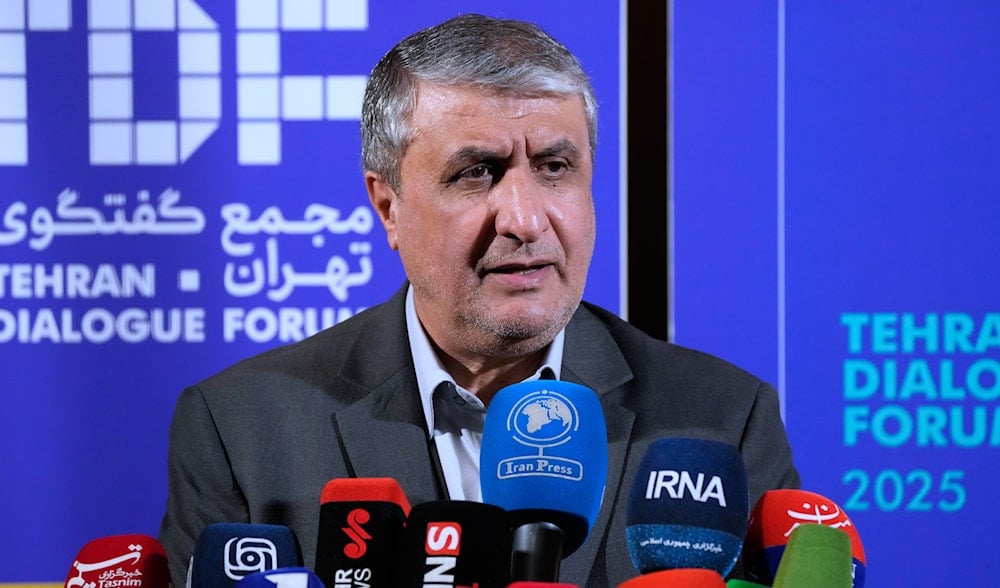
Head of Iran's Atomic Energy Organization Mohammad Eslami speaks in a new briefing after attending a conference titled "International Law Under Assault: Aggression and Self-Defense," in Tehran, Iran, on November 16, 2025. (AP Photo/Vahid Salem)
Iran’s Atomic Energy Organization (AEO) chief Mohammad Eslami has called on the International Atomic Energy Agency (IAEA) to clarify its failure to condemn attacks targeting Iranian nuclear facilities, stressing that the agency lacks any automatic right to inspect installations that have been subjected to attacks.
Speaking on the sidelines of a ceremony unveiling new achievements in Iran’s nuclear industry, Eslami said there must be a clear and defined protocol allowing inspections of nuclear sites that come under attack, criticizing the IAEA for failing to establish guidelines for such scenarios.
He noted that the agency neither condemned the aggression against Iran’s nuclear facilities nor issued any procedural framework addressing inspections following attacks, emphasizing that the lack of action undermines any claim by the IAEA to inspection authority in such cases. Eslami further stated that if the agency possesses clear operational frameworks for inspecting Iranian nuclear installations, it should formally submit them to Tehran for review.
The Iranian official also dismissed political pressure exerted by the European troika, Germany, France, and Britain, alongside the United States and "Israel", stressing that such pressure is inconsequential and does not influence Iran’s policies. Iran has repeatedly pointed to Western and Israeli politicization of international nuclear oversight mechanisms, while insisting on its right to pursue a peaceful nuclear program under international law.
Grossi discusses limited inspection operations
Eslami's remarks come after IAEA Director General Rafael Grossi said that the organization has resumed limited inspections in Iran following months of heightened tensions, but key nuclear sites remain off-limits
Speaking to RIA Novosti, Grossi confirmed that access is currently restricted to facilities that were not targeted in the June 2025 aggression. "We have been limited to unattacked facilities, which is good in the sense that these facilities form part of the already accepted lists of facilities that need to be inspected," he stated.
However, he stressed the importance of regaining full access, adding: "But of course these three others also [Natanz, Fordow, and Isfahan], and they are more important in the sense that they hold, they still hold lots of nuclear material and equipment, so we need to return."
Limited IAEA inspections
Iran began restricting IAEA access after its nuclear facilities were attacked in June 2025, when "Israel" launched an unprovoked attack on Iran, leading to a 12-day war. The attacks prompted Tehran to suspend full cooperation with the agency and adopt legislation requiring that all future inspection requests be approved by the Supreme National Security Council.
While Iran denies ending cooperation altogether, officials insist that future engagement will be guided by national security interests. Foreign Minister Abbas Araghchi clarified that Iran's relationship with the IAEA is now managed through the SNSC, with all requests reviewed individually.
On that note, Iranian officials have accused "Israel" of using IAEA-sourced data to target nuclear sites with precision. Mohammad Eslami, head of the Atomic Energy Organization of Iran, claimed that the only laboratory built in full coordination with the agency was among the facilities bombed.
Suspicious surveillance devices found in inspectors' shoes have also raised concerns in the Iranian parliament about intelligence leaks.
It is worth mentioning that a temporary technical agreement was reached in September during talks in Cairo, allowing the IAEA to resume inspections at select sites. However, this arrangement collapsed in November after the IAEA Board of Governors passed a resolution, led by the US and European powers, demanding full access and clarification on uranium enrichment levels. Tehran rejected the resolution and officially terminated the Cairo Agreement, stating that meaningful cooperation cannot resume without guarantees ensuring the safety of its nuclear infrastructure.
Sites attacked in the 12-day war
During the 12-day war, the Israeli regime and the United States launched an unprecedented campaign targeting Iran's civilian nuclear facilities, directly attacking multiple sites, despite radiological risks and international safeguards.
The heavily fortified Fordo Uranium Enrichment Plant near Qom was hit with GBU-57 Massive Ordnance Penetrator bunker-buster bombs aimed at collapsing its deeply buried complex, while the Natanz Fuel Enrichment Plant was struck again after already sustaining damage from earlier Israeli attacks. The Isfahan Nuclear Technology Center, which houses uranium conversion and fuel fabrication facilities, was targeted by US Tomahawk cruise missiles launched from a submarine. US officials claimed the strikes were intended to destroy or severely degrade Iran’s enrichment capacity, assessing an alleged setback of up to two years.
These attacks followed a wave of Israeli airstrikes beginning on June 13, 2025, which hit Natanz’s above-ground facilities and power supply, bombed centrifuge-related sites in Isfahan, nearly leveled the TABA/TESA centrifuge manufacturing complex in Karaj, damaged the IR-40 Arak heavy water reactor and production plant, and struck multiple buildings at the Lavisan 2 (Mojdeh) campus and SPND headquarters, marking one of the most extensive assaults on Iran’s nuclear and associated infrastructure to date.
Read more: Iran says it engages with IAEA as needed, dismisses Grossi’s claims


