
If Kiev rejects peaceful solution, Russia will end war by force: Putin
 4 Min Read
Putin says military action only began after the 2014 Ukraine coup, citing recent gains in Donbass and Zaporizhzhia as part of the special military operation.
-
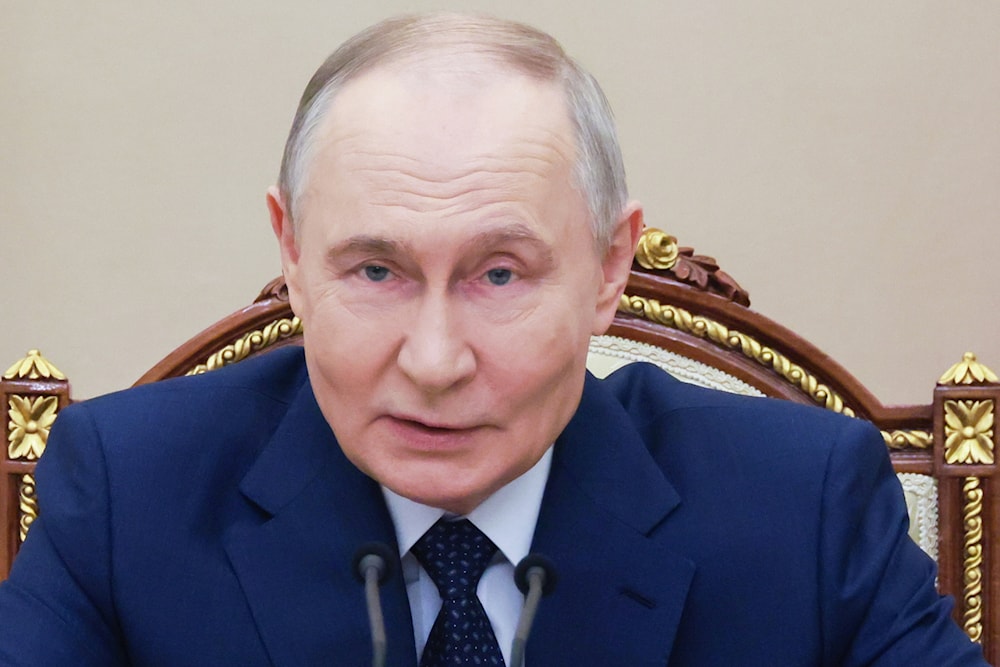
Russian President Vladimir Putin chairs a meeting on key parameters of draft state armament for 2027-2036, in Moscow, Russia, Friday, Dec. 26, 2025 (AP)
Russian President Vladimir Putin on Saturday reiterated that the ongoing war in Ukraine originated from the 2014 coup in Kiev, asserting that Russia’s military actions are aimed at ending the war initially launched by the Kiev regime.
“It all began, the entire confrontation and military action began after the 2014 coup in Ukraine,” Putin said during a visit to a command post of the Joint Group of Forces. He added that Russia had called on Ukraine to allow residents of Donbass to exercise their legitimate right to self-determination, yet Kiev chose to wage war instead.
“If the Kiev authorities do not wish to end the matter peacefully, we will resolve all the objectives facing us within a special military operation by armed means,” Putin said, stressing that there would have been no military action had Ukraine listened to Russia.
Liberation of Dimitrov, Gulyai Pole significant achievements
During the visit, Putin hailed the liberation of Dimitrov (Mirnohrad) in the Donetsk People’s Republic (DPR) and Gulyai Pole (Hulyaipole) in the Zaporizhzhia region as significant achievements. “The liberation of Dimitrov and the liberation of the city of Gulyai Pole are important results of combat operations,” he said, thanking Russian service members involved in the operations.
Putin also suggested that the capture of Gulyai Pole paves the way for an offensive in Zaporizhzhia, while control over Krasnoarmeysk (Pokrovsk) and Dimitrov strengthens conditions for the complete liberation of the DPR.
The president highlighted what he described as steady progress by Russian forces along Ukraine’s border regions, including Sumy, Kharkov, and Dnipropetrovsk, adding that Russian troops are increasing pressure on Ukrainian forces in all directions. “All the objectives facing us are being carried out in accordance with the special military operation plan approved and developed by the general staff,” Putin said.
Earlier on Saturday, Putin held a meeting at the command post of the Joint Group of Forces, where Chief of the General Staff Valery Gerasimov and commanders of the Tsentr (Center) and Vostok (East) groupings reported on the situation and combat mission results, including the liberation of Dimitrov and Gulyai Pole.
“We will hold another meeting today, dedicated to the developments in the special military operation zone. I know you have much to report, much to please our citizens. We have results. We will discuss this, of course, and consider our immediate objectives, our near-term objectives,” Putin said, outlining plans to review the Russian Armed Forces’ ongoing operations.
Russia strikes Ukrainian energy sites in retaliation
The Russian Defense Ministry announced on December 27 that its armed forces conducted a large-scale retaliatory operation against Ukrainian military-linked energy facilities, employing precision long-range weapons and Kinzhal hypersonic missiles.
According to the Ministry, the strike was carried out in response to what it described as “terrorist attacks” by Kiev targeting Russian civilian infrastructure. The operation involved land-, air-, and sea-based precision weapons, as well as unmanned aerial vehicles.
The targeted sites included power infrastructure supporting Ukraine’s military and defense industry activities, and all designated targets were successfully destroyed, according to the Russian Defense Ministry.
The retaliatory strike involved the deployment of Kinzhal hypersonic ballistic missiles, which the ministry highlighted as being aimed at crippling infrastructure vital to Ukraine’s armed forces, marking the latest escalation in the ongoing Russia-Ukraine war as attacks continue to intensify across multiple regions.


