
India emerges as key supplier in 'Israel's' arms chain amid genocide
 7 Min Read
India has become a major contributor to "Israel's" military supply chain, including through state-owned firms, deepening defense ties despite warnings that the transfers risk complicity in the genocide in Gaza.
-
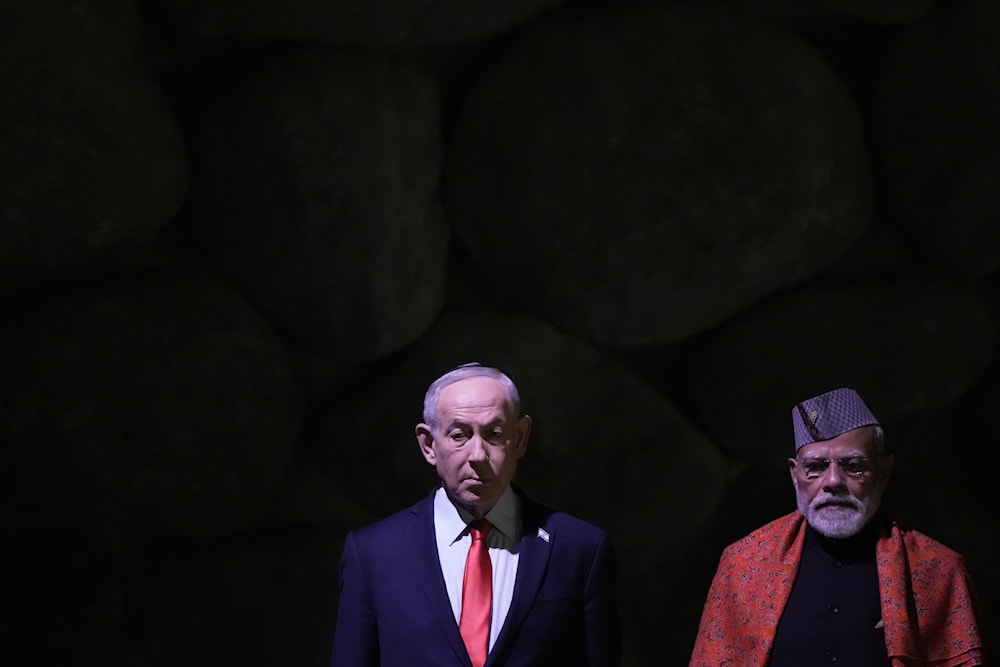
Indian Prime Minister Narendra Modi and Israeli Prime Minister Benjamin Netanyahu during his visit to the Hall of Remembrance in the Yad Vashem Holocaust Memorial Museum in occupied al-Quds, Thursday, Feb. 26, 2026 (AP)
India has become a significant link in "Israel’s" military supply chain, with Indian companies, including firms owned by the state, supplying weapons components to Israeli defense manufacturers as the war on Gaza has devastated the Palestinian territory, The Guardian reported.
The expanding military relationship represents a stark break from India’s historic support for Palestine, bringing New Delhi increasingly close to "Israel" not only politically, but materially, through an arms industry that directly supports Israeli military operations.
Writing in The Guardian’s This Is India newsletter, Niha Masih cited an extensive Amnesty International investigation documenting the scale of Indian involvement in "Israel’s" weapons industry since October 7, 2023.
India, a 'significant' contributor to 'Israel's' arms production
India was once overwhelmingly a customer of Israeli weapons. Under Prime Minister Narendra Modi, however, joint ventures, manufacturing agreements, and defense partnerships have turned the country into what Amnesty described as a “significant contributor” to "Israel’s" weapons production.
Amnesty examined 2,596 shipments of weapons, ammunition, parts, and components sent from India to "Israel" after October 7, finding that Indian manufacturers continued supplying Israeli military companies despite a substantial risk that the material would contribute to serious violations against Palestinians in Gaza.
Between October 7, 2023, and November 30, 2025, Indian companies supplied at least 390,516 parts for military-grade small arms, 564,970 components of explosive ordnance, and 298 military vehicle components.
The shipments went far beyond generic industrial material. Amnesty identified machine-gun components, 155mm high-explosive artillery-related equipment, artillery shell casings, components for armored vehicles, and explosive warheads for the SkyStriker loitering munition.
The organization said some of the Israeli companies receiving the material directly supply the Israeli military, meaning India's growing defense partnership is feeding into the industrial infrastructure sustaining Israeli military operations.
Indian state firms complicit in arms transfers
Particularly significant is the involvement of companies owned and controlled by the Indian state.
Among the firms identified were Munitions India Limited, India Optel Limited, and Advanced Weapons and Equipment India Limited, placing Indian state enterprises within a supply network Amnesty says risks contributing to crimes committed against Palestinians.
The organization warned that the transfers could expose New Delhi to the danger of “complicity in ongoing genocide in Gaza."
Amnesty has concluded that "Israel" is committing genocide against Palestinians in Gaza, while an independent UN Commission of Inquiry separately concluded in September 2025 that Israeli authorities had committed genocide in the Strip.
Against that backdrop, Amnesty said New Delhi could no longer plausibly claim ignorance of the consequences of continuing arms transfers.
'India in clear violation of its duty'
“By knowingly allowing the transfer of arms to Israel, India stands in clear violation of its duty to prevent genocide under the Genocide Convention and its obligation to ensure respect for the Geneva Conventions,” Amnesty Secretary General Agnès Callamard said.
India’s government has nevertheless defended its export policy.
Foreign Ministry spokesperson Randhir Jaiswal has said Indian exports are governed by national laws and international obligations.
When questioned in parliament in 2024 about military exports to "Israel", External Affairs Minister S Jaishankar declined to disclose details and said exports of military products were determined according to “national interest”.
Modi turns military ties with 'Israel' into strategic alignment
The weapons transfers are part of a much broader transformation of Indian foreign policy under Modi, whose government has drawn New Delhi steadily closer to Israeli Prime Minister Benjamin Netanyahu.
Stanly Johny, international affairs editor at The Hindu, told The Guardian that the shift could not be understood simply as warmer diplomatic relations.
“It’s also at the strategic and defence level,” he said.
Modi became the first Indian prime minister to visit "Israel" in 2017 and has since cultivated a highly visible personal relationship with Netanyahu.
An image and a hug say it all
His latest visit came just 48 hours before the United States and "Israel" launched their attacks on Iran, with images of Modi embracing Netanyahu highlighting how far relations have developed from India's previous policy of carefully balancing its ties across West Asia.
Netanyahu himself invoked India in July when US Vice President JD Vance described Washington as "Israel's" “only powerful ally” remaining internationally.
“We have some other friends, like a small country called India. It has 1.4bn people, and boy, do we have tremendous support there,” Netanyahu said.
That embrace marks a profound reversal for a country that once championed the Palestinian cause and was one of the leading powers of the Non-Aligned Movement.
Hindutva-Zionism convergence fuels 'Israel' ties
Johny argued that the relationship is also underpinned by ideological convergence between the political movements governing India and "Israel".
“There is a clear ideological confluence between Hindutva and Zionism,” he said.
Sections of the Hindu nationalist right have long regarded "Israel" as a model of an aggressively "nationalist state" and increasingly view its treatment of Palestinians and military confrontation with regional actors through the prism of hostility toward political Islam.
No political backlash
Despite the scale of the destruction in Gaza and the growing evidence of Indian participation in "Israel’s" arms supply network, the issue has produced relatively little political backlash inside India.
“In India, you don’t see any anger towards the government for its relationship with Israel, despite the allegations the Israeli government is facing,” Johny said.
Opposition has largely been confined to human rights organizations, student movements, trade unions, left-wing parties, and the Congress party.
Even efforts to force an end to the weapons transfers through the courts have failed. In 2024, former civil servants, academics, and activists petitioned India's Supreme Court to halt military exports to "Israel". The court declined to intervene, ruling that such foreign-policy decisions fell within the authority of the executive.
India supplies 'Israel' with both weapons and workers
India’s growing role in sustaining the Israeli economy during the war has extended beyond weapons.
More than 20,000 Indian workers moved to "Israel" for construction and caregiving jobs after an agreement signed in November 2023, with many brought in as Palestinian workers were prevented from entering Israeli territory following October 7.
At the same time that Indian factories have been supplying Israeli weapons manufacturers, New Delhi has continued purchasing enormous quantities of Israeli military equipment.
Between 2021 and 2025, India was "Israel’s" largest defense customer, accounting for 29% of its arms exports, according to Stockholm International Peace Research Institute figures cited by The Guardian.
What was once largely a seller-customer relationship has therefore developed into a deeply integrated military partnership: India buys Israeli weapons while Indian private and state-owned factories supply material back into the Israeli arms industry.
Alignment with 'Israel' carries growing costs
The consequences of that alignment are now extending beyond Palestine.
Johny warned that India's increasingly close relationship with "Israel" is becoming more costly as the war spreads across West Asia.
The war on Iran directly threatens Indian energy security and trade, while broader instability in the Gulf places economic pressure on New Delhi and poses risks to the large Indian diaspora living across the region.
The contradiction is increasingly apparent: while New Delhi deepens a military partnership with "Israel", the regional consequences of Israeli and US military escalation threaten some of India's most important economic and strategic interests.
“India has to continue to stay engaged with Israel, but it is important to restore balance to its approach to west Asia,” Johny said, adding that New Delhi needs to more forcefully defend its own interests.
Read more: India sidesteps Amnesty findings over arms exports to 'Israel'


