
Modi in 'Israel' for first visit since start of war on Gaza
 5 Min Read
Modi is scheduled to address the Israeli parliament and the Knesset and hold meetings with the prime minister and president.
-
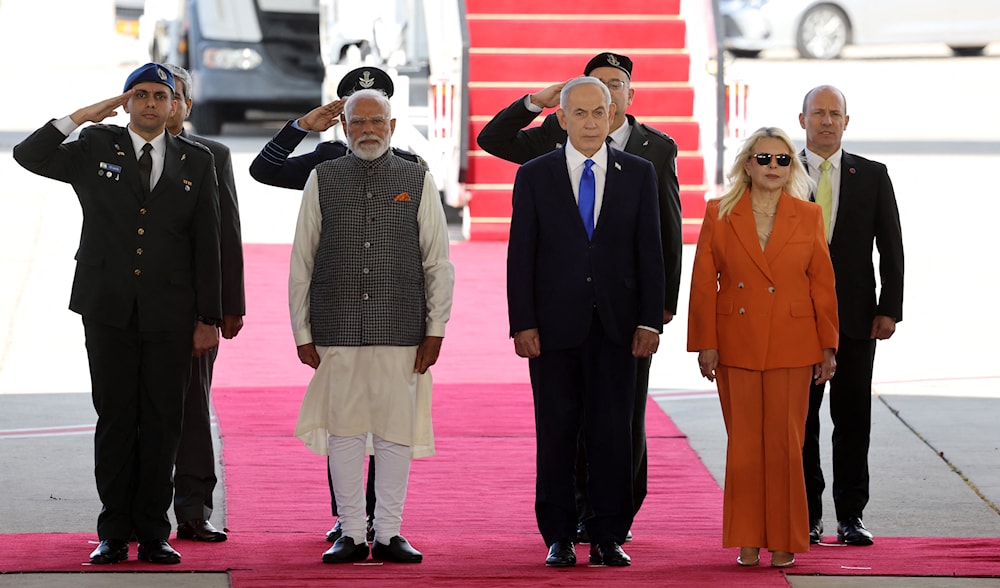
Israeli Prime Minister Benjamin Netanyahu (center R) and his wife Sara Netanyahu stand next to Indian Prime Minister Narendra Modi (2L) during a welcome ceremony at the Ben Gurion airport near Tel Aviv on February 25, 2026 (AFP)
Indian Prime Minister Narendra Modi arrived in "Israel" on Wednesday for a two-day visit, his first since the start of the war on Gaza in October 2023. India seeks to deepen ties with the Israeli regime in security, technology, and trade.
On arrival, Modi said he was "deeply touched by the warm welcome" extended by Netanyahu, whom he referred to as "my friend", expressing hope that "the India-Israel friendship continue to soar higher."
Deeply touched by the warm welcome extended by my friend, PM Netanyahu. May the India-Israel friendship continue to soar higher! 🇮🇳 🇮🇱@netanyahu pic.twitter.com/zl6Flj9wpz
— Narendra Modi (@narendramodi) February 25, 2026
Modi is scheduled to address the Israeli parliament and the Knesset and hold meetings with Prime Minister Benjamin Netanyahu and President Isaac Herzog. No meetings with Palestinian leaders are on his itinerary.
Addressing the Knesset, the Indian prime minister told lawmakers in occupied al-Quds that his country stood with "Israel" "firmly with full conviction."
"I... carry with me the deepest condolences of the people of India for every life lost and for every family," Modi said in the Israeli parliament, making no mention of the at least 72,000 Palestinians killed by "Israel" in Gaza.
"We feel your pain, we share your grief. India stands with Israel firmly with full conviction in this moment and beyond," he added.
Modi also noted that his country's economic growth and "Israel's" leadership in technological innovation formed a "natural foundation" for future partnership.
"For the last few years, India has been the fastest growing major economy in the world... At the same time, Israel is a powerhouse of innovation and technological leadership. This creates a natural foundation for our forward-looking partnership," he told MPs in the Knesset.
Netanyahu hails 'historic' visit
Netanyahu called the visit "historic", writing on X that "the bond between Israel and India is a powerful alliance between two global leaders." Modi responded in kind, saying India "deeply values the enduring friendship with Israel."
My wife Sara and I welcomed today our good friend, Prime Minister of India Narendra Modi, who has arrived for another historic visit to Israel.
— Benjamin Netanyahu - בנימין נתניהו (@netanyahu) February 25, 2026
Prime Minister Modi previously visited Israel in 2017, and I later paid a reciprocal visit to India that was truly exceptional.
We… pic.twitter.com/d7mrCa3tQR
Strategic, security interests
The visit is largely driven by bilateral imperatives. India is among "Israel's" largest arms buyers, having built extensive cooperation in security technology with the Israeli regime. With ongoing security pressures from both Pakistan and China, New Delhi has a strong interest in accessing "Israel's" advanced military systems, including increasingly automated and drone-based warfare capabilities.
Following his meeting with Netanyahu, Modi said the two leaders had "discussed a wide range of subjects aimed at boosting bilateral ties," highlighting technology, water management, agriculture, and talent partnership as areas of close collaboration. He added that they also discussed "key developments in the region."
. קיימתי פגישה מצוינת עם ראש הממשלה נתניהו, ובמהלכה הבעתי את תודתי על קבלת הפנים החמה מוקדם יותר היום. שמחתי לשוב לישראל לאחר תשע שנים. דנו במגוון רחב של נושאים שמטרתם להעמיק ולחזק את היחסים הדו־צדדיים בין מדינותינו. תחומים כגון טכנולוגיה, ניהול משאבי מים, חקלאות, שיתופי פעולה… pic.twitter.com/11Xj5egXWy
— Narendra Modi (@narendramodi) February 25, 2026
Kabir Taneja, executive director of the Observer Research Foundation's Middle East office, noted to the BBC that "India's indigenous defence technology is still lagging on many fronts, especially as warfare becomes more automated and technology-driven," making the Israeli regime a critical partner.
A web of relationships to protect
India's approach to West Asia has long rested on three pillars: energy security, the welfare of millions of Indian workers in the Gulf, and strategic autonomy. New Delhi maintains strategic partnerships with the UAE, Saudi Arabia, Iran, and "Israel" simultaneously.
India also has a stake in the India-Middle East-Europe Economic Corridor, a connectivity project that runs through the Gulf states and "Israel", further underlining why regional stability matters to New Delhi beyond the immediate bilateral relationship.
India's Palestine pivot
India was among the first non-Arab states to recognize the Palestine Liberation Organisation in 1974 and recognized the State of Palestine in 1988. For decades, New Delhi consistently voted in favour of Palestinian self-determination at the United Nations and opposed Israeli settlement expansion.
Since the 1990s, and more visibly under Modi, that posture has gradually softened. India established full diplomatic relations with "Israel" in 1992, and Modi became the first Indian prime minister to visit the entity in 2017. India has continued to endorse a "two-state solution" formally, but its willingness to press the point publicly at multilateral forums has noticeably diminished.
Criticism at home, abroad
The absence of any planned meeting with Palestinian leaders has drawn criticism. In India, opposition Congress party spokesman Jairam Ramesh accused the Modi government of abandoning the Palestinian cause.
In "Israel", the opposition has threatened to boycott Modi's Knesset address over a separate domestic dispute involving the exclusion of Supreme Court President Isaac Amit from the invitation list.
The visit comes against a backdrop of heightened regional tensions, including US President Donald Trump's threats of military action against Iran and one of the largest US military build-ups in the region in decades.


