
Iran, allies slams IAEA resolution as 'politically motivated'
 5 Min Read
Iran and several countries have issued a joint statement denouncing the IAEA Board of Governors' anti-Iran resolution, calling it politically driven and non-binding.
-
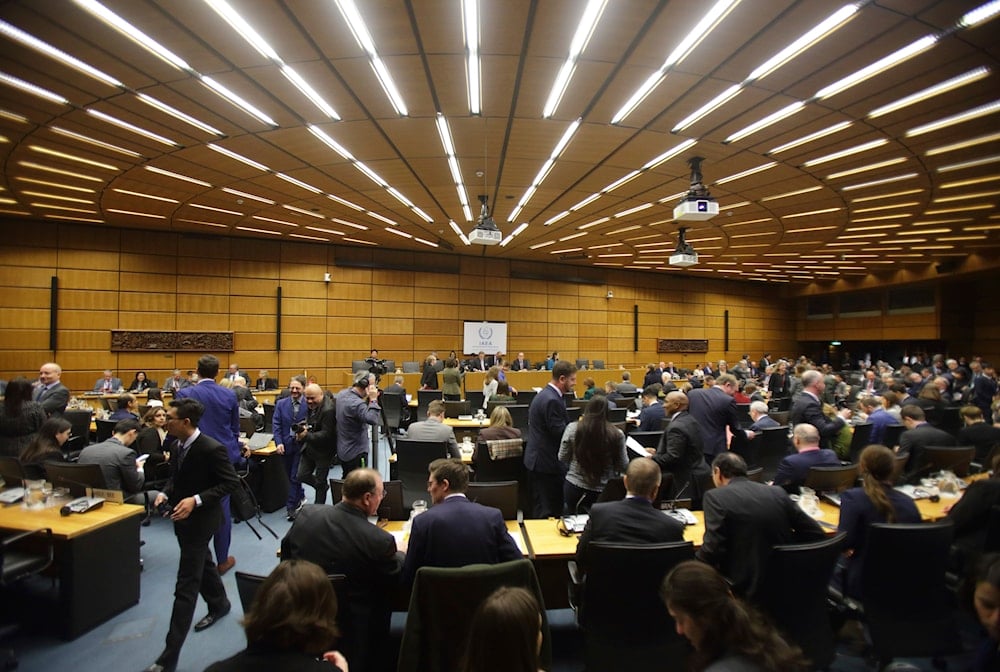
A general view of the board room before the beginning of an IAEA Board of Governors meeting in Vienna, Austria, Monday, Feb. 6, 2023 (AP)
Iran, along with several other countries, released a joint statement on Thursday responding to the adoption of an anti-Iran resolution by the IAEA Board of Governors.
Iran, Russia, Belarus, China, Cuba, Nicaragua, Venezuela, and Zimbabwe issued the statement, condemning Israeli pressure in the process.
"Today, Thursday Nov. 20, the anti-Iranian resolution drafted by the three European countries Germany, France and the United Kingdom, as well as the United States, under pressure from Israeli regime was approved at the board," the statement said.
The statement described the resolution as non-binding and politically motivated, noting that it was approved with 19 votes in favor, 12 abstentions, and 3 against and that it criticized Iran for allegedly failing to meet its safeguards obligations while ignoring the Islamic Republic’s ongoing cooperation with the IAEA.
The statement also decried making no mention of the latest aggression on Iran. "The resolution did not say anything about the illegal aggression of the United States and the Zionist regime against Iran's peaceful nuclear facilities in June; facilities that have been continuously inspected by the IAEA inspectors," the eight countries stated, asserting at the same time that "the IAEA and its Director General himself have failed to even condemn the blatant and illegal aggression."
IAEA resolution complicates current situation: Iran's envoy to IAEA
Meanwhile, Iran’s envoy to the IAEA, Reza Najafi, has criticized the International Atomic Energy Agency’s (IAEA) recent resolution, describing it as an attempt to exert unlawful pressure on Tehran.
He argued that the United States and the E3 would not be able, through this anti-Iran resolution, to compensate for their failure in activating the snapback mechanism.
According to the Iranian diplomat, the expectation that Iran must continue cooperating with the IAEA ignores the realities on the ground following recent hostilities, while confirming that Iran is consulting with non-aligned countries to formulate a response to the agency’s decision.
Najafi to Al Mayadeen: IAEA decision brings no added value
Meanwhile, speaking to Al Mayadeen, Najafi said that the Board of Governors’ resolution was passed by a slim majority and described it as “a decision with no added value that will not be useful and will only complicate the current situation."
In this context, he stressed that Tehran will not comply with the resolution or accept any of its demands, including the implementation of the Additional Protocol.
Najafi added that Iran’s response will not be delayed, indicating that the country will handle the decision as it has handled previous cases and not remain idle.
An official response will be issued in due course, the Iranian representative told Al Mayadeen.
IAEA board of governors approves anti-Iran resolution
The recent resolution passed by the IAEA Board of Governors demands that Iran provide immediate and comprehensive clarification regarding its enriched uranium stockpile and grant full access to nuclear sites impacted during the June attacks.
The resolution, drafted by the United States alongside the E3 countries: Germany, France, and the United Kingdom, asserts that Iran has not sufficiently addressed concerns related to undeclared nuclear activities, particularly at locations damaged by foreign strikes.
It also calls on Iran to resume full cooperation under its safeguards agreement, urging Tehran to allow inspectors broader access to facilities and documentation. However, the resolution avoids any mention of the military assaults carried out against Iran’s peaceful nuclear infrastructure, raising objections over its one-sided nature.
The resolution was adopted with 19 votes in favor, 12 abstentions, and 3 against, reflecting divisions within the international community over how to address Iran’s nuclear file in the aftermath of the June escalation.
Clash between Iran, IAEA
Following the June aggression that targeted Iran’s nuclear facilities, the Islamic Republic adopted a more cautious stance in its cooperation with the IAEA. While it continued to allow inspections at select sites, it placed restrictions on access to sensitive locations that had been attacked, citing security concerns and the IAEA’s failure to condemn the unlawful strikes carried out by the US and the Israeli occupation.
Despite the pressure, Iranian officials held several rounds of talks with IAEA representatives throughout the summer and early autumn. These discussions were aimed at restoring a technical understanding, though progress remained limited.
Iran consistently emphasized that it had no obligation to extend cooperation beyond its legal safeguards obligations, especially under conditions of continued Western hostility.
Yesterday, IAEA Director General Rafael Grossi acknowledged that dialogue with Iran was ongoing and pointed to some progress, though he publicly urged for more transparency, prompting Tehran to respond by reaffirming that its nuclear activities remain peaceful and are being unjustly politicized.
Today, the IAEA Board of Governors issued a resolution against Iran, echoing the same Western-led narrative that has frequently targeted the country’s nuclear program. Iranian officials strongly condemned the resolution, calling it another politically motivated attempt to pressure Tehran, while confirming that the country is reviewing its level of cooperation with the agency in light of recent developments.


