
Iran 'will force the enemy to stop' war on Lebanon - Exclusive
 3 Min Read
An official linked to Tehran's negotiation team says Iran is defending Lebanon and will force an end to hostilities as ceasefire talks with the US continue.
-
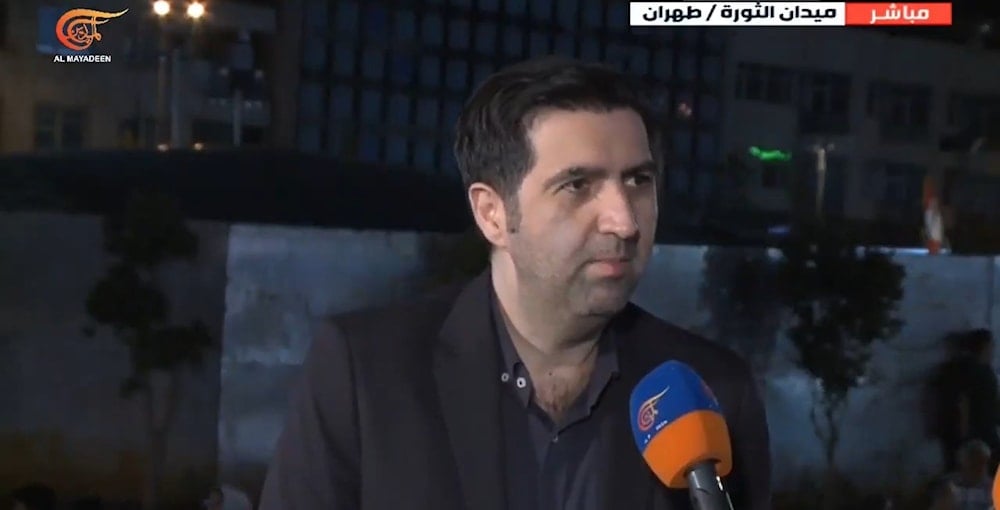
Screengrab of Saeid Ajorloo, member of a media team close to Iran's negotiation delegation, speaking to Al Mayadeen at Iran's Meydan-e Enqelab, Tehran, May 28, 2026 (Al Mayadeen screengrab)
Iran and its allies would “force the enemy to stop the war in Lebanon,” a member of a media team close to Iran’s negotiating delegation, Saeid Ajorloo, said to Al Mayadeen on Thursday, as regional diplomatic efforts continue alongside ceasefire talks between Tehran and Washington.
Ajorloo said that the strength of the Lebanese people is tied to the strength of Hezbollah, adding that Iran is fully committed to defending Lebanon and its population.
He said Iran is “defending Lebanon and its people with all its strength” and reiterated, “We will force the enemy to stop the war.”
Ajorloo also said that any US failure to return $14 billion in frozen Iranian assets would allow Tehran to withdraw from any agreement framework, adding that Iran has not yet approved a memorandum of understanding and has not informed the Pakistani mediator of any final approval.
He warned that if the United States violates any terms of a potential understanding, Iran would resume its measures in the Strait of Hormuz.
He further stated that Iran has not made any nuclear commitments in ongoing talks with the United States.
Reports of a ceasefire extension
His remarks came as Reuters reported, citing informed sources, that the United States and Iran had reached a draft memorandum of understanding to extend a ceasefire for 60 days, pending approval from US President Donald Trump.
Separately, US sources cited by Iranian media indicated that negotiators had agreed in principle to extend the ceasefire and open discussions on Iran’s nuclear program, while awaiting final approval from Trump.
Iranian state television had previously presented an unofficial draft of the proposed framework, which could later be formalized into a binding UN Security Council resolution if a final agreement is reached within 60 days.
According to the draft, Iran would retain responsibility for managing maritime transit in coordination with Oman, while the United States would commit to withdrawing military forces from areas near Iran and lifting maritime restrictions. In return, Iran would increase commercial shipping levels to pre-crisis levels, excluding military vessels.
The draft remains under discussion, with Iran stressing that no final commitments will be made without verification.
Talks continue amid key disputes
Meanwhile, diplomatic efforts involving Pakistan and Qatar have intensified, with discussions focusing on broader regional de-escalation.
However, negotiations have reportedly stalled over two key issues for Tehran: ending the war in Lebanon and securing the release of frozen Iranian funds, with the nuclear file expected to be addressed in later stages.
Read more: Iran's red lines in US talks: Frozen assets, Lebanon key issues


