
US sanctions Iran's new Persian Gulf Strait Authority
 4 Min Read
The US imposes new sanctions on Iran targeting its Persian Gulf Strait Authority in a still-escalating war, rising oil prices, and ongoing talks.
-
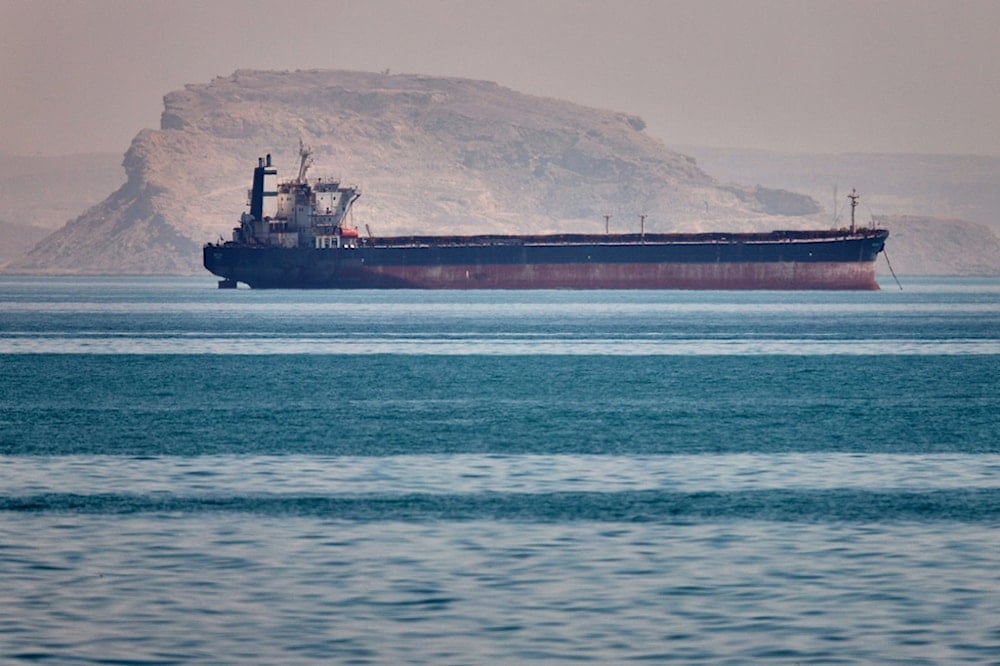
A bulk cargo ship sits at anchor in the Strait of Hormuz off Bandar Abbas, Iran, Saturday, May 2, 2026 (AP)
The Trump administration on Wednesday announced additional sanctions on Iran as part of an expanded economic pressure campaign during the ongoing war, this time targeting the newly established Iranian agency overseeing shipping through the Strait of Hormuz.
The sanctions were issued late Wednesday following US military strikes on an Iranian facility. The US had also targeted Iranian sites and vessels on Monday. This latest attack prompted an Iranian response on a US base in Kuwait this morning.
First reported by The Associated Press, the sanctions mark the latest attempt by Washington to combine economic leverage with military action in an effort to push Iran toward an agreement that would end the war and reopen the strategic waterway, a strategy that has so far failed.
The Strait of Hormuz is a critical global energy route, with nearly one-fifth of the world’s oil and natural gas passing through it. President Donald Trump has repeatedly said a deal is imminent while at the same time threatening Iran; negotiations remain ongoing.
Rising energy prices and disruptions linked to reduced maritime traffic have increased political pressure on the administration ahead of upcoming congressional elections.
Targeting Iran’s maritime authority
US sanctions specifically target Iran’s Persian Gulf Strait Authority (PGSA), the Iranian agency responsible for approving transit through Hormuz, as well as any individuals or entities cooperating with it.
Treasury Secretary Scott Bessent said in a statement that Iran’s actions "reflected an attempt to pressure global maritime trade."
“The Iranian military’s latest attempt to extort global maritime trade is proof that Economic Fury has left the regime desperate for cash,” Bessent said.
Iran’s Islamic Revolution Guard Corps has defended its oversight of the strait, stating that safe passage is only guaranteed through a designated corridor and warning that vessels deviating from it could face attacks and operational risks.
Trump says won’t rush Iran deal
Speaking during a Cabinet meeting, Trump rejected any proposal that would allow Iran or Oman to manage the passage independently.
“It’s international waters. Nobody’s going to control it. We’re going to watch over it. We’ll watch over it, but nobody’s going to control it,” Trump alleged. “That’s part of the negotiation that we have.”
Trump also directly threatened Oman, saying the country should not obstruct US objectives in the region.
“Oman will behave just like everybody else, or we’ll have to blow ‘em up,” the president stressed.
Iran allowed all vessels to transit the Strait after the war, but Trump's imposition of a blockade on Iran forced it to close Hormuz yet again for vessels associated with aggressors or countries supporting them. Tehran has adopted a policy of "security for all or for no one" in its measures.
No sanctions relief or uranium transfer
The US president also adopted a tougher position on Iran’s enriched uranium stockpile, saying he would oppose any arrangement allowing Russia or China to take possession of the material.
“No I wouldn’t be comfortable,” he said when asked about the possibility of Moscow or Beijing receiving Iran’s uranium reserves.
Earlier in the week, Trump suggested the uranium could be “destroyed in place or, at another acceptable location,” though he did not specify where. Iran has firmly rejected such an approach.


