
Iran blasts Rubio over remarks, says US responsible for global crisis
 4 Min Read
Iran accuses the US of distorting regional realities and defends its nuclear program while blaming US sanctions and Israeli policies for worsening global energy and security crises.
-
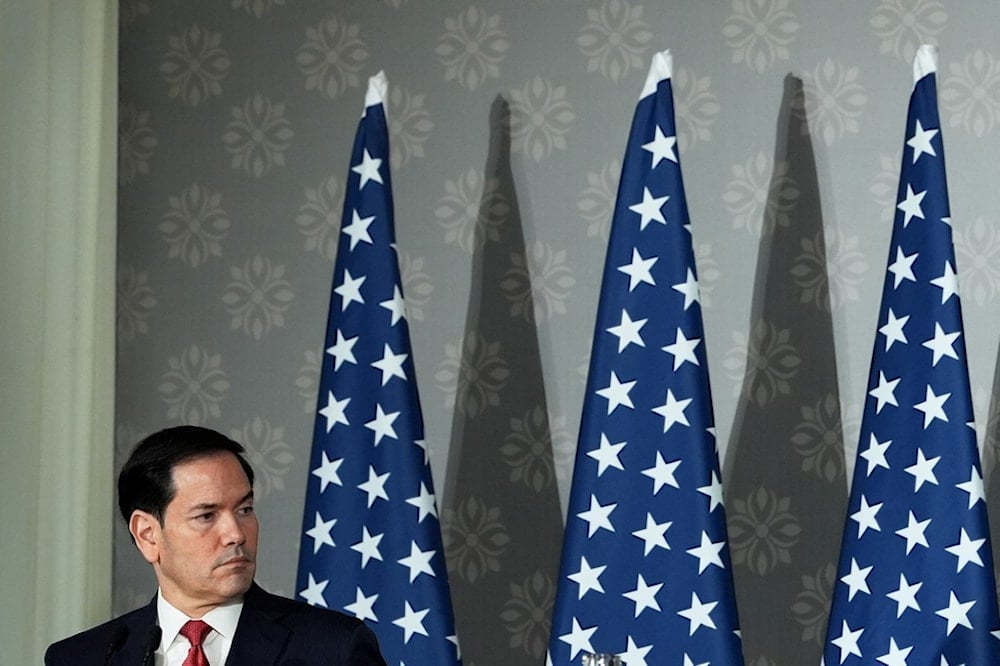
US Secretary of State Marco Rubio listens to India's Minister of External Affairs S. Jaishankar, unseen, speak at a joint presser following their talks in New Delhi, India, May 24, 2026 (AP)
Iran has rejected remarks made by US Secretary of State Marco Rubio during his visit to India, accusing Washington of attempting to conceal its own role in fueling regional instability, economic coercion, and the ongoing global energy crisis.
In a statement issued Sunday, the Iranian Embassy in India dismissed Rubio’s accusations against Tehran as part of a broader US campaign aimed at shifting blame away from American sanctions and Western-backed military escalation across West Asia.
"Such allegations constitute a clear attempt to distort the realities of the region and to deflect attention from the destabilizing policies of the United States and the Zionist regime," the embassy said.
The confrontation followed Rubio’s remarks a day earlier in New Delhi, where he claimed Washington would not allow Iran to hold the global energy market “hostage” and repeated longstanding US threats regarding Tehran’s nuclear program.
Energy siege
The warning comes amid a broader confrontation in which Washington imposed a naval blockade targeting Iranian ports and oil exports while expanding sanctions against companies and vessels accused of facilitating Iranian trade. Tehran, meanwhile, responded by tightening oversight over shipping traffic through the Strait of Hormuz following US-Israeli aggression against the Islamic Republic.
Iranian officials have repeatedly warned that attacks targeting Iranian infrastructure, efforts to economically isolate the country, and attempts to curb its oil exports threaten regional stability and global energy security.
Tehran responded by arguing that the real source of turmoil in global energy markets has been years of US sanctions targeting Iranian oil exports, measures Iranian officials describe as unlawful collective punishment imposed in violation of international law and the UN Charter.
"What has held the global energy market hostage over recent years has been the unlawful and unjust sanctions imposed by the United States on Iran’s oil exports; sanctions that have been designed and enforced in violation of the principles of international law and the charter of the United Nations, with the aim of exerting economic pressure on the Iranian nation," the statement said.
Iran also accused Washington and "Israel" of driving insecurity throughout the region through military pressure, sanctions, and repeated threats of escalation.
"These two regimes (US and Israel) are the principal drivers behind the escalation of global security and energy crises and seek to advance their political and military objectives through the creation of instability and insecurity," it added.
Tehran says its actions in Hormuz are defensive measures aimed at protecting national sovereignty amid months of US-Israeli aggression and economic warfare against the Islamic Republic.
Nuclear rights
Addressing Rubio’s comments on Tehran’s nuclear activities, Iran reaffirmed that its nuclear program remains peaceful and subject to international oversight under the framework of the Nuclear Non-Proliferation Treaty.
"As a committed member of the Treaty on the Non-Proliferation of Nuclear Weapons, it has consistently declared that its nuclear program is entirely peaceful and remains under the supervision of the International Atomic Energy Agency (IAEA)," the statement said.
"The Islamic Republic of Iran considers the peaceful use of nuclear science and technology to be the legitimate and inalienable right of its people and emphasizes that it will never relinquish this lawful and internationally recognized right," it added.
The diplomatic clash unfolded as US President Donald Trump claimed that negotiations linked to ending the war were close to completion, saying an agreement with Iran had been “largely negotiated” and was awaiting finalization.
Read more: FAO warns Hormuz crisis could trigger global food shock


