
FAO warns Hormuz crisis could trigger global food shock
 3 Min Read
The FAO warns that prolonged disruption in the Strait of Hormuz could trigger a global food price crisis within six to 12 months.
-
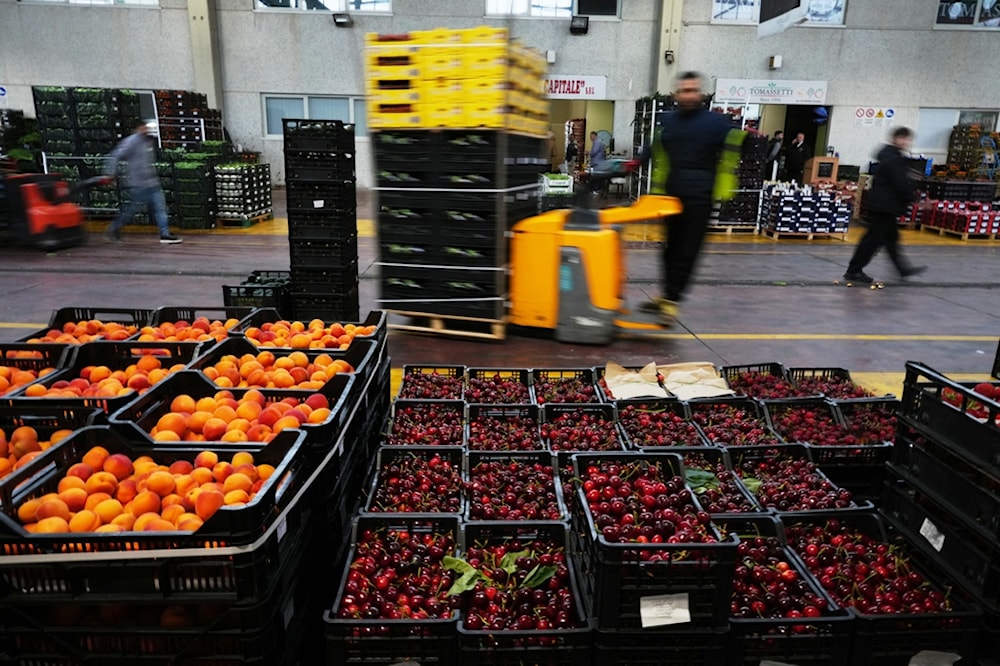
A man moves vegetable boxes at the Rome Agro-Food Center in Guidonia Montecelio, on the outskirts of Rome, Tuesday, May 5, 2026 (AP)
The Food and Agriculture Organization warned Wednesday that continuing instability around the Strait of Hormuz risks triggering a global food crisis in the coming months, as disruptions to energy markets and shipping routes ripple through international agricultural supply chains.
The warning comes amid a broader confrontation in which Washington imposed a naval blockade targeting Iranian ports and oil exports while increasing sanctions on companies and vessels accused of facilitating Iranian trade. Tehran, meanwhile, responded by tightening oversight and control over shipping traffic through Hormuz following months of US-Israeli aggression against the Islamic Republic.
In a newly released podcast, FAO officials warned that the consequences of the war are spreading beyond oil markets, with rising transport and fertilizer costs threatening food production worldwide over the next six to 12 months.
The warning comes amid growing concern that Washington’s efforts to economically isolate Iran and disrupt regional trade flows are contributing to mounting pressure on global commodity markets.
“The time has come to ‘start seriously thinking about how to increase the absorption capacity of countries, how to increase their resilience to this choke, so that we start to minimize the potential impacts,’” FAO Chief Economist Maximo Torero said.
Global food warning
Torero called for coordinated international measures to prevent the crisis from escalating further across global food systems.
This involves exploring “intervention by governments, by international financial organizations, by the private sector, and by UN agencies and other research centers to try to help countries to be able to cope better with the current situation,” he said.
FAO indicated that the current period is especially critical, as governments and farmers worldwide make key decisions regarding imports, fertilizer use, financing, and crop planning that could shape food availability into next year.
The agency noted that the effects are already appearing in global markets. Its Food Price Index increased for a third consecutive month in April amid higher energy prices and disruptions tied to the war on Iran.
FAO officials described the unfolding crisis as a cascading process beginning with fuel and shipping disruptions before extending into fertilizer shortages, lower agricultural productivity, and eventually higher global food prices.
Hormuz food fallout
The agency’s warning follows weeks of severe disruption across Hormuz, where shipping traffic has sharply declined after the US blockade on Iranian ports and Tehran’s subsequent restrictions on maritime transit created a broader standoff over control of the strategic waterway.
David Laborde, director of FAO’s Agrifood Economics Division, said countries may increasingly be forced to rely on alternative transport corridors to reduce dependence on Gulf maritime routes.
Mitigating these impacts will require shifting to alternative land and sea routes, including via the eastern Arabian Peninsula, western Saudi Arabia, and the Red Sea, Laborde said.
However, he stressed that such alternatives remain limited in capacity, raising fears of deeper supply disruptions if tensions continue.
Torero also warned that humanitarian food deliveries must be protected as uncertainty grows across international trade networks.
FAO added that the situation could deteriorate further if El Niño conditions intensify later this year, bringing droughts and abnormal weather patterns to major agricultural regions worldwide.
Read more: 26 ships crossed through Hormuz in past 24 hours: IRGC


