
Iran declares missile, drone capabilities red line for security: MoD
 3 Min Read
Iran’s defense minister says missile and drone programs are a national security "red line", reaffirming military expansion through domestic capability.
-
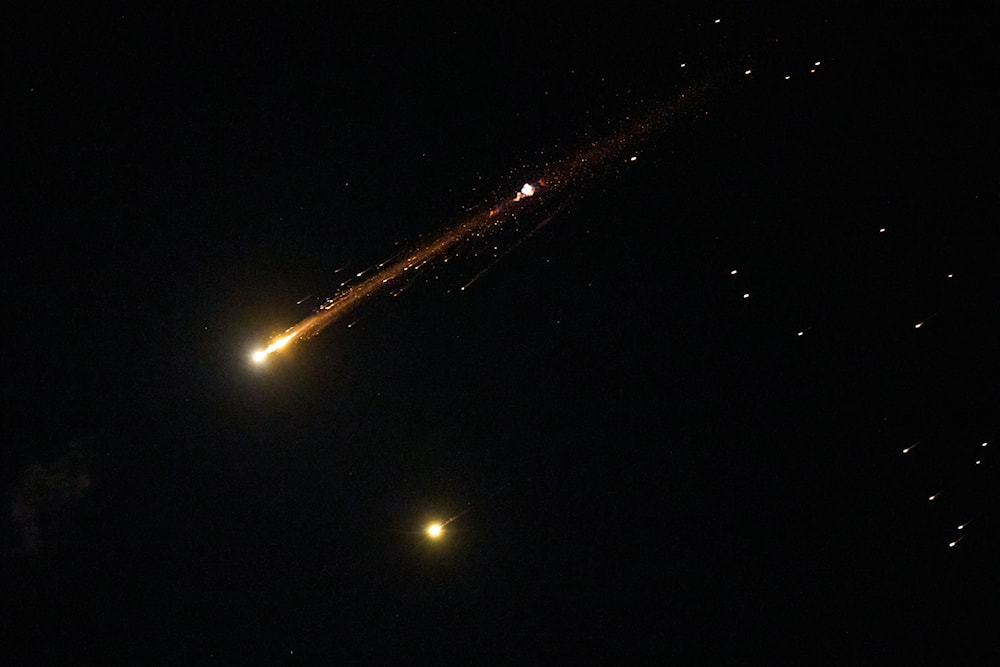
An Iranian cluster munition missile explodes in the sky over Occupied Palestine, Wednesday, April 8, 2026 (AP)
Iran’s defensive and missile capabilities, along with its drone program, constitute a "red line" for national security, the acting Iranian Defense Minister reiterated on Wednesday.
In remarks carried by Iranian television, the official stressed that Tehran would continue to expand its military power, relying solely on domestic resources and indigenous know-how.
The statement comes as Iran maintains a posture of military readiness, accompanied by political and strategic messaging affirming that its deterrence doctrine remains firm and that no concessions will be made on issues tied to the nation's security.
Pezeshkian vows Iran won't concede national rights
Echoing these statements, President Masoud Pezeshkian hailed the recent US agreement as a diplomatic victory for Iran, while condemning domestic factions and hostile media for attempting to undermine the deal through psychological warfare.
Speaking in Qom to senior clerics, Pezeshkian insisted Iran would never abandon its core principles, national interests, or the rights of its people, citing God, public support, and supreme leadership as the nation's ultimate strengths.
He detailed that all negotiation phases followed state policy, maintained constant coordination with the Leader of Iran, and adhered to all legal frameworks, with the final text fully vetted by experts and security bodies.
The president stressed that every decision involved careful cost-benefit analysis and that the Supreme National Security Council reached a consensus to leverage diplomacy in securing national gains and interests.
On war crimes accountability, he vowed to pursue all legal avenues, domestic and international, against the US and "Israel" until Iranian rights are upheld, with no retreat from this judicial path.
He also defended his government's record amid crises, citing achievements in energy, infrastructure, education, healthcare, reconstruction, domestic production, and defense, while urging national unity over divisive criticism.
Foreign vessel grounds in the Strait of Hormuz
In a separate development, Iranian state television reported that a foreign vessel ran aground in the Strait of Hormuz, saying the ship had been following a route that deviated from the designated course prescribed under Iranian regulations.
The strategic strait, through which roughly one-fifth of global oil supplies pass, has seen a sharp slowdown in maritime traffic over the past 48 hours. Shipping sources indicate that vessels have been avoiding the southern lane off the Omani coast amid heightened regional tensions.
Commenting on the strait's status, Ebrahim Azizi, head of the Iranian Parliament's National Security and Foreign Policy Committee, described the waterway as "an inseparable part of Iran's national sovereignty," adding that its management is the sole responsibility of Tehran.
The traffic disruption follows renewed Iranian warnings to ships against using unauthorized routes for transit through the strait. It also comes in the wake of an incident on Saturday in which an oil tanker was struck by a projectile, causing material damage but no reported casualties.


