
Iran has not accepted Trump's 'red lines' post-Geneva talks: Vance
 3 Min Read
JD Vance says Iran has not accepted Trump’s “red lines” after Geneva talks, as Washington signals diplomacy continues but force remains an option.
-
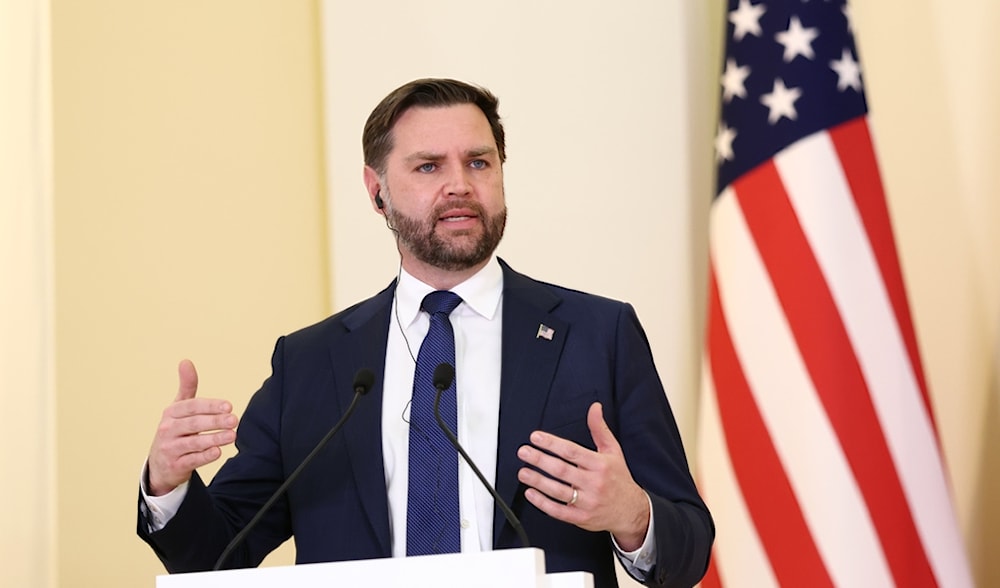
US Vice President JD Vance holds a joint press conference with Armenia's Prime Minister Nikol Pashinyan, not pictured, in Yerevan, Armenia, Monday, Feb. 9, 2026. (AP)
Iran has not agreed to all the "red lines" outlined by US President Donald Trump, Vice President JD Vance stated on Tuesday, following the mediated talks in Geneva.
In an interview with Fox News, Vance claimed that the United States remains open to diplomacy, although Trump has consistently threatened Tehran with military force if it does not concede to Washington's demands, including halting its uranium enrichment, transferring its stockpiles to a third country, and curbing its ballistic missile program.
Among the previously declared "red lines" were also Iran's material support for Resistance groups across West Asia, including Hamas and Hezbollah, as well as a pledge to refrain from striking the Israeli occupation. Vance did not disclose if any changes were made to this list.
“In some ways, it went well; they agreed to meet afterwards,” Vance said, adding, “But in other ways, it was very clear that the president has set some red lines that the Iranians are not yet willing to actually acknowledge and work through.”
Although Vance said the US would resume diplomatic efforts, he also noted that Trump "reserves the ability to say when he thinks that diplomacy has reached its natural end."
“We hope we don't get to that point, but if we do, that will be the president's call,” he added.
Iran maintains its position, says talks 'productive'
Meanwhile, Iran agreed to mediated talks if the United States commits to the proposed agenda, which is limited to the nuclear issue and lifting US sanctions imposed on the Islamic Republic. Iran has rejected any attempt to broaden discussions beyond those issues.
Tehran also reiterated that uranium enrichment remains a sovereign right and a non-negotiable principle within its civilian nuclear program.
Iranian Foreign Minister Abbas Araghchi also disclosed certain details after Tuesday's talks in Geneva, stating that the nature of the talks was constructive and "more productive."
"I can say that at this round, compared to the last one, we brought up absolutely serious issues for discussion, the atmosphere was more productive. Various ideas were put up for discussion, and we had serious discussions on these ideas, and finally we found a strategic route that we will follow, along which we will move and reach a text of a possible agreement," Araghchi said on Iranian television, following talks with the United States in Geneva.
According to Araghchi, the parties worked out the basic principles during the Geneva talks that will guide efforts toward a potential agreement on the Iranian nuclear dossier. He cautioned, however, that identifying principles does not necessarily guarantee a final deal.
"The time has not been determined yet. We agreed that the parties will work on the texts of a possible agreement, then we will exchange these texts, and then we will determine the date of the third round of negotiations," Araghchi said.
The minister concluded that there was tangible progress in dialogue with the US compared to the previous round.
Read more: Iran says US nuclear stance ‘more realistic’ ahead of Geneva talks


