
Iran says US nuclear stance ‘more realistic’ ahead of Geneva talks
 4 Min Read
Iran says Washington’s position on its nuclear program has become “more realistic” ahead of indirect Iran-US nuclear talks in Geneva, while Tehran insists sanctions must be lifted and enrichment remains non-negotiable.
-
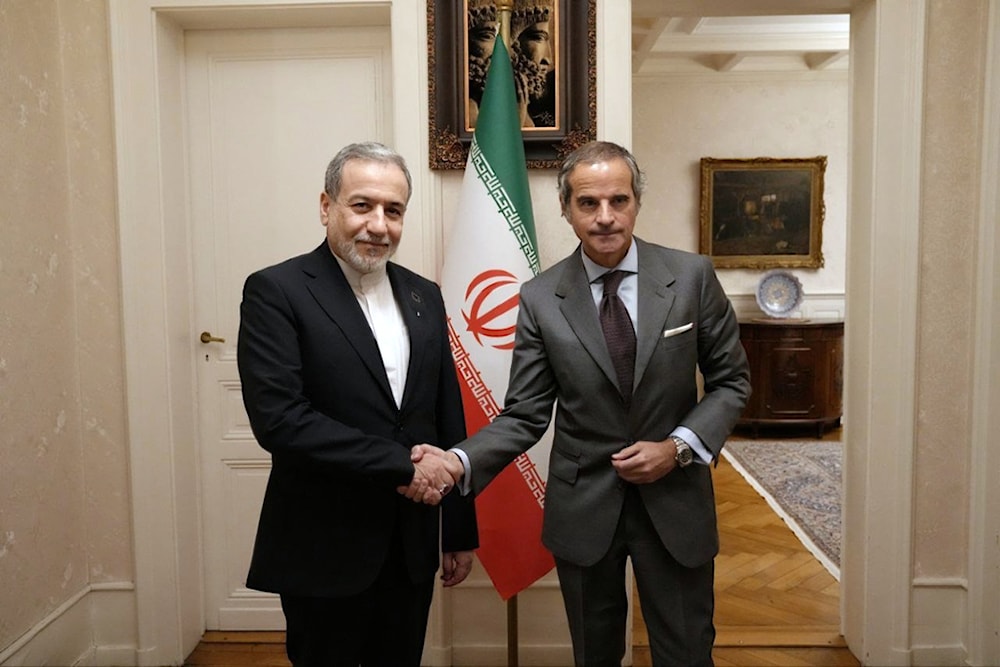
Iranian Foreign Minister Abbas Araghchi, left, shakes hands with International Atomic Energy Agency (IAEA) Director-General Rafael Grossi during their meeting in Geneva, Switzerland, Monday, Feb. 16, 2026. (AP)
Iran said Monday that the US position on its nuclear program “has moved towards a more realistic one” ahead of a second round of indirect negotiations set to take place in Geneva under Omani mediation.
The renewed Iran-US nuclear talks follow an initial session held earlier this month in Muscat and come amid heightened regional and military tensions.
Geneva round follows Muscat nuclear negotiations
Iran and the United States are scheduled to hold indirect talks on Tuesday in Geneva, with Oman continuing its mediating role.
The Geneva round marks the second session of negotiations after earlier Muscat nuclear negotiations were described by Omani Foreign Minister Badr al-Busaidi as “serious and constructive,” helping clarify both sides’ positions.
Iranian Foreign Minister Abbas Araghchi has traveled to Switzerland ahead of the talks. He is also expected to meet with International Atomic Energy Agency (IAEA) Director-General Rafael Grossi, as well as the foreign ministers of Switzerland and Oman.
The latest diplomatic push comes after talks collapsed during last year’s 12 day war waged by the Israeli occupation on Iran.
Iran says US position shifting on nuclear issue
“A cautious assessment is that, from the discussions that have taken place in Muscat to date, at least what we have been told is that the US position on the Iranian nuclear issue has moved towards a more realistic one,” Foreign Ministry spokesman Esmaeil Baqaei said, according to the official IRNA news agency.
He added that Iran's “inalienable rights under the Non-Proliferation Treaty (NPT) were recognised”, referring to the “peaceful uses of nuclear energy, including enrichment”.
Tehran maintains that its Iran NPT rights include the peaceful use of nuclear energy and uranium enrichment within the framework of international law.
Tehran signals flexibility but sets red lines
Iranian officials have indicated readiness to consider concessions within the framework of a potential agreement, provided Washington demonstrates seriousness regarding the lifting of US sanctions on Iran.
Deputy Foreign Minister Majid Takht-Ravanchi stressed that halting uranium enrichment remains non-negotiable, describing enrichment as a sovereign right and saying the ball is “in America's court to prove that they want to make a deal.”
Earlier, Mohammad Eslami, head of the Atomic Energy Organization of Iran, said Tehran could reduce the concentration of its highest enriched uranium stockpile in exchange for the removal of all financial sanctions.
Tehran insists that US sanctions on Iran remain the primary obstacle to progress in the ongoing Iran US nuclear talks.
Uranium enrichment remains central sticking point
Key sticking points include Iran uranium enrichment levels and the country’s stockpile of enriched uranium, which had reached 60 percent purity before the war. Washington has repeatedly called on Tehran to reduce enrichment levels to zero.
On Sunday, Israeli officials also called for Iran to have “no enrichment capability” and for all of its enriched material to be transferred abroad.
In June, Israeli forces launched an unprecedented bombing campaign against Iran, triggering a 12-day war during which Israeli and US strikes targeted Iranian nuclear facilities.
Considerable uncertainty surrounds the fate of Iran’s stockpile of more than 400 kilogrammes of 60-percent enriched uranium that was last seen by inspectors in June before the war.
Iran has said its enriched material remains under the rubble of nuclear sites struck during the conflict.
Tehran has stated it is prepared to dilute its highly enriched uranium if all sanctions are lifted. Dilution involves blending enriched uranium with other material to lower its concentration below a specified threshold.


