
Iran Hormuz grip exposes US power limits: Marandi, Henningsen | Excl.
 6 Min Read
Marandi and Henningsen agree that Gulf states hosting US forces and facilitating attacks on Iran risk retaliation as continued US pressure threatens further regional escalation.
-
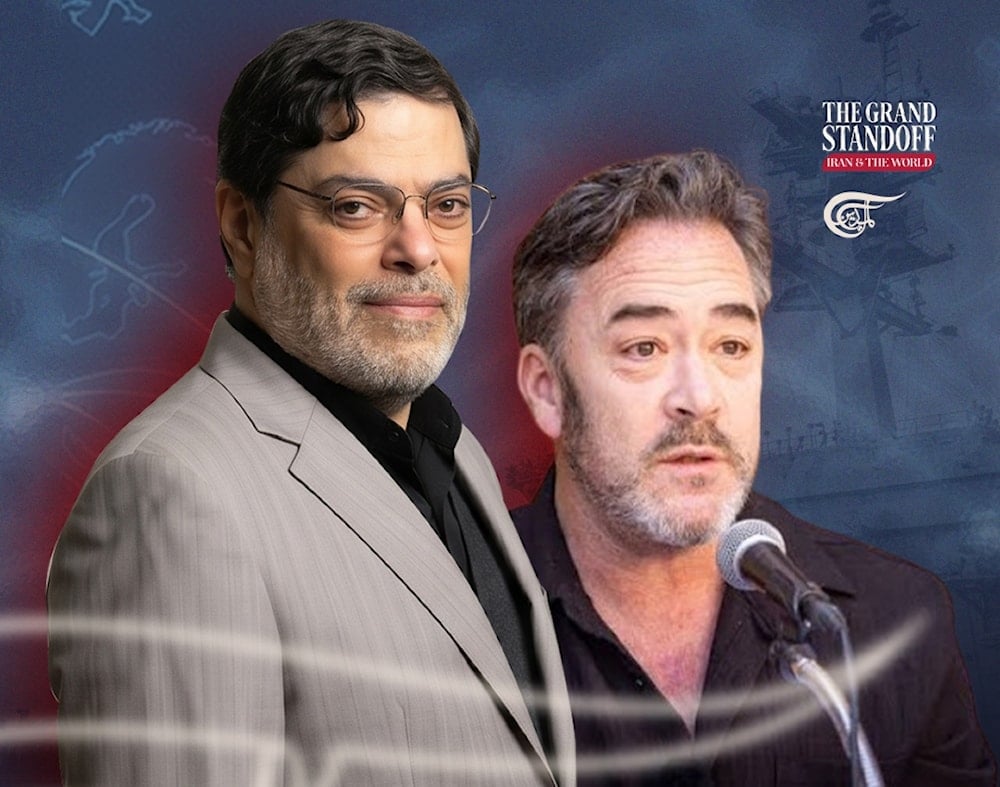
Designed by Zaynab El-Hajj for Al Mayadeen English
Further US-Israeli aggression against Iran could trigger stronger retaliation and tighter restrictions on shipping through the Strait of Hormuz, Iranian Professor Mohammad Marandi and US geopolitical analyst and journalist Patrick Henningsen said, warning that Washington's policies are exposing its Gulf allies to mounting military and economic risks.
Speaking on Al Mayadeen's The Grand Standoff: Iran and the World on Saturday, Marandi and Henningsen argued that US pressure has failed to undermine Tehran's ability to regulate passage through the strategic waterway.
The discussion addressed Iran's response to economic warfare, the vulnerability of Gulf states hosting US forces, and the possibility of renewed attacks driven by political calculations in Washington and Tel Aviv.
Speaking on Saturday’s episode of The Grand Standoff: Iran and the World, Iranian Professor Mohammad Marandi said that most oil shipments passing through the Strait of Hormuz do so with Iran’s consent, asserting that "that consent comes with obligations from the other side." He added that Iran can easily reduce maritime traffic or prevent vessels that violate its directives from passing through, citing developments over the past 10 to 11 days. Professor Marandi said restrictions are now increasing because the United States is waging economic warfare against Iran, while Saudi Arabia, the UAE, Qatar, Bahrain, and Kuwait are helping Washington wage war against the country. He added that these countries are collaborating with the United States and will therefore also pay the price. @s_m_marandi #Iran #IranWar #WestAsia #USA #AlMayadeen
— Al Mayadeen English (@MayadeenEnglish) October 11, 2026
Iran determines passage through Hormuz
Marandi said Iranian operations against vessels violating its navigation directives demonstrated Tehran's ability to control maritime traffic despite Washington's claims otherwise, arguing that Iran's capacity to authorize passage, restrict shipping, and collect transit fees contradicted assertions that the United States controlled the waterway.
Most oil shipments passing through Hormuz, he said, were moving with Iranian consent and under conditions established by Tehran.
“So the more we see escalation on the American side, the more escalation we're going to see on the Iranian side,” Marandi said.
Iran could tighten shipping restrictions in response to US escalation
The Iranian professor linked tighter restrictions to US economic warfare and the support provided by regional governments for attacks on Iran, arguing that countries facilitating those operations could not expect their exports to remain unaffected.
Marandi suggested that continued escalation could prompt Iran to further reduce shipping traffic, potentially bringing passage to a halt at certain points, alongside a stronger military response if large-scale attacks resumed.
“So Iran is sending a strong message that we will not tolerate economic warfare and we will, of course, be fully prepared to strike back if the hot war resumes.”
Washington's messaging cannot restore shipping stability
Henningsen, on his part, described US statements about oil flows through Hormuz as part of an information campaign aimed at influencing markets and sustaining public confidence in Washington's policy.
He argued that claims circulated through presidential statements and social media should be assessed against actual shipping conditions, rather than treated as evidence that normal trade had resumed.
US strategy targets Iran’s control of Hormuz
Washington's underlying approach, the US journalist said, remained focused on weakening Iran's ability to administer maritime traffic through periodic military attacks.
“The long-term US policy is to attack and to degrade and to try to weaken Iran's ability to manage or administer the Strait of Hormuz in maritime traffic.”
That approach, combined with erratic messaging from Washington, was prolonging uncertainty for shipping companies, insurers, and energy markets, Henningsen argued.
“And business as usual is not happening now, and I don't see it happening for the foreseeable future,” he said.
Russian diesel cannot resolve broader shortages
Both guests discussed arrangements involving Russian diesel exports, questioning whether additional supplies could meaningfully ease the consequences of disruption in the Gulf.
Marandi dismissed suggestions that the issue represented a source of tension between Tehran and Moscow, describing Iranian-Russian relations as excellent.
He argued that the shortages extended beyond crude oil to diesel, petrochemicals, and liquefied natural gas, making limited additional fuel supplies insufficient to address the wider problem.
“The shortage of diesel will not be resolved with this agreement.”
US seeks to control global energy flows
Henningsen, meanwhile, viewed Washington's dealings with Moscow as an attempt to direct global energy flows, pressure China, and maintain Iran's isolation.
Russia, he argued, would pursue opportunities to ease sanctions pressure and expand transactions without abandoning its longer-term strategic interests.
US efforts to dictate energy trade might produce temporary gains, he said, but would not alter the underlying economic relationships connecting producing countries and their buyers.
Gulf bases expose host countries to retaliation
The guests sharply criticized Gulf governments for facilitating US military operations, arguing that hosting American forces increased their exposure to retaliation.
Henningsen said the positioning of US military assets in Qatar and Saudi Arabia had again placed both countries at risk of becoming targets in a renewed confrontation.
He also argued that Washington's support for Saudi aggression on Yemen was drawing Riyadh deeper into a confrontation that would weaken the kingdom and the wider Gulf Cooperation Council.
Qatar's energy ambitions face growing risks
Focusing particularly on Qatar, Marandi accused Doha of providing bases and fuel supporting US and Israeli attacks on Iran.
He warned that Qatar's energy ambitions were vulnerable to regional escalation, including possible action by the Yemeni Armed Forces, and argued that its support for Washington carried consequences for its own security.
Both guests portrayed the Gulf states' reliance on US protection as a source of growing vulnerability as the confrontation widened.
Henningsen warns attacks could precede elections
Henningsen cautioned against assuming that Washington would postpone renewed military action until after the US midterm elections.
He suggested that Israeli Prime Minister Benjamin Netanyahu's struggle for political survival could encourage an earlier attack, drawing the United States into another round of aggression.
“But again, I would not rule out a joint US-Israeli strike on Iran, an act of aggression before the Israeli elections,” he said.
Henningsen also raised the possibility that Trump could follow renewed attacks with claims of a diplomatic breakthrough intended to influence domestic opinion.
He argued that Iran was preparing for such a scenario, while questioning whether US forces and their Gulf hosts were adequately prepared for the retaliation it could bring.
Read more: Iran may strike first as Tehran warns of possible US assault | Excl.


