
Iran navy warns of new weapon, threatens Hormuz closure
 3 Min Read
Iran’s navy warns of a feared new weapon and signals possible closure of the Strait of Hormuz amid the continued US maritime blockade.
-
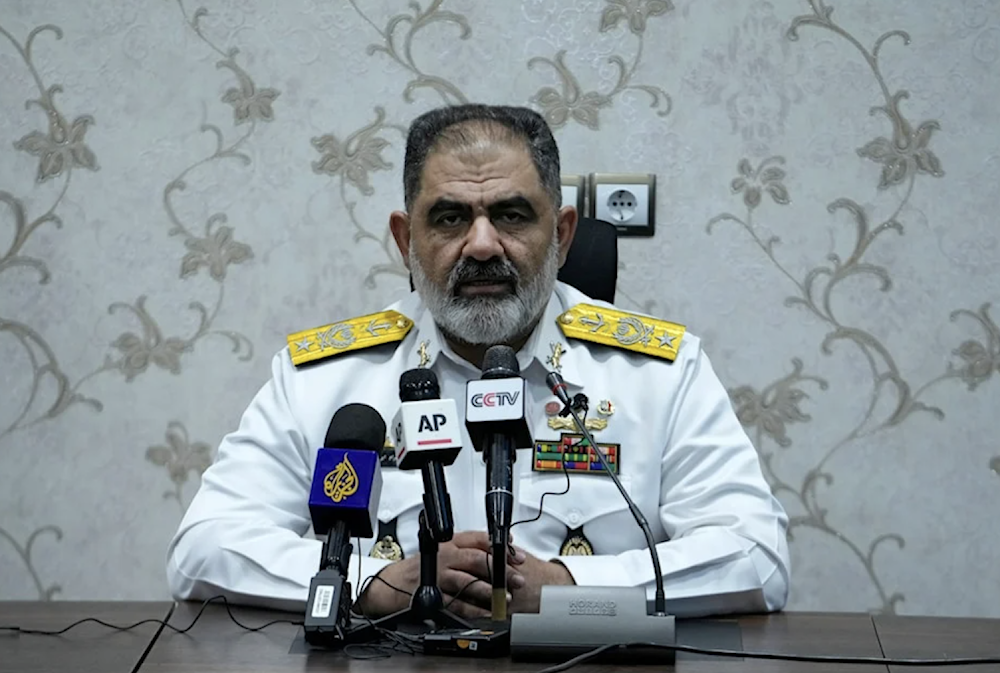
Iran Navy Chief Admiral Shahram Irani speaks in a news conference during a joint naval drill of Iran, Russia, and China, in Konark, Iran, on March 11, 2025 (AP)
Iran’s navy commander has issued a stark warning to the United States and its allies, saying a new weapon will soon be unveiled while signaling the potential closure of the Strait of Hormuz.
Commander of the Iranian army’s naval force, Admiral Shahram Irani, said that “the enemies will see a weapon they fear very soon,” emphasizing that it would be deployed at close range.
His remarks come as tensions intensify following ongoing US aggression in the region, including what Iranian officials describe as a maritime blockade targeting Iranian ports.
Strikes on US aircraft carrier
Irani stated that Iranian naval forces carried out “7 strikes against the aircraft carrier Abraham Lincoln,” adding that the vessel was temporarily unable to conduct operations.
He also warned that Iran could move to close the Strait of Hormuz from the Arabian Sea side, stressing that naval forces are prepared to carry out rapid operations.
“The enemy thought that it would achieve results against Iran within 3 days to a week, but this perception of theirs has turned into a joke,” he said.
Strategic importance of maritime control
The Iranian commander highlighted the country’s maritime positioning, saying Iran’s access to key waterways provides a strategic advantage.
He noted that three major sea lanes lie within Iran’s sphere of influence, particularly the Strait of Hormuz, which remains one of the world’s most critical energy transit routes.
Irani stressed that Iran’s naval posture sends a clear message that any threat would be met with a decisive response.
Ghalibaf: Enemies have failed at every turn; Iran will secure victory
Iran's Parliament Speaker Mohammad Bagher Ghalibaf declared on Wednesday that "the enemies have failed to achieve their objectives," vowing that Iran will emerge victorious from the ongoing war.
In an audio message addressed to the Iranian people, Ghalibaf said adversaries had sought to "bring down the system within three days" from the very first day, through the assassination of Iranian Leader Sayyed Ali Khamenei and senior military commanders, but ultimately failed.
Enemies then shifted their focus to dismantling Iran's offensive military capabilities, he said, only to find that the pace of Iranian missile and drone strikes had continued unabated.
"They then attempted to activate separatist movements in the west of the country," Ghalibaf explained, "but thanks to God and the efforts of the military and intelligence forces, they failed again."
He further revealed that after months of planning and strikes on security installations, adversaries "plotted a coup during the last Wednesday eve celebrations of the Persian year," attempting to infiltrate forces into the country, a plan tested in Isfahan that he said turned into a "second Tabas scandal."


