
US fails to turn tactical gains into strategic win, left exposed
 3 Min Read
The US war on Iran enters its 50th day amid claims of tactical gains, rising economic strain, and a lack of clear strategic objectives or end goals.
-
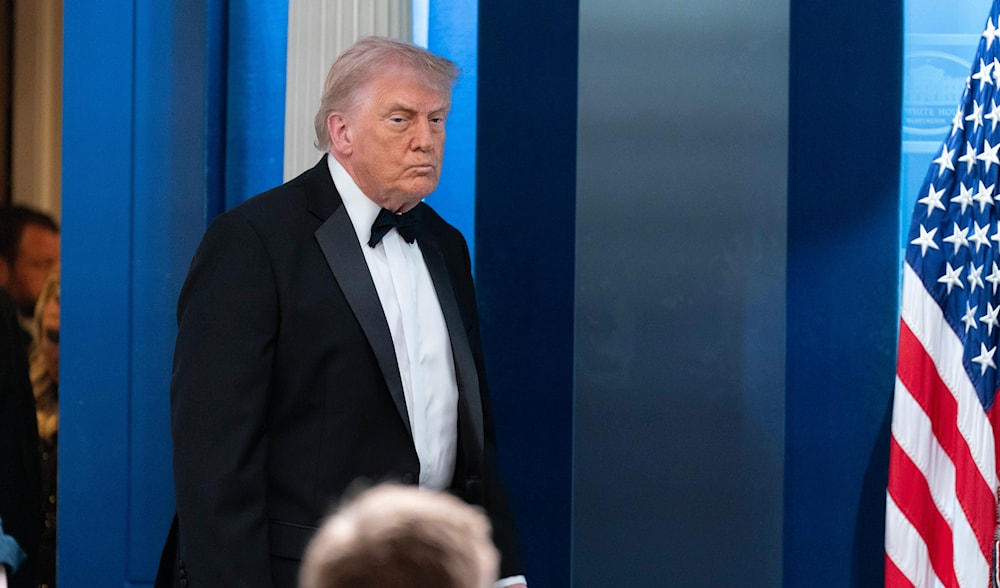
US President Donald Trump arrives to speak to the media in the James Brady Press Briefing Room at the White House after an unspecified threat at the annual White House Correspondents' Association Dinner in Washington, April 25, 2026 (AP)
Fifty days into the US-Israeli war on Iran, a familiar and increasingly concerning pattern has emerged, according to War Without Journal, which argues that tactical military success has not translated into strategic victory.
The platform said that despite “tactical success” on the battlefield, the United States has failed to develop a stable strategic framework, leaving it in a largely reactive position and exposed to economic risks and diplomatic isolation. It added that the absence of a credible “theory of victory” has undermined Washington’s ability to turn military gains into political outcomes.
According to the report, the United States launched the war on Iran without a clearly defined end political objective, while coordination between national security agencies was structurally weakened both before and during the affression.
This strategic deficit, the platform argued, is reflected in fluctuating ceasefire talks, an unresolved crisis surrounding the Strait of Hormuz, and the absence of a clear mechanism to convert battlefield gains into sustainable political results. It noted that corrective measures remain possible, but would require restoring effective interagency coordination.
Washington locked between a rock and hard place
As April 2026 draws to a close, the United States, according to the report, finds itself locked into a fragile ceasefire, while mediation efforts are being conducted in Islamabad through a Pakistani intermediary. Meanwhile, the Strait of Hormuz remains in a state of intermittent disruption, opening and closing in line with developments on the ground.
Domestically, the report said Washington is facing growing economic consequences, with gasoline prices rising above four dollars per gallon and inflation exceeding Federal Reserve targets.
It added that the central question is no longer whether the war achieved its tactical objectives, but rather what strategic purpose it was designed to serve in the first place, and whether such a purpose was ever clearly defined.
The platform maintained that while the United States entered the war with significant military capabilities, political will, and tactical clarity, it lacked a strategic architecture capable of converting military action into durable political outcomes, an architecture it says depends on effective coordination among national security institutions, which it claims was systematically sidelined.
The absence of the intellectual and institutional architecture that converts military power into strategic outcomes has taken its toll on the US side throughout the war, as it lacks:
- A theory of victory;
- A functioning interagency process;
- A defined political end-state;
- A sequenced multi-instrument strategy.
In conclusion, it asserted that the means to correct the downhill course are already there,but the key question is whether the administration has the strategic awareness and institutional discipline to act before the ceasefire ends, talks break down, and the war moves into its next stage still lacking a coherent "theory of victory."


