
Iran operation may have targeted Isfahan enriched uranium: Exclusive
 4 Min Read
Former Pentagon analyst Michael Maalouf says US losses exceeded $500M in operation near Isfahan; strategy contradictions raise concerns over Iran mission.
-
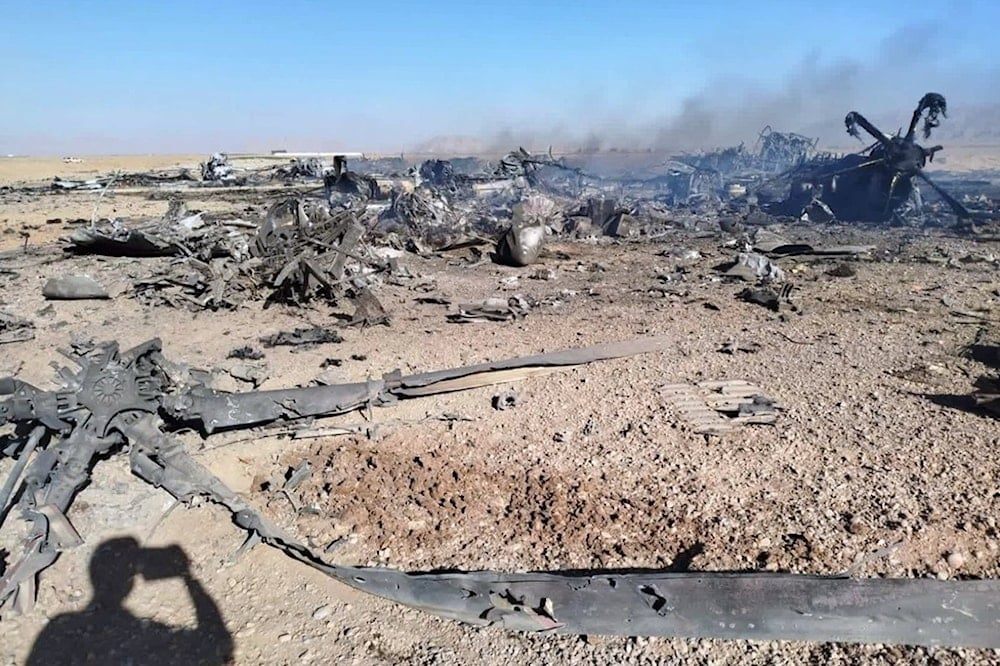
Wreckage is shown at the site of a downed American transport plane and two helicopters involved in a rescue operation, in Isfahan province, Iran, April, 2026 (Sepahnews)
Former Pentagon Senior Security Policy Analyst Michael Maloof told Al Mayadeen that the recent US operation in Iran was likely aimed at securing enriched uranium from the Isfahan nuclear facility.
“I listened to the entire news conference… Trump is trying to build a lot of support, if you will, for the attack on Iran that, frankly, the American people are very, very leery of,” Maloof said, adding that US actions are increasingly viewed through the prism of the Israeli regime.
Maloof reported that the US incurred losses exceeding $500 million during the Isfahan operation. “Even though we lost approximately $500 million in equipment the other day to rescue the one pilot,” he said, referencing the destruction of two C-130 aircraft approximately 35 kilometers from Isfahan. A separate F-35 fighter jet crashed roughly 200 kilometers northwest of the facility, highlighting the complexity of the mission.
Regarding intelligence on the site, Maloof noted: “The US lacks precise data regarding the presence of uranium at the Isfahan facility… there’s no certainty.” He suggested that special forces may have been inserted into the area under the cover of the pilot rescue operation: “The rescue of the pilots… might have been a cover for more of an insertion of special forces in the Isfahan region.”
'Trump has no plan'
Maloof also raised concerns about contradictions in US policy: “He says that the Strait of Hormuz is nothing to him… but he’s now insisting that unless by 8 o’clock Eastern Standard… those terms have not been met, he’s going to be bombing infrastructure of Iran. It tells me he has no plan.”
Highlighting the broader military goals, Maloof added: “They were very, very pleased with the operation… and they wanted to make the point that they never leave a soldier behind. One thing they were very concerned about was that if he was captured by Iranian authorities, it would be a big propaganda coup.”
The analyst concluded that the high-risk operation, combined with unclear intelligence and inconsistent statements, underscores a volatile situation in US-Iran relations and raises questions about long-term strategic planning in the Middle East.
Failed uranium heist
Iranian Foreign Ministry spokesperson Esmail Baghaei said the “American operation failed miserably," adding that Iranian forces had effectively countered the attempt, drawing parallels to Operation Eagle Claw, the failed US mission in Tabas.
Baghaei pointed to inconsistencies in the US account of the operation, particularly regarding the location where American aircraft landed in Isfahan.
“The point where US aircraft landed in Isfahan is very far from the location they claimed was the hiding place of the downed pilot,” he said, referring to the area of Kohgiluyeh and Boyer-Ahmad province.
He added that “there is a possibility that cannot be ruled out” that the US operation in southern Isfahan was part of a plan to steal Iran’s enriched uranium, rather than being solely a rescue mission.
The spokesperson further stressed that the operation constituted a “blatant violation of Iranian sovereignty," describing it as a “catastrophic scandal” for Washington.
Failed operation underscores Iranian response
Baghaei said Iranian forces and local populations played a key role in thwarting the operation, emphasizing that “when Iran’s sovereignty is targeted, all Iranians stand united.”
He also highlighted the role of local tribes, particularly from the Lur community, in countering the incursion.
The Islamic Revolution Guard Corps (IRGC) had earlier stated that it confronted and neutralized hostile aerial targets during a failed US operation inside Iranian territory. At least two MC-130J Commando II aircraft operated by US special forces, in addition to a number of helicopters, were destroyed.
According to US military data, each MC-130J aircraft deployed in the operation carries a price tag exceeding $100 million. The MC-130J is specifically designed for high-risk missions, including the insertion and extraction of special operations forces in hostile environments, and features advanced defensive systems to counter sophisticated air defenses.


