
Iran rejects UAE proposal on ‘maritime corridor’ in Strait of Hormuz
 4 Min Read
Iran has rejected a UAE-backed proposal adopted by the IMO for a “safe maritime corridor” in the Strait of Hormuz.
-
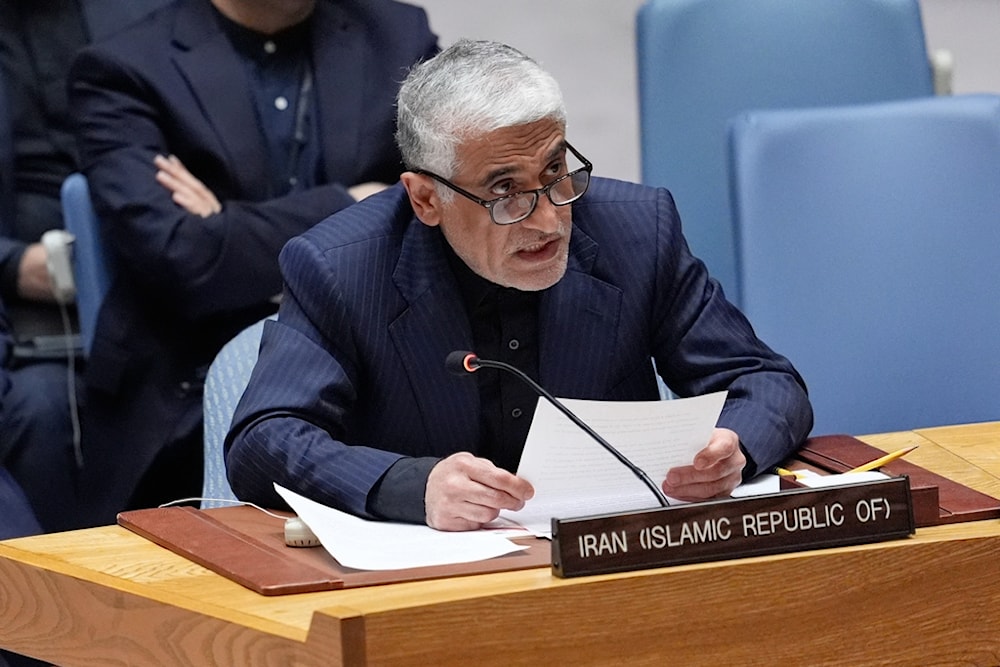
Iranian ambassador to the United Nations Amir-Saeid Iravani speaks during a Security Council meeting at United Nations headquarters, on March 11, 2026. (AP)
Iran has strongly rejected a United Arab Emirates-backed proposal adopted by the International Maritime Organization calling for the establishment of a so-called “safe maritime corridor” in the Strait of Hormuz, describing it as legally groundless, procedurally invalid, and politically motivated.
The rejection was conveyed at the 113th meeting of the IMO Legal Committee on Tuesday by Deputy Permanent Representative of Iran’s Ports and Maritime Organization to the IMO, Pouria Kolivand.
Iran rejects UAE-backed maritime corridor proposal
Kolivand categorically rejected the Emirati proposal, arguing that it relies on an arbitrary narrative and contains “groundless claims and legally invalid conclusions.”
He further stressed that any arrangement regarding maritime passage in the Strait of Hormuz must be based on the full consent and coordination of Iran as a key coastal state, warning that bypassing such consent undermines legal norms governing international waterways.
Iran also asserted that the IMO adopted a flawed proposal lacking procedural validity, cautioning against the politicization of a technical maritime body.
US-Israeli war, maritime security
Iran attributed the deterioration of maritime safety in the region to the US-Israeli war on Iran, which was launched on February 28, stating that such actions constitute a violation of the UN Charter.
“The current situation in the region, particularly in the Strait of Hormuz, is the direct consequence of savage and illegal war by the US and the Israeli regime against the Islamic Republic of Iran, a war that is in sheer violation of fundamental principles of the UN Charter, particularly the principle of prohibition of appeal to force,” Kolivand said at the IMO meeting.
Tehran emphasized that any legal assessment isolating maritime consequences from the root cause of the crisis is “incomplete and legally flawed.”
Iran further stated that it has exercised its right to self-defense under Article 51 of the UN Charter in response to the aggression.
Read more: Gulf states weigh pipeline expansion plans, hoping to bypass Hormuz
Maritime security claims and regional responsibility
According to Iran’s assessment presented at the IMO, 39 Iranian commercial vessels have been attacked and sunk, while 20 seafarers have been killed during the 40-day period of war.
Tehran said the Strait of Hormuz has remained open to maritime traffic, stressing that only vessels linked to hostile activities have been restricted, while non-hostile shipping continues to pass through following coordination with Iranian authorities and compliance with safety regulations.
Iran also rejected claims assigning responsibility for maritime instability to Tehran, arguing that some regional states, including the UAE, have facilitated aggression by allowing their territories to be used in attacks against Iran, which triggers international responsibility under the principles of international law.
Warning over politicization of IMO, maritime law
Additionally, Iran issued a strongly worded statement to the IMO Legal Committee, condemning violations of international law, including international humanitarian law and maritime law, by the United States and "Israel".
“These acts constitute serious violations of international law, including international humanitarian law, the law of the sea, and the principles enshrined in IMO instruments,” the statement explained, adding, “These are not simple numbers; these are war crimes and crimes against humanity.”
Tehran also warned that any attempt to establish a maritime corridor without its explicit approval would risk further politicizing the IMO and undermining its technical mandate.
Iran further condemned the US naval blockade of Iranian ports in the Gulf and the Sea of Oman, calling it a continuation of unilateral measures that endanger maritime safety and seafarers.
Read more: UAE prepares to join US-led move to open Hormuz by military force: WSJ


