
Iran's indigenous nuclear knowledge cannot be destroyed: AEOI
 2 Min Read
Iran says attacks on its nuclear facilities are war crimes, vows legal action, and affirms its nuclear knowledge cannot be destroyed despite US-Israeli aggression.
-
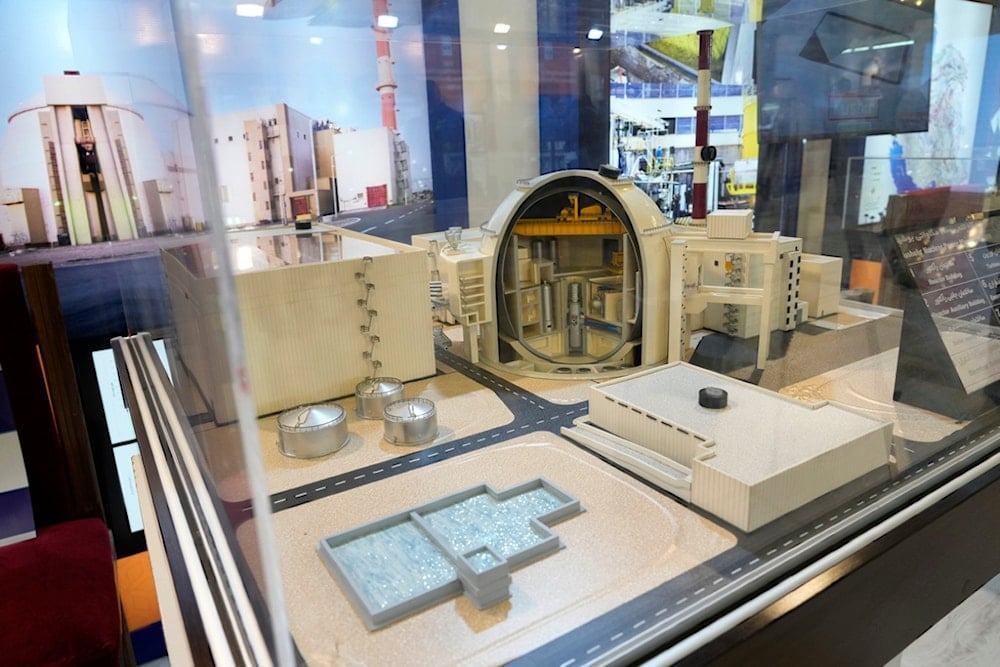
A model of the Bushehr nuclear power plant is on display in an exhibition of Iran's nuclear achievements during the "International Conference on Nuclear Science and Technology" in the central city of Isfahan, Iran, on May 6, 2024. (AP)
Targeting nuclear facilities constitutes a war crime, the spokesperson for Iran’s Atomic Energy Organization, Behrouz Kamalvandi, affirmed on Wednesday, stressing that Iran will pursue legal action against those responsible for attacks on its infrastructure.
Kamalvandi stated that “attacking nuclear facilities is a war crime," adding that strikes on Iranian sites operating under international safeguards represent a clear violation of international law. He further emphasized that the attack on the Arak Nuclear Complex's heavy water reactor is a war crime.
The Iranian official underscored that Tehran will “legally pursue accountability against the aggressors targeting Iranian nuclear facilities at the international level,” signaling a potential escalation on the legal and diplomatic fronts. He stressed that despite repeated attacks, “it is not possible to destroy Iran’s indigenous nuclear knowledge,” highlighting the resilience and continuity of the country’s scientific capabilities.
Read more: No one could have predicted scale of Iran's response: US official
Repeated attacks on nuclear sites
Several Iranian nuclear facilities have come under attack since the outset of the US-Israeli aggression against Iran, including sites in Bushehr, Natanz, and Isfahan.
In response, Iran has continued to exercise its legitimate right to defend its territory, targeting US bases across the region, as well as military and strategic sites in the occupied Palestinian territories.
Tehran’s stance reflects a broader policy of deterrence, as it maintains that attacks on its sovereign infrastructure will not go unanswered. Iranian officials continue to emphasize defensive measures through military responses aimed at safeguarding national security and regional stability, while taking legal action in parallel.
Iran's Islamic Revolution Guard Corps (IRGC) Aerospace Force had previously responded to Israeli strikes on Iranian nuclear infrastructure by targeting both Arad and Dimona, two settlements located near the Dimona nuclear site, which the Israeli regime uses for military purposes. One of the strikes targeted the housing area of employees of the nuclear facility, according to Iranian officials.
Read more: Iran’s judiciary chief: War will end with expulsion of US forces


