
Iran's missile strategy exposes mounting strain on US Patriot defenses
 7 Min Read
A major Iranian missile barrage in Jordan highlights mounting pressure on US Patriot defenses as Washington faces a growing shortage of interceptors.
-
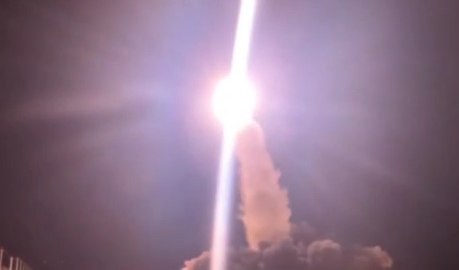
Screengrab from footage released by Iran's Islamic Revolution Guard Corps showing the moment of launch during retaliatory strikes on US military bases in Jordan, overnight Sunday into Monday, August 31, 2026. (IRGC via Telegram)
The scale of the US response to Iran’s latest missile barrage has highlighted a growing vulnerability in American air defenses: intercepting incoming missiles can itself become an unsustainable drain on limited stocks of defensive weapons, according to a report by Military Watch Magazine.
During the night of August 30, US forces deployed two MIM-104 Patriot batteries from Ansbach, Germany, to defend US military positions in Jordan against an Iranian ballistic missile attack. More than 80 surface-to-air interceptors were reportedly launched, with close to four Patriot missiles fired against each incoming Iranian missile in some cases.
The exchange illustrates the cost imbalance between the two sides. A Patriot interceptor is estimated to cost four to five times more than the Iranian ballistic missiles it is used to destroy. That disparity allows an attacker to impose substantial financial and logistical pressure even if most of its missiles are intercepted.
Iran launched the barrage after the US struck Iranian naval facilities, an attack that caused multiple casualties. While US officials claimed that the Iranian response caused no damage to facilities, footage from the ground and satellite imagery cited in the report indicate otherwise.
More significant than the immediate damage, however, is what the engagement reveals about the sustainability of the US missile-defense posture. Some estimates suggest that the more than 80 PAC-3 interceptors used during the attack amounted to over 10% of the entire US stockpile, at a time when Patriot ammunition is already in short supply across the Western world.
Iran turns missile defense into a war of attrition
Iran’s approach has increasingly placed the emphasis not simply on penetrating American defenses, but on forcing them to expend their most valuable interceptors.
Tehran has substantial stocks of older ballistic missiles, including the Shahab 3, which were acquired during the 1990s. These weapons remain useful in a strategy where the objective is to make the defender spend more ammunition than the attacker does.
An Iranian missile does not necessarily have to reach its intended target to serve that purpose. If a single incoming projectile prompts several Patriot interceptors to be launched against it, Iran can consume multiple expensive defensive weapons with one comparatively cheaper offensive missile.
Repeated over large barrages, that calculation can quickly become problematic for the defender. The number of interceptors required to defeat an attack may therefore matter as much as the number of missiles that successfully evade the defense.
This dynamic has been described as an interceptor-exhaustion strategy, exploiting the finite supply of American defensive missiles rather than relying solely on the ability of individual Iranian weapons to defeat the Patriot system.
US Patriot stocks were already under severe pressure
The latest expenditure comes after months of heavy use of American air-defense systems.
When the US began its attacks on Iran in February, its Patriot interceptor reserves were already significantly depleted. According to the report, figures confirmed in July 2026 showed stocks had fallen to just 25% of the level the Pentagon considered necessary.
The depletion accelerated during the war. Western sources cited by the report said the US Army had used more than 800 Patriot interceptors during only five days of fighting with Iranian forces on March 5.
The shortage became sufficiently serious that Washington sought additional interceptors from Poland in March to replenish its stocks.
The problem is not confined to the immediate defense of US positions in West Asia. Every interceptor fired in combat represents a weapon that must eventually be replaced, while production capacity remains constrained and other theaters continue to demand American air-defense resources.
Where did US' air defense shield go? Following emergency transfers to West Asia, US Patriot missile stockpiles in Europe have dropped past a critical threshold.
— Al Mayadeen English (@MayadeenEnglish) August 31, 2026
An AP report reveals that out of 2,330 available Patriot interceptors, around 1,500 were consumed in the war on Iran. pic.twitter.com/lZOL0XHoVo
Interceptor shortages are reshaping US military deployments
Washington has already been forced to make broader adjustments as missile stocks come under pressure.
The United States has suspended some arms deliveries to strategic partners in Asia and Europe while also withdrawing air-defense capabilities from the Pacific theater. Among the systems redeployed have been Patriot and THAAD batteries stationed in South Korea.
The decisions demonstrate how a sustained conflict with Iran can generate consequences far beyond the immediate battlefield. Maintaining sufficient defensive ammunition for American forces in the region increasingly competes with the requirement to equip allies and preserve US military capabilities elsewhere.
Iran, meanwhile, has continued to employ a varied arsenal of missiles and drones rather than relying on a single weapon type. More sophisticated systems have reportedly been reserved for higher-priority targets.
One example is the Fattah 2, which incorporates a hypersonic glide vehicle and is described as particularly difficult for conventional missile defenses to intercept.
That combination of weapons allows Iran to vary the cost and complexity of its attacks. Older and comparatively less expensive missiles can be used to place pressure on defensive stocks, while more advanced systems can be deployed against targets where greater penetration capability is considered necessary.
The effectiveness question goes beyond interception rates
The report also points to an assessment published by the Israeli newspaper Haaretz in late March, which found that 80% of Iranian missiles launched against Israeli targets were successfully reaching their targets.
If that assessment is accurate, it would raise questions about the vulnerability of less heavily defended US military positions in Europe and elsewhere, particularly as American interceptor stocks continue to decline.
The issue is therefore not simply whether Patriot batteries can intercept Iranian ballistic missiles. The larger concern is whether the United States can continue sustaining the volume of defensive fire required when faced with repeated large-scale attacks.
A missile-defense system can achieve a high rate of interception while still facing a strategic problem if every successful defense requires the expenditure of multiple interceptors. The attacker can exploit that imbalance by forcing the defender to consume its limited ammunition at a faster rate than it can be replenished.
Iran's missile campaign tests the sustainability of US defenses
The August 30 barrage has brought this problem into sharp focus. More than 80 Patriot interceptors reportedly being used during a single engagement illustrates how quickly a large Iranian attack can consume American defensive resources.
For Iran, the advantage lies not necessarily in ensuring that every missile reaches its target, but in making the US repeatedly commit expensive interceptors to defeat incoming weapons. As the conflict continues, the resulting pressure falls on the finite stockpile available to American forces.
That creates a difficult strategic equation for Washington. The United States must defend its military positions against Iranian attacks while preserving enough interceptors for future barrages and maintaining air-defense capabilities in other regions.
Iran’s continued use of ballistic missiles, drones, and increasingly sophisticated weapons consequently emphasizes endurance. The question is not only whether the Patriot can intercept an Iranian missile, but how many interceptors the US can afford to expend before the defensive stockpile becomes a more serious vulnerability than the incoming missiles themselves.
Read more: US Patriot stocks depleted by up to 67% during Iran war: CSIS


