
Iran says Lebanon ceasefire, release of assets key before talks
 3 Min Read
Iran’s Ghalibaf says a Lebanon ceasefire and release of blocked assets must be implemented before negotiations can begin.
-
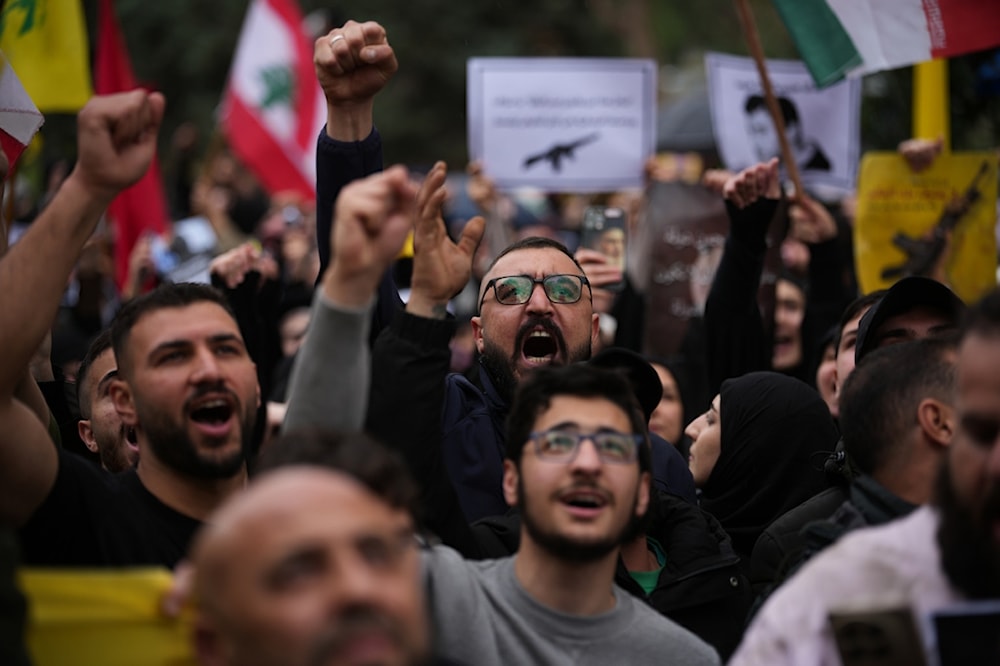
Levabese demonstrators shout slogans during a protest against the Lebanese Prime Minister Nawaf Salam, in front of the government palace in Beirut, Lebanon, Friday, April 10, 2026 (AP)
Iranian Parliament Speaker Mohammad Bagher Ghalibaf said that key preconditions for negotiations have yet to be met, stressing that talks cannot begin without their implementation.
In a statement, Ghalibaf said: “Two of the measures mutually agreed upon between the parties have yet to be implemented: a ceasefire in Lebanon and the release of Iran’s blocked assets prior to the commencement of negotiations.”
He emphasized that both conditions are essential before any diplomatic process can move forward. “These two matters must be fulfilled before negotiations begin,” he added.
Lebanon ceasefire non-negotiable
Tehran has made it unequivocally clear that any negotiations over a ceasefire in the region are contingent on Lebanon being included in the deal, Fars News Agency reported, citing an informed source.
According to the source, Iran views the situation in Lebanon and a halt to hostilities there as an absolute, non-negotiable condition for engaging in any new negotiation process.
The source added that Pakistan’s mediation proposal aligns fully with this principle. Tehran’s 10‑point plan, communicated to international mediators, contains an explicit clause stressing the necessity of including Lebanon in a comprehensive ceasefire.
Iran did not accept a ceasefire until the United States, and President Donald Trump personally, formally acknowledged the entirety of the 10‑point package, the source stated. In the meantime, the ongoing attacks on Lebanon have led Tehran to see negotiations as strategically meaningless and futile.
Iran ties ceasefire to Lebanon's peace
Iran has tied any move toward a ceasefire to a complete halt of aggression on all fronts, including Lebanon. Tehran insists that a lasting end to hostilities must go beyond a temporary truce and must stop attacks against Iran and its allies.
Tehran’s 10‑point proposal, accepted by Washington as the framework for talks during the two-week ceasefire, calls for the cessation of all regional aggression as a precondition for negotiations. The plan demands an end to wartime attacks and guarantees that further aggression will not target Iran or allied forces.
The proposal also includes ending all US and Israeli military operations against Iranian territory and affiliated groups, as well as halting Israeli attacks on Lebanon and other countries in the region. Iran’s negotiators stress that without a permanent stop to aggression on all fronts, any ceasefire would be meaningless and allow enemy forces to regroup.
Hours after the ceasefire deal was announced, Israeli Prime Minister Benjamin Netanyahu declared support for the US decision to suspend strikes on Iran for two weeks, but immediately limited the agreement, claiming it does not apply to Lebanon despite Pakistan and Iran affirming it does."Israel" then launched a brutal aggression on Lebanon, attacking 100 locations with approximately 150 airstrikes within ten minutes, killing 254 people and wounding 1,165, according to the Lebanese Civil Defense. In Beirut alone, 92 people were martyred and 742 were wounded, while in Beirut's Southern Suburb, 61 were martyred and 200 were wounded.


