
War on Iran enters dangerous phase as US options for talks narrow: BBC
 5 Min Read
An analysis by Amir Azimi for BBC finds that despite US claims of crippling Iran, the aggression is spiraling beyond Washington's control with Tehran's sustained retaliation and no clear exit points.
-
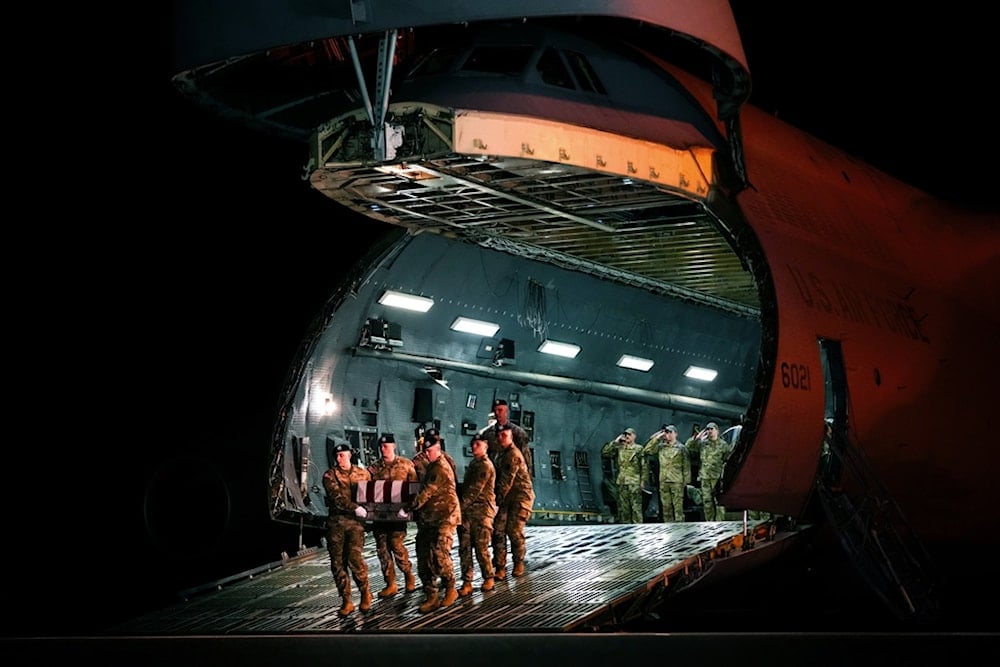
An Army carry team moves the flag-draped transfer case containing the remains of U.S. Army soldier Maj. Sorffly Davius, of Cambria Heights, N.Y., who died in Kuwait, during a casualty return, Monday, March 9, 2026, at Dover Air Force Base, Del. (AP)
For weeks, the United States and "Israel" have insisted that Iran's military capacity has been severely degraded. US President Donald Trump and War Secretary Pete Hegseth have repeatedly claimed that sustained strikes have crippled Iran's command structure and weakened its ability to respond. By their account, the conflict should already be moving toward an end.
Yet the opposite appears to be happening. The escalation continues faster, sharper, and with fewer clear exit points, according to an analysis by BBC's Amir Azimi published Monday.
Iran's capabilities defy expectations
On Saturday, claims surfaced that Iran launched two missiles toward the US-UK base on Diego Garcia in the Indian Ocean, a distance of approximately 3,800 kilometers, far beyond the 2,000-kilometer range previously attributed to Iran's arsenal.
Although it should be noted that Iran did not assume responsibility for this, the missiles did not reach the island, and the incident was heavily discussed in the media in terms of Washington's underestimation of Iranian capabilities.
Whether this reflects a previously undisclosed capability or one developed under bombardment, the implication is the same: military pressure has not halted Iran's progress.
If much of its leadership has indeed been eliminated, including Sayyed Ali Khamenei, senior figures such as Ali Larijani, commanders of the Islamic Revolution Guards Corps, and the armed forces' chief of staff, then who is directing this campaign, and how has Iran managed to sustain its capabilities under such pressure?
The uncertainty begins at the very top. Sayyed Mojtaba Khamenei, who survived the strike that killed his father and several close family members, has since been named as the new leader. And yet, Iranian actions suggest anything but collapse. On Saturday, Iran struck the town of Dimona in occupied Palestine, an area linked to the regime's undeclared nuclear program, following Israeli strikes on Iran's energy infrastructure near Bushehr, which also hosts Iran's nuclear power plant. The message was simple: escalation will be matched, and key sites are no longer off limits.
These actions suggest coordination rather than confusion. The assumption behind US and Israeli strategy, that removing top leaders would lead to paralysis, now appears uncertain.
Who is left to negotiate with?
If that is the case, a more immediate problem emerges: who is left to negotiate with? Iranian President Masoud Pezeshkian has kept a low profile. Since Sayyed Mojtaba Khamenei's rise, he has said little, further narrowing options that the US can use to backtrack.
From Tehran's perspective, recent events offer little reason to trust any negotiations. In the 14 months since Trump returned to office, signs of progress toward a nuclear deal in two separate sets of negotiations have been cut short by military action in the middle of talks.
Iranian officials say that during the second round of talks in Geneva on February 27, they addressed most US concerns. Preparations were underway for technical discussions in Vienna. But Trump said he was "not happy" with the way the negotiations were going, and strikes began the next day.
For Iranian decision-makers, the message is clear: negotiation does not prevent attacks; it may even invite them, Azimi says.
Trump's ultimatum and retreat
Trump raised the stakes on Saturday night, issuing a 48-hour threat demanding that Iran reopen the Strait of Hormuz, warning that failure to comply would lead to the US "obliterating" Iranian power plants.
Iran rejected the demand and responded with a similar threat: any attack on its energy infrastructure would be met with strikes across the region. Iran's Defense Council also raised the possibility of mining parts of the Persian Gulf.
The exchange appeared to set both sides on a direct path toward a far more dangerous phase of the war on Iran. Yet only hours before the deadline was due to expire, Trump stepped back. In a post on Truth Social, he claimed there had been "very good and productive conversations" with Iran and announced a five-day pause on any planned strikes against Iranian energy infrastructure.
Iranian officials swiftly denied that any direct talks had taken place, be they direct or indirect.
With limited channels for talks, Trump's choices are narrowing. Further escalation by the belligerents risks becoming a cycle of destruction with little strategic gain for them, leaving only the most extreme options on the table.
Both sides are now limited in their choices. Iran is unwilling to step back after being aggressed repeatedly, while the United States and "Israel" cannot achieve a "decisive outcome" through air power alone.
Read More: Senior Iranian official outlines conditions for ending war: Exclusive


