
Iran war's hidden toll: Brain injuries threaten US troops' future
 5 Min Read
US troops wounded in the Iran war renew scrutiny over traumatic brain injuries, exposing the long-term consequences of Washington’s wars.
-
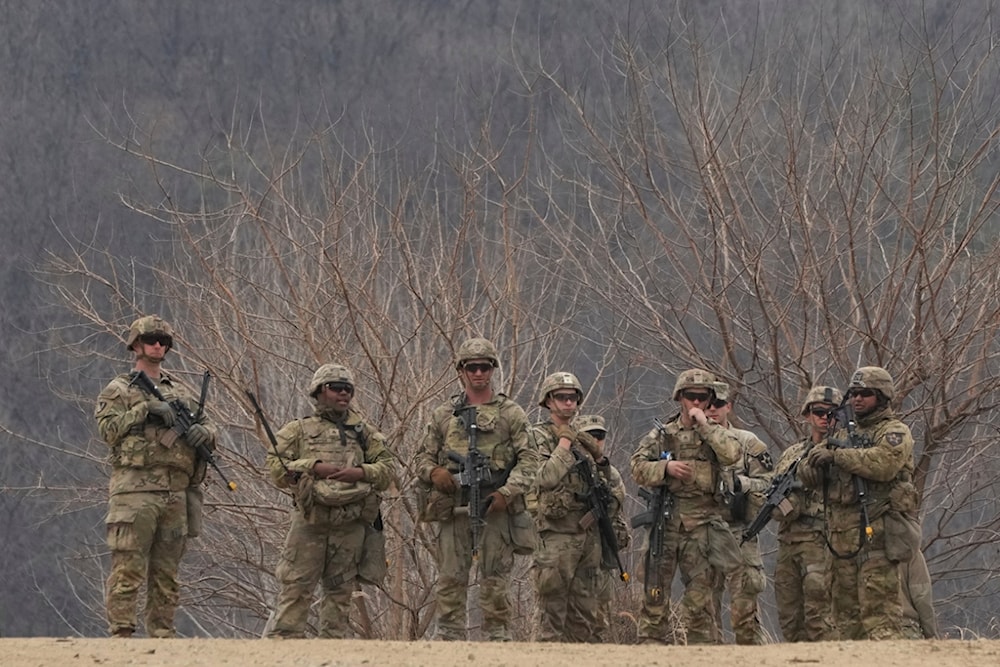
US Army soldiers attend a joint river-crossing exercise between South Korea and the United States as part of the Freedom Shield military exercise in Yeoncheon, South Korea, Saturday, March 14, 2026 (AP)
The latest escalation of the US war on Iran has renewed concerns over the long-term health consequences facing American troops exposed to drone and missile attacks, with traumatic brain injuries emerging as one of the conflict’s most significant battlefield wounds, the Associated Press reported.
Nearly 700 US service members have reportedly been wounded during attacks on American positions in West Asia and other combat operations. Military officials have said most suffered traumatic brain injuries and later returned to duty.
The Pentagon has described many injuries as "minor concussions", but medical specialists and veterans warn that blast-related brain injuries can produce symptoms that appear years later and may permanently affect memory, balance, and daily life.
Read more: Most Americans say Iran war fell short, not worth the cost: Poll
US troops face renewed concerns over blast-related injuries
Veteran Marine Joe Shearer experienced two blast incidents while in Iraq in 2005. The first came from a mortar explosion that knocked him down and caused vomiting, while a later roadside bomb attack sent a shock wave through his body.
At the time, Shearer continued his missions despite headaches and other symptoms.
"As long as you got back up and could go back on patrol, that’s kind of what you did," he told AP.
Years later, he was diagnosed with traumatic brain injuries linked to those incidents. He continues to experience migraines, dizziness, memory problems, and difficulty completing everyday tasks.
The war on Iran has brought renewed attention to these injuries as US forces face a different battlefield environment, with drones and missiles creating blast effects that can strike troops at close range.
Unlike the roadside bombs and improvised explosive devices common during the US wars on Iraq and Afghanistan, drone warfare presents new challenges for understanding how blast waves affect the brain.
The hidden cost of Washington’s overseas wars
Traumatic brain injuries have become one of the defining medical consequences of US wars over the past two decades.
More than 500,000 US service members were diagnosed with traumatic brain injuries between 2000 and 2025, according to military data. Around 82% of these cases were classified as mild, although experts caution that symptoms can persist long after the initial injury.
Medical specialists say repeated exposure to explosions increases the risk of long-term neurological damage, including chronic traumatic encephalopathy (CTE), a degenerative brain condition associated with repeated head trauma.
Dr. James Kelly, a neurologist at the University of Colorado School of Medicine and chief medical scientist at the Invisible Wounds Foundation, said blast injuries differ from conventional head trauma.
"The blast wave itself can be injurious," Kelly told AP. "It’s a different cellular injury. Blast is a different thing than a blunt injury to the head."
Doctors have also warned that the term "mild" traumatic brain injury can underestimate the severity of long-term effects, as some individuals experience symptoms for months or years.
Veterans describe years of untreated trauma
Many veterans say military culture discouraged them from reporting injuries during deployment.
Shearer said troops often avoided medical attention because they feared appearing weak or being removed from their units.
"You don’t want to be the guy who goes to sick call or says, ‘Oh, I’m hurt,’ because you’re away from your team," he told AP.
After returning from Iraq, he struggled with nightmares, insomnia, and headaches. He later received treatment for post-traumatic stress disorder but only discovered years afterward that he had suffered traumatic brain injuries.
Other veterans describe similar experiences.
Army veteran Frank Sonntag suffered a brain injury after a mortar blast in Iraq in 2004. He did not seek treatment for two years despite worsening headaches and cognitive difficulties.
Eventually, his condition deteriorated to the point where writing an email became extremely difficult, and he struggled with speech and memory.
"Speech therapy was one of the greatest things I had," Sonntag said to AP.
Medical professionals say rehabilitation, early treatment, and continued support can help patients recover functions and adapt through therapy.
Medical challenges in diagnosing battlefield injuries
Experts say predicting which service members will suffer lasting effects remains difficult.
Kelly Parker of the Wounded Warrior Project said traumatic brain injuries vary significantly between individuals.
"If you’ve seen one TBI, you’ve seen one TBI," she told AP.
Specialists emphasize that symptoms often overlap with post-traumatic stress disorder and other conditions, potentially causing cases to remain undiagnosed.
Army veteran Spencer Milo, who suffered traumatic brain injuries in Iraq in 2008 and Afghanistan in 2011, said many people struggle to understand injuries that are not visible.
"I really wish it was that simple," Milo told AP. "It’s tough because when you can’t see something, it’s hard to believe that it’s really there."
Read more: War on Iran deepens US Patriot shortages after Ukraine transfers: RIA


