
Failed war on Iran exposes collapse of US strategy in West Asia: FP
 8 Min Read
Michael Fuchs argues that the failed US-Israeli war on Iran proves Washington should withdraw from the region.
-
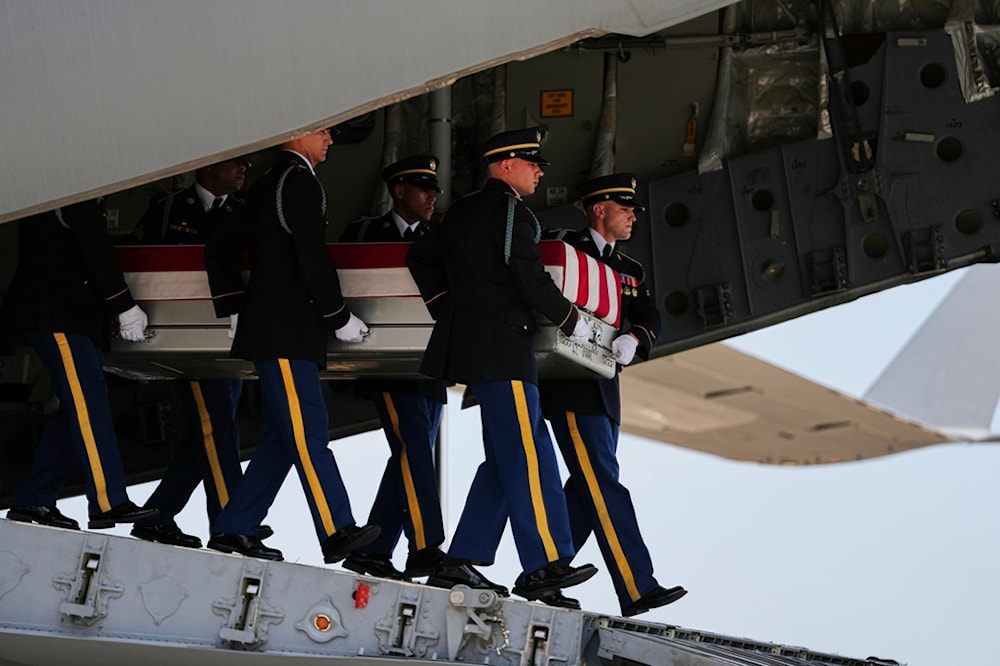
A U.S. Army carry team moves a transfer case containing the remains of 1st Lt. Tyler James Feehan of Ewa Beach, Hawaii, on July 22, 2026, at Dover Air Force Base, Del. (AP)
The failure of the US-Israeli war on Iran has exposed the limits of Washington’s military power and strengthened demands for a complete US withdrawal from West Asia, former US official Michael Fuchs argued in Foreign Policy.
Fuchs presents withdrawal as a correction to decades of failed policy. A Resistance-based reading, however, would draw a sharper conclusion: Washington is reconsidering its regional presence not only because its wars have caused immense destruction, but because Iran and allied resistance movements have made US military domination increasingly costly and unsustainable.
Fuchs described the war as "an epic disaster", saying the United States and “Israel” launched an unnecessary and unlawful campaign that failed to make Washington or its partners safer.
At least 1,700 Iranian civilians, including 307 children, were killed, while civilian infrastructure suffered extensive damage. The closure of the Strait of Hormuz also disrupted energy markets and drove up global prices.
Iranian retaliation killed 18 US troops and injured more than 600 others at US bases in neighboring countries, according to the article.
For Fuchs, the outcome shows that Washington’s vast regional network of troops and military installations has failed to achieve its stated objectives. From the perspective of the Axis of Resistance, it also demonstrates that the regional balance of deterrence has shifted and that US forces and allies can no longer assume immunity from retaliation.
US bases as sources of instability
Washington has long justified its presence in the region as necessary to protect energy routes, defend partners, support “Israel,” confront armed groups and contain Iran.
Fuchs argued that the opposite has occurred. US deployments have encouraged repeated intervention, exposed US personnel to attack and turned host countries into potential battlefields.
Thousands of US troops remain stationed across Iraq, Saudi Arabia, the United Arab Emirates, Jordan, Bahrain, Qatar and Kuwait. Each threat against those forces becomes a justification for more defenses, reinforcements and retaliatory operations, allowing the military presence to perpetuate itself.
Resistance movements have advanced a similar criticism for years. Iran, Hezbollah, Iraqi factions and Yemen’s Ansar Allah view US bases not as neutral security guarantees but as instruments used to protect “Israel,” pressure independent states, enforce sanctions and support military aggression.
Under that interpretation, the damage inflicted on US installations during the war on Iran proved that such bases had become liabilities rather than symbols of uncontested dominance.
Withdrawal or defeat?
Fuchs portrays departure as a strategic decision Washington should voluntarily make after examining the consequences of 35 years of intervention.
The Resistance would frame it differently.
From its perspective, the United States withdraws when the military, political and economic costs of remaining become intolerable. Any departure would therefore be presented not as enlightened restraint but as the result of sustained deterrence and pressure.
The Iran war showed that Washington could attack Iran but could not prevent Tehran from reaching US bases, disrupting regional energy flows or imposing costs on countries that facilitated the aggression.
The Foreign Policy essay would therefore be viewed as a belated acknowledgment from within the US establishment that the project of permanent regional military supremacy is failing.
Human cost of US wars
Fuchs linked the Iran war to a longer pattern of US interventions, including the invasion of Iraq, the war in Afghanistan and operations across Pakistan, Syria and Yemen.
Citing Brown University research, he said Washington spent around $8 trillion on wars launched after September 11. Around three million Americans served, more than 15,000 US personnel and contractors were killed, and 1.8 million troops were left disabled.
The toll on targeted countries was far greater. More than 940,000 people were killed directly, including 432,000 civilians. Another 3.6 million died from indirect consequences linked to the collapse of health systems, infrastructure and state institutions, while 38 million were displaced.
"But numbers alone cannot convey the human toll", Fuchs wrote, citing children who lost parents, families driven from their homes and generations deprived of normal lives.
A Resistance-oriented assessment would agree with his condemnation but reject the notion that these were merely policy errors. It would describe them as foreseeable consequences of occupation, regime-change wars, sanctions and attempts to impose regional order through force.
Washington’s support for regional aggression
Fuchs also criticized US alliances with governments accused of repression and violations of international law. He argued that Washington sustained the Saudi-led war on Yemen, supported Egypt’s government and enabled the UAE’s involvement in Sudan.
His strongest criticism concerned “Israel.” Fuchs said unconditional US military, financial and diplomatic support enabled settlement expansion, repression in the occupied West Bank, the genocide in Gaza and the subsequent war on Iran.
He called for suspending aid and weapons exports to governments responsible for gross abuses.
The Resistance would welcome that acknowledgment but regard conditional assistance as insufficient. It would argue that US support is a central pillar sustaining Israeli occupation and enabling attacks on Palestine, Lebanon, Syria and Iran.
From this perspective, regional stability cannot be built around protecting a nuclear-armed occupying entity while Palestinians and neighboring peoples remain subjected to blockade, dispossession and repeated aggression.
Full withdrawal, not rebranding
Fuchs urged Washington to begin withdrawing once a stable ceasefire with Iran is reached.
He rejected a smaller military footprint, noting that Iran damaged or destroyed buildings and equipment at at least 15 US sites during the war. Consolidating troops into fewer bases would still leave them exposed and require further deployments for protection.
“It is long past time for the United States to withdraw its forces from the Middle East, stop arming governments that violate U.S. and international law, and end its role as guarantor of regional order,” Fuchs wrote.
Resistance factions would broadly agree but remain suspicious of partial drawdowns that replace combat troops with advisers, contractors, intelligence personnel or bilateral missions.
A genuine departure, in their view, would require the removal of troops, bases and unauthorized operations rather than a change in labels.
Security after the United States
Fuchs argued that Gulf states should pursue regional security arrangements based on diplomacy and de-escalation with Tehran.
The war showed that US forces could neither prevent the closure of the Strait of Hormuz nor fully protect Gulf partners from Iranian retaliation, despite the presence of the Fifth Fleet and extensive military infrastructure.
This argument closely resembles Tehran’s long-standing position that regional security must be created by regional states rather than imported through foreign armies.
The Resistance would warn Gulf governments that hosting US forces does not guarantee protection. Once those bases are used to support aggression, they become part of the battlefield. A post-US order, from this perspective, should be based on sovereignty, nonaggression, economic cooperation and dialogue between Iran and its Arab neighbors.
Limits of Fuchs’s argument
Despite criticizing US policy, Fuchs retains elements of Washington’s traditional framework. He continues to describe Iran as destabilizing and treats resistance movements mainly through their relationship with Tehran.
The Axis of Resistance would reject that portrayal, arguing that Hezbollah emerged from Israeli occupation, Iraqi resistance from the US invasion, Palestinian resistance from dispossession and settlement expansion, and Ansar Allah from war, blockade and foreign intervention.
It would also reject Fuchs’s proposal to redirect US resources toward China and Russia. Moving American military power from West Asia to Asia or Europe would not represent an end to hegemony, but its relocation.
Fuchs concluded that public opposition to endless wars is rising even as the US military budget reached around $1 trillion in 2026 and the Trump administration sought a major increase for 2027. "Decades of ill-conceived wars and entanglements have cost too many lives and too much treasure while adding little to US security", he wrote.
"It is time for the United States military to leave".
The Resistance would agree with the demand but interpret it as evidence that sustained confrontation has imposed new limits on US power.
In that reading, the war on Iran did not merely reveal a flawed American strategy. It showed that Washington’s bases can be reached, its allies cannot be permanently shielded, and the era of low-cost US domination of the region is increasingly difficult to sustain.
Read more: Trump, Hegseth clash at Camp David over depleted US missile stockpiles


