
Legal experts warn US-led war on Iran 'likely' violates int'l law: NYT
 4 Min Read
100+ legal experts have warned that the war on Iran may violate international law, citing the illegality of its initiation, potential war crimes in US operations, and risks to global legal norms.
-
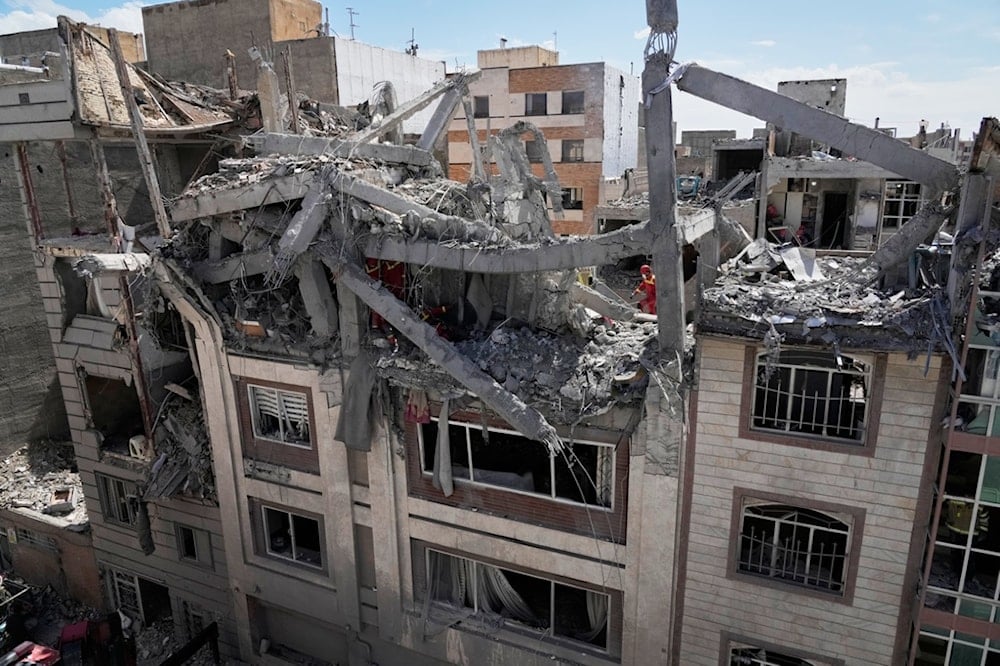
First responders inspect a residential building hit in an earlier U.S.-Israeli strike in Tehran, Friday, March 27, 2026.(AP)
More than 100 international law experts have issued an open letter warning of “serious violations of international law and alarming rhetoric” in the ongoing war on Iran, with particular scrutiny directed at the United States’ role in launching and conducting the campaign, the New York Times reported on Thursday.
Published by the Just Security platform affiliated with New York University, the letter was signed by legal scholars and former government officials, including Harold Hongju Koh and Beth Van Schaack. It argues that the initial US-Israeli assault on Iran on February 28 lacked legal justification under international law, describing it as “a clear violation of the United Nations Charter.”
The signatories point to the absence of authorization from the United Nations Security Council and question Washington’s claims of self-defense, noting that US officials have provided limited details regarding the alleged imminent threat posed by Iran.
War crimes concerns
Beyond the legality of the war’s initiation, the letter raises concerns about the conduct of US military operations. It warns that both actions on the ground and statements by senior officials may constitute breaches of international humanitarian law and human rights law, including “potential war crimes.”
Particular attention is given to a deadly strike in the southern Iranian town of Minab, where a missile hit a girls’ elementary school on the first day of the war on Iran, killing at least 175 people, many of them children. Investigations and open-source evidence have pointed to US responsibility for the attack, which stands as the deadliest single episode of civilian killings in the aggression.
“The strike likely violates international humanitarian law, and if evidence is found that those responsible were reckless, it could also be a war crime,” the letter reads.
The experts warn that such actions not only endanger civilians in the region but also “risk degrading the rule of law and fundamental norms that protect every nation’s civilians.”
Civilian toll mounts
The broader impact of the US-Israeli aggression on Iran has been reflected in mounting reports of widespread civilian harm and damage to essential infrastructure. The World Health Organization has verified multiple attacks on healthcare facilities since the start of the war, while humanitarian agencies report growing strain on Iran’s medical system. The International Federation of Red Cross and Red Crescent Societies said that more than 1,900 people have been killed and over 21,000 injured since February 28, as aid workers and medical personnel have also been among those affected. UNICEF has also reported that hundreds of children have been killed or injured.
Investigations and rights groups have also pointed to strikes affecting schools, hospitals, and other civilian sites, while reports indicate damage to medical research centers, including the Pasteur Institute of Iran, as well as some university infrastructure. These developments have reinforced concerns among observers that the war on Iran is increasingly impacting civilian sectors and essential services.
While the letter places primary emphasis on the United States, it also criticizes Iran’s retaliatory actions, stating that strikes targeting civilian infrastructure across the region are unlawful and increase risks to non-combatants. Iranian officials, however, have maintained that their operations are carried out in self-defense and are directed at US and Israeli assets in response to the aggression.
Rising dissent
The concerns raised in the letter echo a broader wave of criticism from international observers, including legal scholars, nuclear experts, and foreign policy analysts, many of whom have questioned both the legality and strategic rationale of the war on Iran. Critics argue that the campaign lacks a clear legal basis, may be undermining non-proliferation efforts, and risks escalating into a prolonged regional conflict with significant global economic consequences.
At the same time, signs of internal dissent have emerged within the United States. Joe Kent, who led the National Counterterrorism Center, resigned in protest over the war, reportedly arguing that Iran did not pose an imminent threat and that he could not support the campaign. His departure, along with reports of unease among intelligence and national security officials, points to growing divisions within the administration over the direction and justification of the war on Iran.
Read more: Trump weighs replacing intelligence chief amid rift over war on Iran


