
Trump weighs replacing intelligence chief amid rift over war on Iran
 5 Min Read
The US president is considering replacing Tulsi Gabbard amid growing tensions over her handling of dissent and reluctance to fully support the administration’s justification for the war on Iran.
-
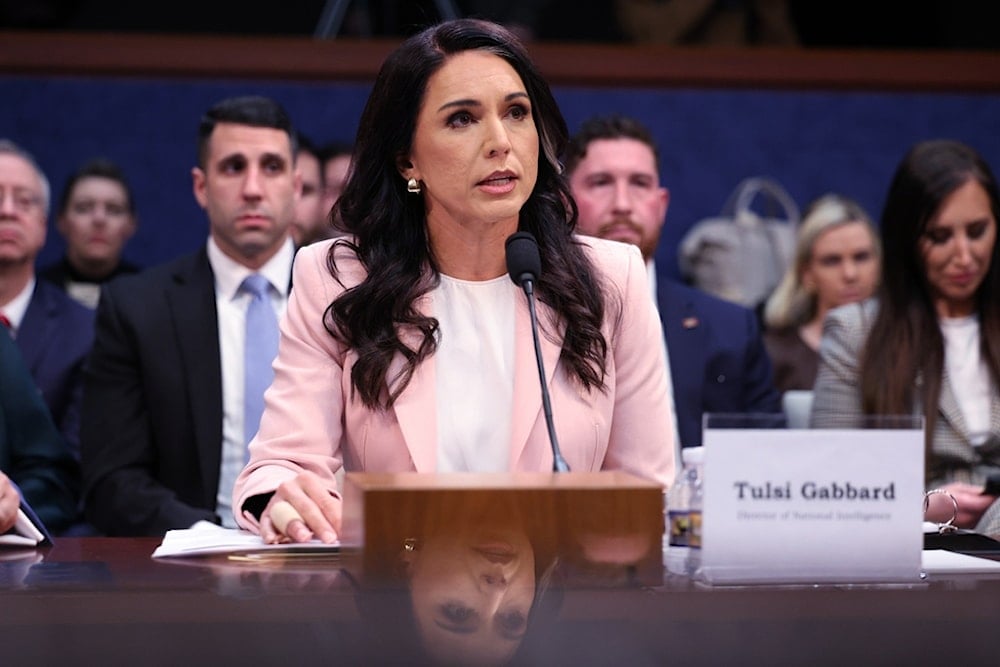
Director of National Intelligence Tulsi Gabbard speaks during a House Permanent Select Committee on Intelligence hearing to examine worldwide threats, Thursday, March 19, 2026, on Capitol Hill in Washington (AP)
US President Donald Trump has privately raised the possibility of removing Tulsi Gabbard from her post, voicing frustration over her handling of internal dissent related to the administration’s war on Iran, sources told The Guardian.
The conversations, which took place in recent weeks, focused in part on Gabbard’s response to the resignation of Joe Kent, who had challenged the administration’s rationale for military action by arguing that Iran did not pose an imminent threat. Trump was reportedly displeased that Gabbard did not openly rebuke Kent and appeared reluctant to defend the case for war.
It remains uncertain whether Trump will ultimately move to dismiss Gabbard. Advisors have warned that creating a vacancy without a clear successor could generate unnecessary political complications, particularly at a time of heightened tensions.
Still, Trump’s outreach to confidants signals potential concern about her position, as he has often consulted aides before making personnel changes. The matter has been discussed privately, with sources speaking on condition of anonymity due to the sensitivity of internal deliberations.
Gabbard under pressure
The issue gained prominence following Gabbard’s testimony during last month’s worldwide threats hearing on Capitol Hill. Days earlier, Kent had stepped down after publicly questioning the urgency of the Iran threat. Trump was said to be particularly dissatisfied with Gabbard’s unwillingness to firmly counter those claims.
When asked on Sunday whether he continued to back her, Trump offered a qualified response. “Yeah, sure,” Trump told reporters aboard Air Force One. “I mean, she’s a little bit different in her thought process than me, but that doesn’t make somebody not available to serve.”
The White House has since sought to project unity. Spokesperson Steven Cheung said Gabbard retains the president’s support, stating, “As President Trump just said in his remarks, he has confidence in Director Gabbard and the tireless work she is doing. He has assembled the most talented and impactful cabinet ever, and they have collectively delivered historic victories on behalf of the American people.”
Mounting internal strains
Since returning to the office, Trump has generally avoided outright dismissals, instead opting to reassign officials viewed as liabilities. Kristi Noem was recently shifted from her role as homeland security secretary to a lower-profile diplomatic position.
Within the administration, some officials acknowledge that Gabbard has faced difficulties in her role, which requires balancing competing intelligence assessments while supporting White House policy objectives. Her testimony, however, reflected long-held views opposing US military entanglements and questioning the legality of preemptive strikes.
According to a person familiar with the matter, her remarks had been coordinated in advance with the CIA, and she has spent considerable time at the White House contributing to efforts related to the war on Iran.
Gabbard has at times aligned closely with Trump, including backing an intelligence report asserting that Russia did not act to boost his 2016 campaign, a conclusion that diverged from findings by congressional investigators.
Tensions persist internally
Her office has stressed continuity. “Over the past two weeks, President Trump said both that he has confidence in the DNI and that she did well at her hearings before Congress. She remains committed to fulfilling the responsibilities the president placed in her,” spokesperson Olivia Coleman said.
Despite that, tensions have persisted. Trump previously criticized Gabbard after she told lawmakers that Iran had not decided to develop a nuclear weapon, responding at the time, “She’s wrong.” He later approved strikes on Iranian nuclear facilities at Fordow, Isfahan, and Natanz.
Other disputes have added to the strain, including internal backlash after Gabbard revoked dozens of security clearances without prior coordination with senior officials. The episode led to friction with intelligence agencies before the White House intervened to defuse the situation.
Public undermining
A pattern is emerging within Trump’s administration in which several high-profile women have found themselves publicly undermined while serving in senior roles. Figures such as Gabbard, Pam Bondi, Noem, and Karoline Leavitt have each faced moments of public criticism, reassignment, or internal pressure, often playing out in full view of the media.
While Trump has long applied a confrontational style to both allies and adversaries, the repeated spectacle of women in his orbit being corrected, contradicted, or sidelined has drawn attention to the optics of their roles, where proximity to power appears to come with a heightened risk of public embarrassment.
The dynamic reflects a governing approach in which loyalty is constantly tested and messaging is tightly controlled, but one that, in practice, has left several female officials facing a cycle of visibility, pressure, and public diminishment.
Read more: ‘Americans have died’: Calls for firing Noem amid fatal shootings rise


