
Iran warns US against threats as Tehran studies response to violations
 4 Min Read
Iran’s top military academic leader, Esmail Ahmadi-Moghaddam, says Trump’s threats are election rhetoric as Tehran reviews its response to US memorandum violations.
-
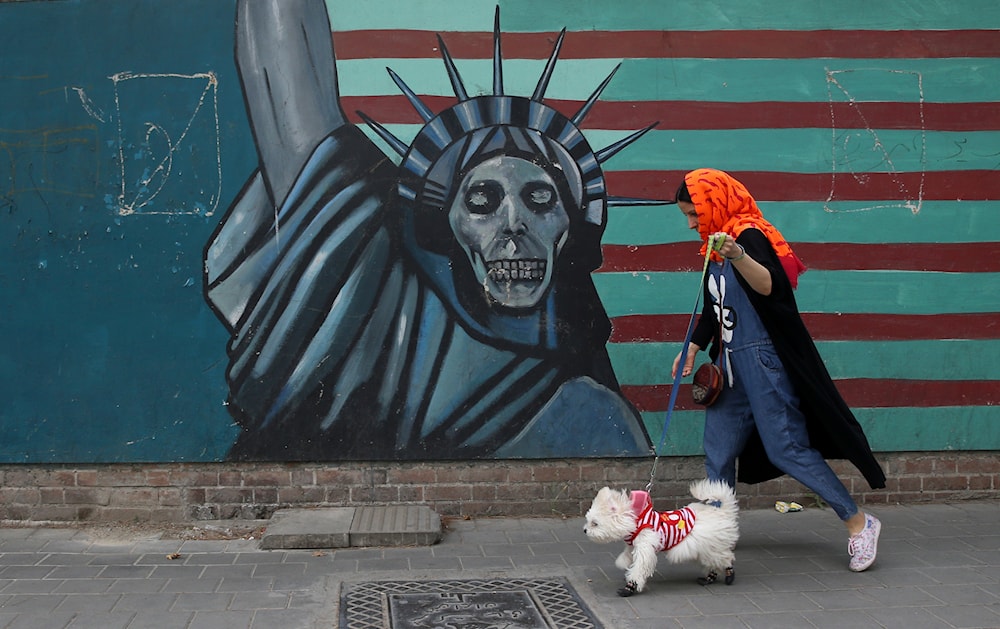
A woman walks her dog past an anti-US mural painted on the wall of the former US Embassy in Tehran, Iran, Tuesday, May. 8, 2018 (AP)
Iran's top military academic official dismissed US President Donald Trump's threats as empty rhetoric aimed at bolstering domestic support ahead of the congressional midterm elections, adding that Tehran is currently assessing its response to what it describes as US violations of the Islamabad memorandum of understanding.
Major General Esmail Ahmadi-Moghaddam, head of the Armed Forces Defense University, challenged the US president directly: "If Trump could actually get the job done, why did he flee from war and sign the memorandum?"
In a series of remarks over recent days, the general dismissed US rhetoric as election-year posturing, warned that Tehran is ready for "the worst and hardest options," and confirmed that Iran has not yet unveiled all its military capabilities.
Moghaddam said that the United States failed to force open the Strait of Hormuz militarily, which forced Trump to "submit" and sign the memorandum. Iran is now studying how to respond to violations of the agreement, he added.
The general also stated that Trump's aggressive language violates the second clause of the bilateral memorandum, which obligates both parties to refrain from the language of threats. He described such posturing as "the standard practice of arrogance" and said the Iranian people are fully accustomed to it.
Iran has papers that have yet to be revealed
"We have in Iran papers we have not revealed," Moghaddam said. "We will use them at the appropriate time according to the needs of the military field. We have certainly not revealed all our military cards. We have military innovations and surprises that will astonish the enemy."
On retaliation, the general laid out Iran's doctrine in stark terms. "We have put forward the strategy of an eye for an eye and a tooth for a tooth," he said. "We do not escalate in war, but we respond to similar targets in the region, for every target the enemy strikes."
He emphasized that the principle of vengeance remains "fundamental and foundational" and is not personal or individual but represents "a current that kills oppression and seeks to achieve justice," emphasizing that it "depends on the circumstances of time, place, and interest."
Moghaddam pointed to the massive turnout at the funeral processions of martyr Sayyed Ali Khamenei as proof that US calculations about internal collapse have failed. "The funerals set records in terms of the number of participants," he said. "Their goal was the collapse of the system from within, but their calculations were wrong, and the proof is this million-strong funeral." He described the attendance as having opened a new front, "the front of the Iranian street."
Damascus bombing work of 'Israel'
Commenting on the recent bombing in Damascus, the general accused France of seeking a regional role and suggested that certain actors are trying to obstruct ongoing negotiations. "France is trying to find a role in the region, and with the negotiations underway, there are those who want to obstruct. This is the work of the Zionists", he said.
He confirmed that technical committees may meet next week, describing this as "normal," and reiterated that Iran remains militarily ready for any scenario.
"The progress of negotiations depends on the commitment of the other side," Moghaddam said, "because the memorandum's final clause obligates the implementation of five items." He noted that some areas remain occupied and that "Israel continues to use the language of threats and criminality and insists on not withdrawing."
If the breaches continue, Moghaddam warned, Iran is prepared for "the worst and hardest options" and stands ready for "the final response." "Trump's speech is not strange to the Iranian people; it is the practice of arrogance, and we respond to it on the battlefield."


