
Iranian diplomat to Al Mayadeen: US, 'Israel' lack clear war strategy
 4 Min Read
Iran's top diplomat in Cairo tells Al Mayadeen that Washington and Tel Aviv are shifting tactics every two days as Tehran's military capabilities remain far from exhausted.
-
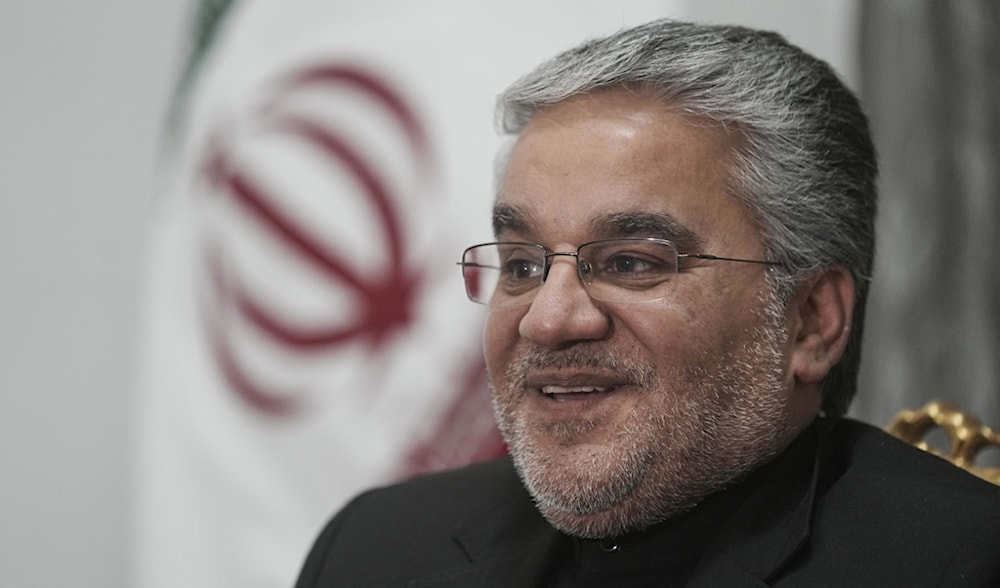
Mojtaba Ferdousi Pour, Head of the Office for the Protection of the Interests of Iran in Cairo, speaks during an interview with Associated Press at the Iranian embassy in Cairo, Thursday, March 5, 2026 (AP Photo/Amr Nabil)
Mojtaba Ferdowsi Pour, Head of the Office for the Protection of the Interests of the Islamic Republic of Iran in Cairo, said in an exclusive interview with Al Mayadeen that the United States and "Israel" have failed to develop any coherent strategy in their ongoing aggression against Iran, warning that Washington is losing both economic and military control of the war.
Ferdowsi Pour said Washington and Tel Aviv have abandoned their initial "rapid war" strategy, pivoting instead to attempts to reopen the Strait of Hormuz and locate downed American pilots following the destruction of two US fighter jets by Iranian air defenses.
He described the shift as emblematic of a broader strategic failure, saying the two sides are "changing their strategy every two days."
"Washington is facing an economic crisis and is losing control of the war," he said, adding that the pace of strategic reversals reflects the absence of a sustainable long-term plan.
'Israel' stretched across multiple fronts
Ferdowsi Pour said "Israel's" Iron Dome air defense system is being depleted under sustained missile fire, and that the Israeli military has lost its ability to effectively manage simultaneous fronts stretching from Iran and Yemen to Lebanon.
He also noted that Israeli settlers are lining up daily at border crossings with Jordan and Egypt in attempts to flee the occupied territories, a sign, he stressed, of deepening internal pressure on the occupation.
He further warned that attempts are underway to draw Gulf states into the confrontation through strikes on civilian targets, while Tehran has denied responsibility for such incidents and affirmed that it maintains open lines of communication with neighboring countries.
Iran's military capabilities far from exhausted
On Iran's military posture, the Iranian diplomat revealed that Tehran has yet to deploy its full capabilities.
He confirmed that Iran continues to produce munitions and possesses advanced missile systems, pointing to the downing of enemy aircraft and drones as evidence of sophisticated air defense technologies.
"The enemy has no control over interception," he stated.
Cairo–Tehran engagement aimed at de-escalation
Ferdowsi Pour also addressed ongoing diplomatic engagement between Iran and Egypt, describing Cairo's role as "positive and constructive" and saying its foreign policy is oriented toward reducing regional tensions. He confirmed that contacts and diplomatic message exchanges are actively taking place between the two capitals.
Beyond bilateral engagement, he announced that efforts are underway to activate a broader regional role involving Turkey and Pakistan in bringing the war to an end.
Ferdowsi Pour praised Egypt's overall stance, drawing a historical parallel: "The current aggression against Iran resembles what occurred during the October War," he said, adding that the Egyptian people stand on the side of justice.
A war without a roadmap
The US-Israeli war on Iran has drawn mounting criticism for its lack of defined objectives and an increasingly elusive path to any form of US success.
Maryland Governor Wes Moore warned on Friday that the United States is "lurching into another forever war," comparing the war to the Afghanistan war and noting that the Trump administration has yet to articulate what success would look like.
A New York Times report similarly detailed how the war's stated goals, preventing Iran from acquiring nuclear weapons, pursuing regime change, and reopening the Strait of Hormuz, remain far from being achieved.
Trump and senior officials have privately acknowledged that reopening the strait, through which roughly 20% of global oil supplies flow, may not be possible within the president's self-imposed four-to-six-week deadline.
Meanwhile, US intelligence has conceded that Iran can restore bombed military facilities within hours, maintains large missile stockpiles and mobile launch platforms, and still retains roughly half of its launch sites despite sustained strikes.


