
Iranian military, Resistance factions voice support for Sayyed Mojtaba
 6 Min Read
Iran's IRGC and military forces pledge loyalty to Sayyed Mojtaba Khamenei, while Lebanese and Iraqi Resistance factions hailed his election as Leader.
-
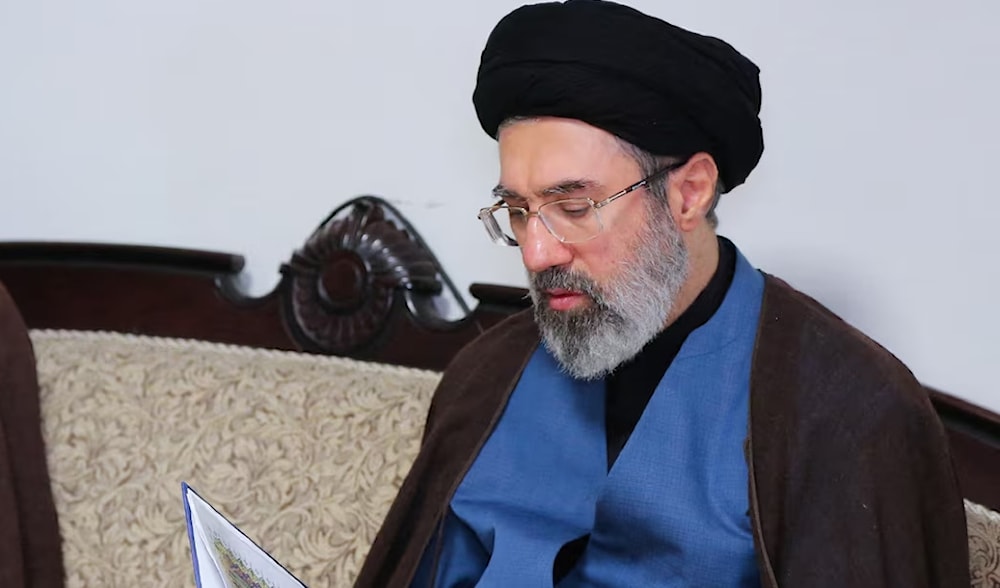
Sayyed Mojtaba Khamenei, the second son of Iran's Leader, Sayyed Ali Khamenei, visits Hezbollah's office in Tehran, Iran, October 1, 2024. (WANA)
Iran’s top military and security bodies have publicly pledged unwavering loyalty following the election of Sayyed Mojtaba Khamenei as the third Leader of the Revolution.
The Iranian Defense Council, in a congratulatory statement, affirmed its commitment to protect the revolution and obey the third Leader of the Revolution and the Islamic Republic "until the last drop of blood."
The IRGC's Quds Force similarly said in a statement, "Our fighters will remain steadfast on the transboundary front of truth."
In a separate statement, the IRGC's Ground Forces congratulated Sayyed Mojtaba Khamenei on his election as the third Leader of the Revolution and the Islamic Republic, emphasizing that its forces are today more determined, capable, and steadfast than ever before.
The statement further declared: "We affirm that we will continue under the guidance and orders of the Commander-in-Chief of the Armed Forces in protecting the revolution, defending Iran's sovereignty, independence, and power, and confronting the enemies’ plots."
Separately, Sheikh Alireza Arafi, the head of Iran’s seminary system, sent a congratulatory message, “Ayatollah Haj Sayyed Mojtaba Khamenei… I extend my congratulations on your election by the esteemed Assembly of Experts for Leadership,” he said in a statement, while again offering condolences over the martyrdom of his father.
Arafi added that “the noble Iranian nation will undoubtedly be at the forefront in pledging allegiance and obedience to the Guardian Jurist,” with seminaries and academic elites supporting the leadership.
Hezbollah vows Revolution will prevail
Hezbollah has congratulated Iran's leadership and people on the election of Sayyed Mojtaba Khamenei as the Islamic Republic's third Leader, issuing a statement that doubles as a defiant message to Washington and Tel Aviv that the ongoing war has failed to break the Islamic Revolution.
The Lebanese Resistance hailed the Assembly of Experts for moving swiftly to elect a new Leader despite the criminal US-Israeli aggression, noting that the assembly itself had been targeted in an attempt to disrupt the succession process. "The election of Sayyed Mojtaba Khamenei has instead left the enemies disappointed and confused," the statement read.
Hezbollah paid tribute to the late Sayyed Ali Khamenei, describing him as "the master of the martyrs among the nation's leaders" whose decades of leadership had safeguarded the Revolution's path.
Pledge of continuity
The movement renewed its pledge of allegiance to the new Leader, vowing steadfast commitment to the path of guardianship (wilaya) and expressing confidence that Iran would emerge from the current aggression "victorious and stronger, more resilient, and more powerful."
"No size of American and Israeli power will be able to break the will of this proud people," the statement said.
Iraqi factions welcome election of Sayyed Mojtaba
Iraqi political and armed groups also welcomed Sayyed Khamenei's election, describing him as an "extension of the Islamic Revolution’s path."
In a statement, the Badr Organization said the election represents a "blessed continuation of the Islamic Revolution’s journey."
The Secretary-General of Asa’ib Ahl al-Haq, Qais al-Khazali, said his election is "a reinforcement of the Islamic Republic’s position."
Kata’ib Hezbollah in Iraq also praised the appointment, describing Sayyed Khamenei as "the best successor to the best predecessor," the same phrasing used by Abu Alaa al-Wala’i, Secretary-General of Kata’ib Sayyed al-Shuhada.
Additionally, the head of the Hikma Movement, Sayyed Ammar al-Hakim, welcomed the election, saying: "We ask God Almighty to grant him success in continuing the path of his martyred father."
Council of Experts elects Sayyed Mojtaba as leader of Iran
On March 8, Iran’s Assembly of Experts announced the election of Sayyed Mojtaba Hosseini Khamenei as the third leader of the Islamic Republic, following the martyrdom of Sayyed Ali Khamenei.
The Assembly said it continued its work despite wartime conditions and direct attacks. According to the statement, the Secretariat offices of the Assembly of Experts were bombed, resulting in the martyrdom of several employees. “The council did not pause for even a moment in the process of selecting and presenting a new leader for the Islamic system,” it said.
The body explained that it convened an extraordinary session in accordance with constitutional procedures to prevent a leadership vacuum. “In accordance with the duties stipulated in the constitution… the necessary measures were taken to convene an extraordinary session to select the new leader,” the statement read, adding that representatives from across the country were coordinated to attend despite the war.
Following extensive deliberations, the Assembly said Sayyed Mojtaba Hosseini Khamenei was chosen by an overwhelming majority. “Out of religious duty and a sense of responsibility before Almighty God… the council announced… the selection of Sayyed Mojtaba Hosseini Khamenei… as the third leader of the Islamic Republic of Iran,” the statement said, calling on the Iranian people to pledge allegiance and preserve national unity.
Leader martyred, succession
Sayyed Ali Khamenei was martyred in a joint US-Israeli aggression on Iran on February 28.
Iranian state television reported that the leader was martyred at his workplace while carrying out his duties in his office during the early hours of Saturday, rejecting claims circulated by “outlets linked to the Israeli regime and regional reactionary currents that the leader was in a secure and undisclosed location,” and affirming that he remained present among his people while fulfilling his responsibilities.
Following his martyrdom, an interim leadership council was formed in accordance with Article 111 of the Iranian Constitution to assume the responsibilities of the Leader until a successor was selected.
The council consisted of Iranian President Masoud Pezeshkian, Judiciary Chief Gholamhossein Mohseni Ejei, and Sheikh Alireza Arafi, a jurist from the Guardian Council elected by the Expediency Discernment Council.
The position of Leader, also known as the Jurist Guardian (Vali-e Faqih), represents the highest authority in Iran’s political and religious system. Rooted in the doctrine of Jurist Guardianship (Velayat-e Faqih), the role grants its holder supreme authority over the executive, legislative, and judicial branches while shaping the country’s domestic policies, national institutions, and broader strategic direction.


