
IRGC adviser: Iran learned how to confront US in latest war
 6 Min Read
IRGC adviser Brigadier General Mohammad Reza Naqdi said Iran emerged from the latest war with greater knowledge of how to confront the United States, arguing that the conflict exposed weaknesses in US military power and reinforced Iran’s resolve.
-
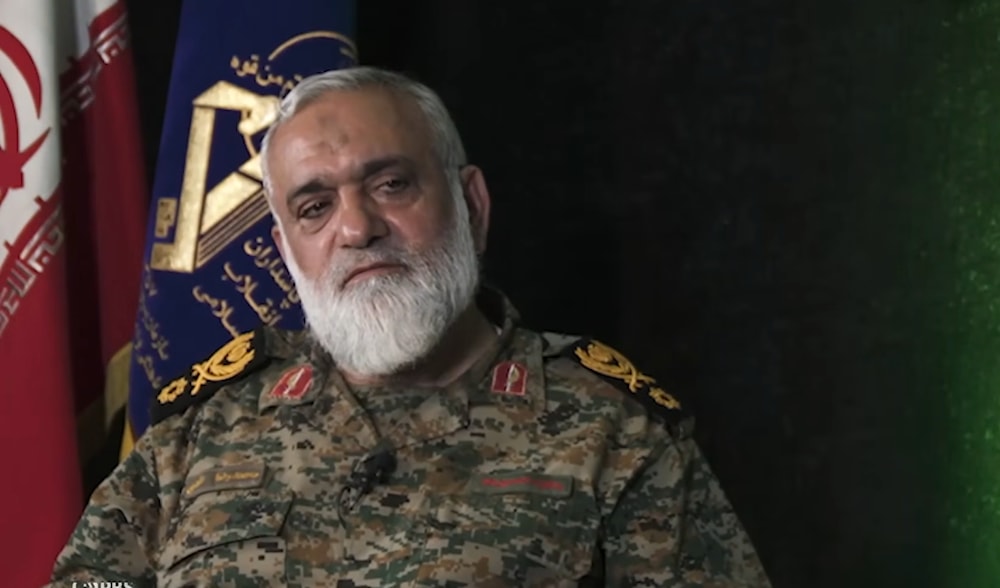
IRGC adviser Brigadier General Mohammad Reza Naqdi speaks during an interview with US broadcaster PBS. (Screenshot/PBS)
Iran has gained direct battlefield experience in confronting the United States during the five-month war and has concluded that the US military is weaker than Tehran previously believed, Brigadier General Mohammad Reza Naqdi, an adviser to the commander of Iran’s Islamic Revolution Guard Corps (IRGC), told PBS.
In an extensive interview with the US broadcaster, Naqdi said Iran considers itself to have prevailed so far after Washington failed to achieve its two principal objectives: removing Iran’s leadership and fragmenting the country.
“Certainly, victory is on our side. After the defeat of America's two main objectives, the toppling of the leadership and the breaking up of Iran. We saw confusion and bewilderment in America,” Naqdi said.
He argued that Washington subsequently struggled to maintain a coherent strategy, repeatedly changing its stated military objectives.
“It became a war without a strategy. Every 2 or 3 days, they announced a new objective,” he said, citing US threats concerning Kharg Island and the Strait of Hormuz.
Naqdi stopped short of saying the war had reached its conclusion, however.
“No, we have not yet reached our final objective. This is clear. Up until now we are victorious. In the future, we will continue to be victorious.”
Five months of war gave Iran direct experience
One of the most significant outcomes of the conflict, according to Naqdi, has been the experience Iran accumulated in directly confronting US forces.
“The longer this war lasts, the more experience we gain. We had never seen a real war to gain real experience, to learn how to fight with America,” he said.
“In these 5 months we have learned how. We have also seen how the American military is weaker than what we perceived.”
Asked whether Tehran intended to prolong the conflict until US President Donald Trump leaves office, Naqdi said Iran’s broader objective was to establish sufficient deterrence to prevent future attacks.
“Look, we have to attain deterrence so that the enemy never dares to attack us, so we can live with security,” he said.
He added that attrition could form part of that strategy.
“One way is to prolong this war until we get to the next term of the presidency and cause attrition, so that if anyone else wants to attack Iran, they will know there is a cost.”
Naqdi says Iran producing more missiles than it launches
Naqdi also rejected suggestions that Iran’s ability to continue fighting depended exclusively on its missile and drone arsenal.
“First of all, we are not reliant on missiles and drones. If we are victorious, we relied on our faith to be victorious. God is with us,” he said.
He nevertheless claimed that Iran’s missile production was keeping ahead of battlefield expenditure.
“The number of missiles we manufacture every day is more than the number we launch in a country this vast, we can make them wherever we want.”
Asked where the missiles were being produced, Naqdi declined to provide specific locations but said Iran had multiple secure methods of manufacturing them.
“Rest assured, even if this war lasts for years, until the last day, Iran's rockets will be launched.”
Naqdi argued that Iran’s capacity to threaten US interests would remain even in a scenario in which its missile stocks were exhausted.
“If there comes a day when Iran has no more missiles left. That's when we will be even more dangerous for America.”
Asked how Iran could become more dangerous without missiles, he replied: “Because America has thousands of economic interests throughout the world, and all of them can be easily destroyed.”
Calls for investigation into Trump wartime finances
The IRGC adviser also sharply attacked US Secretary of War Pete Hegseth when asked to place himself in the American official’s position and assess Washington’s next moves.
“I will never put myself in his place. He is a criminal who killed 168 innocent children,” Naqdi said.
He accused senior US officials of manipulating wartime developments for financial gain and called on Congress to investigate Trump and those around him.
“If I was in the place of the American Congress, I would call for an investigative committee to compare the assets of Mr. Trump, his family, and his inner circle before the war to their assets after the war.”
Iran rejects need for nuclear bomb
Naqdi also addressed the possibility of Washington using a nuclear weapon against Iran, warning that such an action would trigger severe consequences for US forces globally.
“The morning after they use a bomb, all of America's military bases around the world would be occupied. Today things are different than World War II. The people of the world have awakened,” he said.
Asked whether the war had prompted discussions inside Iran or the IRGC about developing a nuclear weapon as a deterrent, Naqdi rejected the premise.
“I will say this clearly. Our nuclear bomb is the hearts of the people of the world that we won fighting oppression.”
“Islamic values and the divine values of the Islamic Revolution are taking over the world. There is no need for nuclear bombs. There is no need for slaughter.”
On Palestine, Naqdi said Iran’s position was based on allowing the people connected to the land to determine its political future through a majority vote.
“This will certainly not be done with a nuclear bomb, but we certainly prefer the Zionist regime did not exist,” he said, comparing its future to that of apartheid-era South Africa.
Naqdi also addressed the slogan “Death to America,” saying it was directed at Washington’s political leadership rather than the American population.
“Look, we have no enmity with the people of America,” he said. “The meaning of death to America means death to America's leadership, a leadership that has invaded or violated more than 70 countries since becoming a superpower.”
Read more: Iran’s Araghchi: Our nuclear bomb is resilience, not weapons


