
IRGC details wave 100, strikes 25 strategic US-Israeli-linked targets
 5 Min Read
Iran’s IRGC announces 100th wave of Operation True Promise 4, carried out prior to the ceasefire, targeting US-linked oil facilities across the Gulf and sites in "Israel".
-
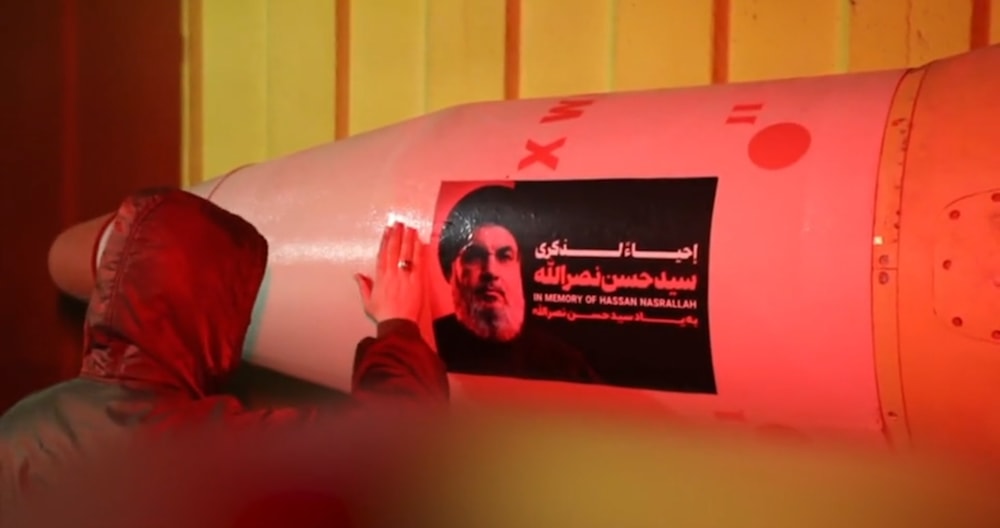
An Islamic Revolution Guard Corps member places his hand on a missile with a picture of Sayyed Hassan Nasrallah on it. Text reads: In memory of Sayyed Hassan Nasrallah, April 8, 2026 (IRGC Public Relations)
Iran’s Islamic Revolution Guard Corps (IRGC) announced that it launched the 100th wave of Operation True Promise 4 late last night, using a combination of ballistic missiles, cruise missiles, and unmanned aerial vehicles (UAVs).
The IRGC stated that this wave struck more than 25 strategic enemy targets, including 13 energy complexes and oil transport lines linked to the United States and the Israeli entity, as well as 10 military, security, and logistical targets and several technological targets and enemy infrastructure.
According to the IRGC, the large-scale operation targeted a wide range of energy infrastructure, military installations, and strategic facilities across the region.
Among the targets were multiple oil and gas facilities linked to US companies in Saudi Arabia, including sites associated with Chevron in Ras al-Juaymah, as well as petrochemical installations belonging to ExxonMobil and Dow Chemical in al-Jubail. Additional strikes reportedly hit oil infrastructure in Yanbu along the Red Sea coast.
The IRGC also reported strikes on energy facilities in other Gulf states, including oil installations in Habshan in the United Arab Emirates, part of a pipeline network transporting crude oil from Dubai to al-Fujairah, as well as key ExxonMobil-linked facilities in Ras Laffan, Qatar. Oil facilities in Bahrain, including those tied to Bapco, and the Das Island refinery in the UAE, were also listed among the targets.
Further strikes were reported on oil storage facilities in al-Fujairah, Kuwait’s Al-Ahmadi refinery, and the Dolphin Gas Project in Qatar. The IRGC added that it targeted the Zirkuh oil island and additional refining infrastructure, including the SATORP refinery and the Manifa oil field processing facilities.
Beyond energy targets, the IRGC said the operation extended to Israeli-linked sites, including technology and intelligence centers in Bir al-Sabe', as well as intelligence and surveillance hubs in the Azrieli and Almas towers in Tel Aviv. Ben Gurion Airport and the Haifa oil refinery were targeted, in addition to the government complex in the capital that houses command and control centers.
IRGC-N carries out operations, asserts control over Strait of Hormuz
In parallel, the IRGC Navy announced operations while maintaining control over maritime routes in the Strait of Hormuz.
According to the IRGC, naval forces targeted an amphibious assault ship (LHA-7) with cruise missiles, causing damage and a fire on deck and forcing it to withdraw deeper into the Indian Ocean. The aircraft carrier USS John C. Stennis (CVN-74) was also struck by multiple drones, sustaining structural damage before retreating.
Additional targets included a drone manufacturing facility linked to "Israel" in the UAE, oil installations operated by US companies in Kuwait, and the US Ali Al-Salem Air Base in Kuwait.
IRGC carries out 99th wave of Operation True Promise 4
Earlier on April 7, Iran's Islamic Revolution Guard Corps announced the launch of wave 99 of Operation True Promise 4, targeting US and Israeli assets across the region.
In its statement, the IRGC Public Relations stated that its forces carried out the 99th wave of Operation True Promise 4, in response to "the enemy's crimes in the attack on the Asaluyeh petrochemical plants and part of its facilities."
According to the statement, the IRGC Navy and the IRGC Aerospace Force launched a joint operation at dawn, utilizing ballistic missiles, cruise missiles, and one-way attack drones, and the operation was dedicated to “the martyrs of the Jewish and Christian communities of the imposed wars.”
The statement added that during the initial phase of the operation, missile and drone strikes targeted major petrochemical facilities in Saudi Arabia’s al-Jubail and al-Juaymah areas.
The facilities hit are partially owned or operated by American companies, including Chevron Phillips, ExxonMobil, Dow Chemical Company, and SADARA Chemical Company, the latter being a joint venture between Aramco and Dow.
Additionally, the IRGC reported that a container ship associated with "Israel" was struck near the UAE port of Khor Fakkan while transporting military equipment intended for Israeli use along an overland route designed to bypass the Strait of Hormuz.
The Revolution Guard stated that this wave was carried out as a tribute to the nation's leader, the late Sayyed Ali Khamenei.
Message to the Iranian People
The IRGC addressed a message to the Iranian people, saying: “Your sincere and remarkable presence for forty days and nights in the streets of the Islamic homeland, Iran, has created an unprecedented historic epic, coming out with a unique pride in the history of this ancient land and the contemporary world.”
It added, “Through your dedication, struggle, sacrifices, insight, and profound understanding, alongside your unity, loyalty, and devotion to the leadership, you presented a complete and exemplary image.”
The message continued, stating that the IRGC and Basij fighters responded to “the enemy’s audacity the previous day, fulfilling their duty to the fullest extent.”


