
Irish MPs push gov. to act on pro-Palestine activist case in Germany
 6 Min Read
Irish politicians have urged Prime Minister Micheál Martin to send observers to Germany’s Ulm 5 trial, citing concerns over the prison conditions and legal rights of Irish activist Daniel Tatlow-Devally.
-
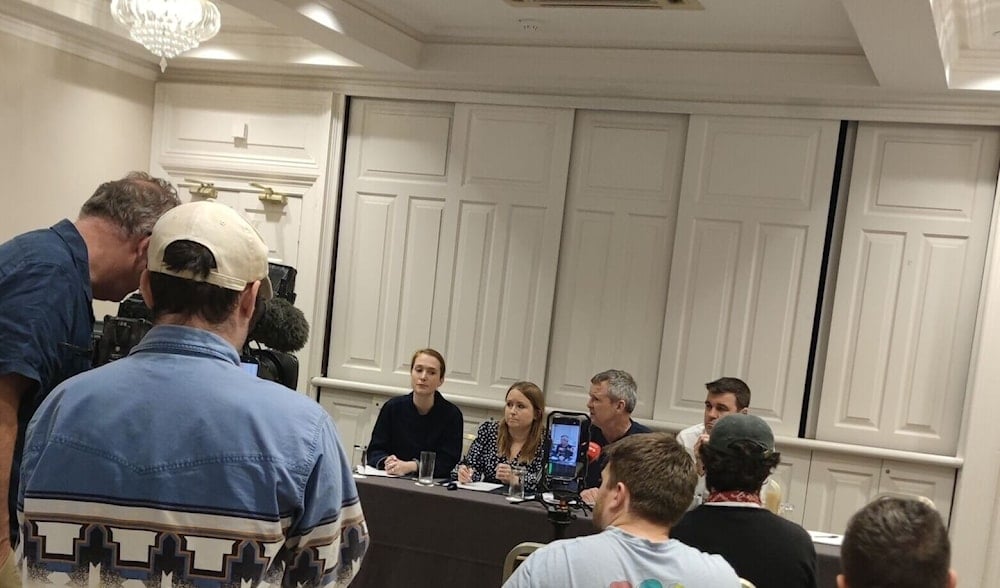
Witnesses of the Ulm 5 trial in Germany speak out, as Irish citizen Daniel Tatlow-Devally is subject to a show trial for taking action for Palestine on July 23, 2026 (X/ @paulmurphy_TD)
A cross-party group of Irish politicians has called on Dublin to send observers to the high-security trial of pro-Palestine activists in Germany and to raise concerns over the detention conditions of the Irish defendant when the German chancellor visits next week, The Guardian reported.
Mairéad Farrell of Sinn Féin, one of seven members of the delegation, said she and her colleagues attended Wednesday’s hearing in Stuttgart involving the Ulm 5 activists, who are facing charges linked to an alleged attack on an Israeli arms company.
Farrell and two other members of the delegation also visited Daniel Tatlow-Devally, the Irish defendant being tried as part of the group, in prison. She said she was deeply concerned by the conditions of his detention.
“I was quite shocked by the treatment that he is receiving. He is 23 hours a day in his cell,” Farrell said, urging Irish prime minister Micheál Martin to discuss the matter with German chancellor Friedrich Merz during his visit on Tuesday.
Irish politician raises concerns over prison conditions
Farrell said Tatlow-Devally’s cell was believed to measure 5x2 metres and that he had limited access to activities outside his cell.
“His cell, from what I understand, is 5x2 metres. He doesn’t have much in his cell, so he’s stuck there for 23 hours a day. He only has an hour of visitation per month, which is obviously incredibly short," Farrell added.
“It just seems that there’s very harsh conditions that seem unwarranted for the scale of the fact that these people haven’t harmed people,” Farrell stressed.
German prosecutors allege that Tatlow-Devally was among five activists who entered a site belonging to "Israel’s" Elbit Systems in the southern city of Ulm last September. Authorities say the group shouted pro-Palestine slogans "while damaging equipment and smashing windows, causing an estimated €1m (£850,000) in damage."
The activists later uploaded videos online claiming responsibility for the action, saying it was intended to highlight Germany’s support for "Israel" and its genocide in Gaza. Germany is the second-largest supplier of arms to "Israel" after the US.
Defendants say action driven by humanitarian concerns
Throughout the proceedings, the defendants have maintained their position. In May, Tatlow-Devally told the court that the group had been motivated by “urgent humanitarian concerns” and aimed to “make a fuss … in the hope to at least interrupt” Elbit’s deliveries to "Israel".
The case follows last month’s sentencing of four Palestine Action activists in Britain, after a judge imposed lengthy prison terms on activists who damaged drones and other equipment at an Elbit Systems UK factory. The judge ruled there was a “terrorist connection” to their actions.
Delegation criticizes restrictions during trial
Farrell said German authorities had prevented the Irish delegation from discussing the case with Tatlow-Devally during their visit.
“That felt, I suppose, quite unusual for us,” she said.
The politicians also raised concerns about the way the trial is being conducted. Farrell said the defendants were “basically in a glass cage or behind a glass wall, unable to communicate with their lawyers in … a kind of free manner."
“One of the accused said that they felt that they couldn’t really participate fully in the trial … because of these barriers that have been put in place,” she stressed.
Defense lawyers, representing Berlin-based activists who hold British, Irish, German, and Spanish citizenship, have repeatedly challenged the use of the glass barrier, arguing that it limits their clients’ ability to communicate effectively with their legal teams.
Activists face criminal organisation charges
The five defendants have been charged with trespassing, property destruction, and membership of a criminal organization, Palestine Action Germany, under section 129 of the German criminal code.
The charge allows authorities to classify the defendants as a threat to society and deny bail, including after the six-month limit for pre-trial detention had expired. If convicted, they face sentences of up to five years in prison.
Court representatives have said the detention conditions are justified due to the seriousness of the charges.
Before proceedings began in April, Stuttgart’s higher regional court ordered that all defendants remain in pre-trial detention, citing “a risk of flight, which would not be sufficiently mitigated even by the posting of bail."
Irish government urged to monitor proceedings
Farrell said it was “absolutely crucial” for the Irish government to send representatives to regularly observe hearings until a verdict is reached.
“That was something that couldn’t have been clearer coming out of that trial yesterday: that there is a need for observers,” she said.
She called on Martin to raise the Ulm 5 case during talks with Merz, whose visit will focus on Dublin’s six-month presidency of the EU, which began on July 1.
Farrell said the Irish prime minister should address concerns raised by Tatlow-Devally, his family, and the delegation regarding his prison treatment and “his access in terms of legal representation as part of the trial”.
Delegation plans further monitoring of case
The delegation included MPs Richard Boyd Barrett and Ruth Coppinger of the People Before Profit-Solidarity party, Barry Ward of Fine Gael and Duncan Smith of Labour, as well as senator Patricia Stephenson of the Social Democrats and MEP Lynn Boylan of Sinn Féin.
Farrell said the group planned to return to Germany before the conclusion of the trial, which is expected around January.
“This isn’t the end for us. We will be keeping an eye on this trial,” she stressed.


