
Is a US ground invasion of Iran imminent? Analysts weigh in
 11 Min Read
Analysts question whether the expanding US bombing campaign is preparing the ground for a limited incursion into southern Iran, citing strikes on key infrastructure and military targets.
-
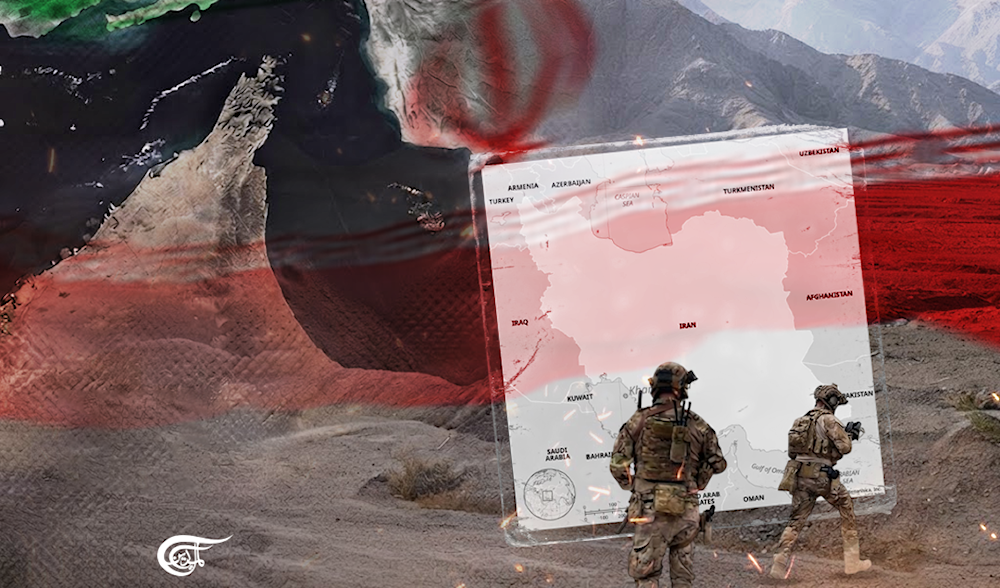
As the US escalates its aggression on Iran, speculation grows over a potential ground invasion in the country's south (Illustrated by Batoul Chamas for Al Mayadeen English)
More than 50,000 US troops are now deployed across West Asia, US Central Command said on Sunday, describing the force as "highly vigilant, focused, lethal, and ready."
The announcement comes more than a month after Tehran and Washington signed a memorandum on June 18 intended to end the US war on Iran, which began on February 28; yet, the pause was short-lived. The US resumed attacks on Iran on July 8, Tehran retaliated against US bases across the region, and President Donald Trump declared the ceasefire over the following day.
Since then, the US campaign has expanded beyond air defenses, coastal radar systems, anti-ship weapons, and Islamic Revolution Guard Corps naval assets. Recent attacks have targeted bridges, railway links, ports, airports, roads, and armored divisions across southern Iran.
The shift has led analysts to consider whether Washington is pursuing more than the reopening of the Strait of Hormuz. While the forces currently deployed remain far below what a full invasion and occupation would require, the targets being bombed could support preparations for a more limited ground operation along Iran’s southern coast or against its islands.
What the strikes are actually hitting
Attacks across the ninth consecutive night of the campaign, and in the days before it, have moved beyond the maritime suppression targets that defined the war's first waves. On July 16 and 17, US strikes hit three bridges, a road tunnel, and the train station in Bandar Khamir, in the Hormozgan province, a strike pattern read by observers as an effort to sever Bandar Abbas, Iran's main port, from inland routes toward central Iran and Tehran.
The bridge that was targeted by the US was a major road connecting Bandar Abbas to Larestan, and from there to Shiraz.
— Arya Yadegaar (@AryJeayBackup) July 17, 2026
Though the bridge will be repaired within a few days. https://t.co/B4H6Eumalk pic.twitter.com/SdLYvQ8a9F
Chabahar's maritime control tower was struck and later confirmed damaged in satellite imagery. A port building at Sarkhur Tahruyi, also in Hormozgan, was hit. Iranshahr airport was reportedly struck as well. Strikes also hit positions of Iran's 88th Armored Division in Sistan and Baluchestan and the 92nd Armored Division in Khuzestan, degrading forces stationed along Iran's principal southern axes.
The July 7 and July 8 waves were framed almost entirely around air defense, coastal radar, anti-ship capabilities, and IRGC naval assets, the classic target set of a campaign aimed at contesting the Strait of Hormuz. By mid-July, the target set had visibly expanded to transport nodes, ports, and armored divisions, the kind of infrastructure and force degradation that precedes a ground deployment rather than sustains a purely maritime one.
The economic weight of the provinces under fire
Writer and political analyst Saeed Shaverdi, speaking to Al Mayadeen, argues that the attacks are not only degrading military capacity but deliberately targeting the Iranian economy.
He points to four southern provinces bearing the brunt of the campaign: Khuzestan, a key oil and gas-producing province; Bushehr, including the Assaluyeh area; Hormozgan; and Sistan and Baluchestan. These provinces, Shaverdi notes, are home to Iran's most important and largest ports, through which the country exports both oil and non-oil goods and imports the commodities it needs from abroad.
By his account, these four provinces have been under sustained attack for roughly ten days, with strikes spilling over into other provinces, including Yazd. He reads this as evidence that Washington concluded that a naval blockade alone was insufficient, since Iran could route around it, and has shifted instead toward severing these provinces' links to the rest of the country entirely.
Analysts see two tracks, possibly converging
Lebanese journalist and analyst Ali Fneish, in an interview for Al Mayadeen, argues that two explanations for the US campaign are now circulating and that the evidence increasingly suggests Washington may be pursuing both simultaneously.
The first and officially declared objective is pressuring Iran to relinquish its control over navigation through the Strait of Hormuz. The second is that the strikes are laying the groundwork for a ground offensive in southern Iran and the possible occupation of Iranian islands. Fneish notes that a ground scenario is no longer theoretical from Iran's side either and is a possibility several Iranian officials have publicly addressed.
Hamidreza Azizi, an Iran security policy expert, echoed a similar sentiment in a social media post, arguing that Washington may now see control of Iran's southern coastal belt as the only durable solution to the Hormuz problem, a more ambitious goal than earlier ideas centered on seizing individual islands.
He pointed to the same infrastructure pattern - bridges, railway links, and airports disrupted, fuel tankers struck at Bandar Abbas, and the armored division strikes - as evidence of a campaign designed to smooth the path toward an eventual ground deployment.
Is the United States Preparing for a Ground Invasion of #Iran?
— Hamidreza Azizi (@HamidRezaAz) July 16, 2026
🔹The escalating pattern of U.S. strikes against southern Iran in recent days – particularly over the past several hours – may point to a gradual strategy aimed at preparing the ground for a potential deployment of…
A ceasefire as cover for invasion prep
International affairs expert Mostafa Khoshcheshm, speaking to Al Mayadeen, argues that any pause in the fighting may itself be part of the preparation for a ground invasion.
He says the US will seek a temporary ceasefire with Iran specifically to prepare for a ground invasion and that Trump remains committed to a ground and naval attack because the two previous rounds of war failed to produce results.
Trump hints at a ground invasion of Iran:
— FactPost (@factpostnews) July 14, 2026
"Sometimes you need a ground campaign" pic.twitter.com/CXL4H5OHPm
Khoshcheshm points to the buildup in Kuwait as evidence the preparations are already underway, saying it appears the Americans are staging there for a ground and naval assault. He adds that Gulf Arab states have become more deeply involved in supporting the United States, a shift that helps explain why that staging is happening on their territory.
Iran, he says, will not risk its national security, and the United States must leave the region.
Iran moves to disrupt invasion preparations
On his part, retired Brigadier General Ali Abi Raad, speaking to Al Mayadeen, argues that Iran is already acting on the assumption that a ground phase is being prepared and is trying to nip it in the bud.
He says Iranian forces are deliberately targeting concentrations of US troops that could play a role in any ground operation or incursion. Iranian strikes on Camp Buehring in Kuwait, in this reading, were not just retaliatory but severed logistical links between US forces in the Gulf and Iraq.
He adds that US stockpiles of Patriot and Iron Dome interceptors have thinned to the point that Iranian missiles are reaching their targets without interception. The strike on the port of Fujairah, converted into a refueling base for US naval vessels, points to the same pressure on logistics.
And despite Trump's claims that Iran's capabilities have been destroyed, Abi Raad says, Tehran continues to control the Strait of Hormuz, undercutting the premise that the air campaign alone has already achieved its aims.
Doubts about whether an invasion could succeed
Shaverdi does not rule out that these attacks are laying the groundwork for a ground offensive, but he is skeptical of its prospects. Such an operation, he says, would not be easy, and the United States would face major difficulties; the chances of it succeeding are, in his words, very slim.
He also offers a sharper read of Iran's response than a purely defensive posture. Iran, he says, has moved to target the operational depth of the US military presence in the region. The IRGC Aerospace Force is striking that depth with "unprecedented intensity", using both ballistic missiles and drones, while Iran's regular army has been running similar operations, relying more on drones than missiles to hit locations where US soldiers and forces are concentrated.
Meanwhile, Margaret Kimberley, executive editor and senior columnist at Black Agenda Report, told Al Mayadeen that Washington continues to misjudge Iran. Washington has already failed to overthrow the Iranian government, she said, and deploying ground troops would not succeed either.
The numbers behind an invasion
If a ground option is being prepared, the scale required is difficult to reconcile with the force currently in place.
Defense and security experts often point to a standard counterinsurgency benchmark of 20 security personnel per 1,000 civilians against Iran's population of roughly 88 million, putting the requirement for full invasion and occupation at 1.76 million troops, more than the entire active-duty US military.
Even a limited operation confined to Iran's coast and Khuzestan was estimated to require 250,000 to 400,000 troops, five to eight times the roughly 50,000 currently deployed region-wide, most of them not ground combat forces.
Some analysts compare a potential Iran invasion to Iraq in 2003, but the comparison undercuts rather than supports confidence in a quick campaign. The US used roughly 170,000 troops to take Iraq, a country a quarter of Iran's size, with flat desert terrain, and a military already weakened by a decade of sanctions and previous wars. Iran offers none of those advantages.
Its Zagros mountains form a natural barrier along its western and southern approaches, its southern coastline alone runs 1,800 kilometers, and its population, at roughly 88 million, is more than three times Iraq's at the time of the 2003 invasion. If Iraq needed 170,000 troops, a harder target nearly four times the size would need significantly more, not less. That is the basis for the far larger troop estimates above, and why the current US deployment falls so far short of them.
Kharg Island, the limits of a smaller option
This is not the first time a narrower option has been floated instead. Azizi's post noted that current speculation already exceeds earlier ideas centered on seizing Kharg Island, Iran's primary oil export terminal, to cut off its exports, or occupying islands near the Strait to secure shipping.
Kharg itself has a track record. Iraq bombed the island repeatedly between 1984 and 1988 during the Iran-Iraq War, and Iran kept exporting oil throughout by rerouting tankers to Larak Island further south.
Any modern seizure would face the same fortified approaches, missile range from nearby Bushehr province, and the likelihood that Iran would treat any ground incursion onto its sovereign territory, even an offshore island, as a red line triggering broader retaliation.
The smaller options carry smaller force requirements and larger political risk, and neither history nor current geography suggests they resolve the standoff on their own.
Iran's response: 'We are waiting for them'
If Washington is weighing a ground option, Tehran has already answered. Iran's ambassador to Russia said on Sunday that if American troops arrive, the war would become "a manly war," adding that he was not sure the US would be able to remove the bodies of its soldiers from the region.
Iranian Ambassador to Russia:
— Global Insight Journal (@GlobalIJournal) July 18, 2026
“If American ground troops come, the situation will be better, and then our war will become a manly war.
I am not sure they will be able to remove the bodies of American soldiers from the region.” pic.twitter.com/i3fuFmbmr9
Foreign Minister Abbas Araghchi struck the same note months earlier, when asked on NBC News whether he feared a ground invasion. "No, we are waiting for them," he said, adding that Iran was confident it could confront US forces and that the result would be "a big disaster for them."
NOW - Reporter: "Are you afraid of a U.S. invasion in your country?"
— Disclose.tv (@disclosetv) March 5, 2026
Araghchi: "No, we are waiting for them."
Reporter: "You are waiting for the U.S. military to invade, the ground troops?!"
Araghchi: "Yes!" pic.twitter.com/0L0cNXLopd
Martyr Ali Larijani, former secretary of Iran's Supreme National Security Council, said Iranian forces were "waiting and ready for American troops," vowing to "disgrace" US officials "by killing and capturing thousands" if ground forces enter Iran.
Full invasion unlikely, limited incursion possible
The available evidence does not show that a US ground invasion is imminent. Washington has not deployed the number or type of forces required for a full-scale occupation, and an operation against Iran would be considerably more difficult than the 2003 invasion of Iraq.
However, the pattern of recent strikes suggests the United States may be preparing for more than just an air and naval campaign. By targeting transport links, ports, airports, armored units, and supply routes, the US could be trying to weaken Iran’s ability to move forces and supplies in the south. This would make it easier to carry out a smaller, more limited ground operation along the coast or on nearby islands.
A full invasion remains unlikely under the current deployment, but a smaller ground incursion cannot be ruled out. Iran appears to be treating that possibility seriously, targeting US troop concentrations, supply routes, and regional bases that could support such an operation.


