
Issues of war, economy, and conscription shape Israeli elections
 6 Min Read
Israeli voters head to the polls amid debates over October 7, prolonged wars, military service, religious influence, and the cost of living.
-
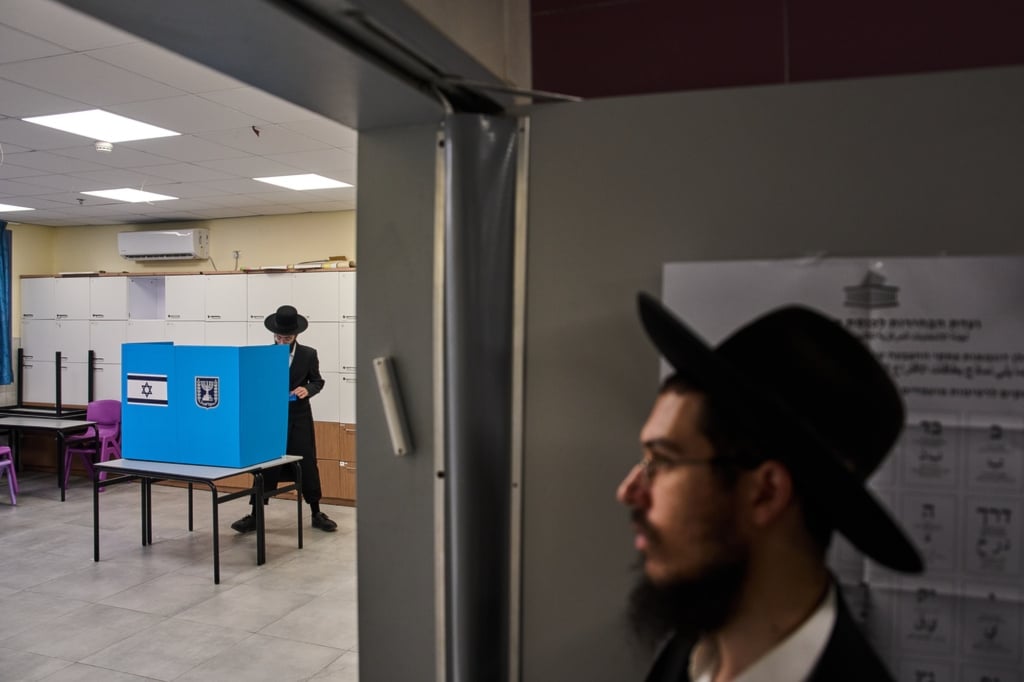
An ultra-Orthodox Jewish man casts his ballot as others wait to vote at a school serving as a polling station during "Israel's" general election in Bnei Brak, occupied Palestine, Tuesday, Oct. 27, 2026 (AP/Oded Balilty)
The Israeli elections come as the occupation continues to face the repercussions of the October 7 operation and the wars that followed, with questions over its military strategy, the role of religious parties, and the economic burden of prolonged military operations dominating the campaign.
As voters head to the polls on Tuesday, an AFP analysis highlights the primary issues driving the debate: military conscription, a surging cost of living, and growing demands for accountability following the security and political failures after October 7, 2023.
Accountability over October 7
Many Israelis have called for an independent "state commission of inquiry" into the failures that preceded and accompanied October 7, 2023.
The attack, described by Israeli media as the deadliest, caused profound trauma, with its political and security repercussions continuing to shape the electoral debate.
The Israeli occupation has previously established commissions of inquiry following major crises. Gadi Eisenkot, the former army chief and a main challenger to Prime Minister Benjamin Netanyahu, has pledged to establish such a commission, stating it as "a way to prevent the next disaster."
Netanyahu's administration, however, has rejected calls for an independent inquiry. Instead, it has blamed the security establishment for failing to prevent what happened on October 7 and proposed a bipartisan commission whose members would be appointed by politicians.
Opposition figure Yair Lapid criticized the proposed mechanism, saying its purpose "is to whitewash [those responsible] and prevent a genuine investigation," as reported by AFP.
Netanyahu has also faced mounting accusations that he ignored early warnings about Hamas' preparations for the October 7 operation. The United Arab Emirates reportedly warned him that Hamas was planning a major operation.
The prime minister has additionally faced scrutiny over his government's previous dealings with Qatar, which financially supported Hamas with Israeli approval and has long hosted the group's political leadership, according to the report.
'Israel's' future security strategy
October 7 has also prompted debate over the Israeli occupation's long-standing security doctrine, which had traditionally relied on intelligence, deterrence, and short wars.
According to AFP, that approach has increasingly given way to prolonged military operations and a multi-front military posture. The Israeli occupation army occupies areas it designates as "security zones" in Gaza, southern Lebanon, and Syria, while its forces conduct near-daily operations in the occupied West Bank.
"Israel" has also waged two wars against Iran and carried out attacks against Yemen, further intensifying debate over its ability to sustain military operations across multiple fronts.
Tens of thousands of reservists have been repeatedly mobilized since 2023, as per AFP, placing significant personal and economic pressure on the Israeli settler community. Military officials have also continued to warn of manpower shortages.
"We have gone from a logic of deterrence and prosperity between wars to a society that lives permanently by the sword," Ofer Shelah, a researcher at "Israel's" Institute for National Security Studies, said, as carried by AFP.
The prolonged military operations have also carried an international political cost, with the Israeli occupation regime facing widespread criticism, particularly over its genocide in Gaza. The Palestinian death toll in the Gaza Strip has exceeded 74,000, according to Gaza's Health Ministry.
US President Donald Trump has also publicly criticized Netanyahu over the Israeli occupation regime's conduct during its latest war against Iran. At one point, Trump launched a profanity-laced tirade after Israeli attacks on Lebanon threatened to undermine ceasefire negotiations.
Trump has since endorsed Netanyahu, telling voters on Sunday that Netanyahu "has been an outstanding Warrior Prime Minister."
Religion, identity, and military service
Manpower shortages in the Israeli occupation military have placed exemptions for ultra-Orthodox Jews at the center of a broader debate over the occupation regime's political and religious identity.
According to AFP, Ultra-Orthodox parties have sought to preserve exemptions allowing religious students to avoid military service. They are backed by Netanyahu's Likud party and, broadly, by his far-right coalition partners.
Opposition parties, meanwhile, support ending the exemptions and have said they would refuse to join a government that includes ultra-Orthodox parties.
Eisenkot, whose son was killed during the genocide of Palestinians in Gaza, has also criticized the exemptions, accusing Netanyahu's government of promoting "evasion of duty without shame."
Netanyahu has sought to balance competing pressures over the issue, as per AFP. He recently criticized the arrest of ultra-Orthodox draft dodgers while also insisting that those who are not engaged in full-time Torah study should enlist.
The dispute has triggered protests by ultra-Orthodox demonstrators and has expanded beyond the question of military service.
Days before parliament was dissolved, the governing coalition introduced measures promoting gender separation in some public spaces and passed legislation emphasizing the importance of Torah study.
Supporters argue that such measures reinforce the occupation regime's Jewish character, while critics warn that they expand religious influence over public life.
Rising cost of living
Despite strong economic growth, with GDP more than doubling since 2000 and unemployment remaining historically low, settlers continue to face one of the world's highest costs of living.
Median wages remain below the OECD average, increasing pressure on households already struggling with high living costs.
Economists have pointed to long-standing structural problems, including housing shortages, trade barriers, and limited competition in key sectors.
The wars since 2023 have added further pressure. The Israeli occupation defense budget has doubled since then, placing an increasing burden on public finances.
Netanyahu recently suggested that the occupation regime could use blockchain technology to establish an "alternative economy" capable of withstanding potential banking sanctions amid mounting international criticism, including from Washington.
The proposal drew a rare rebuke from "Israel's" central bank, according to AFP. Netanyahu's electoral rivals also criticized the idea, arguing that it amounted to an admission that his policies were producing harmful consequences for the economy.
Taken together, the issues confronting voters reflect a deeper debate over the direction of the Israeli occupation regime after October 7. These emerging questions have exposed growing strains within Israeli settler community, making the election a test not only of Netanyahu's political future but also of the policies that will shape the occupation regime's next phase.


