
Japan, US accelerate joint missile production efforts
 3 Min Read
Tokyo and Washington agreed to speed up missile development and expand military coordination in the Asia-Pacific, amid growing US-led security integration and rising regional tensions.
-
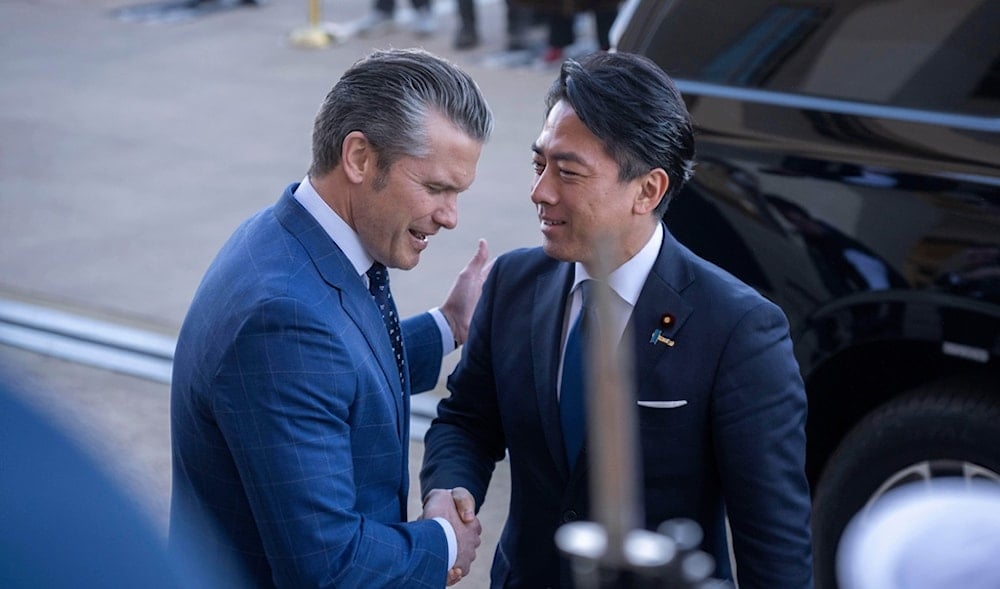
Defense Secretary Pete Hegseth, left, welcomes Japanese Defense Minister Shinjiro Koizumi to the Pentagon, Thursday, Jan. 15, 2026 in Washington (AP)
Japan and the United States have agreed to accelerate the joint development and production of advanced missile systems, deepening military cooperation as Washington expands its security architecture across the Asia-Pacific region.
The agreement was reached during talks between Japanese Defense Minister Shinjiro Koizumi and US War Secretary Pete Hegseth on the sidelines of the Shangri-La Dialogue security forum in Singapore, according to Japanese media reports.
The two sides reportedly agreed to speed up work on advanced medium-range air-to-air missiles (AMRAAM) and upgraded SM-3 Block IIA interceptor missiles, which form part of the missile defense cooperation between Tokyo and Washington.
The ministers also endorsed the temporary deployment of a US Typhon medium-range missile system in Japan and agreed to expand the dispersal of US military aircraft across facilities operated by the Japanese Self-Defense Forces.
Expanding regional military coordination
The discussions also focused on China and broader regional security developments, with both sides reaffirming their commitment to strengthening cooperation with Australia, South Korea, and the Philippines.
According to reports, Japan, the United States, and Australia plan to establish and utilize the TRISHIP information-sharing mechanism to enhance regional air defense coordination and military interoperability.
The agreements reflect ongoing efforts by Washington and its regional allies to deepen defense integration amid growing strategic competition in the Asia-Pacific.
Growing concerns over militarization
The expansion of US military deployments and missile capabilities in the region has drawn criticism from China and Russia, both of which argue that such measures contribute to rising tensions and undermine regional stability.
Beijing has repeatedly opposed the deployment of intermediate-range missile systems near its borders, warning that US-led military alliances and missile defense networks are accelerating an arms race in the Indo-Pacific.
The latest developments come as Washington continues to strengthen security partnerships across the region through frameworks such as AUKUS and trilateral cooperation arrangements involving Japan, South Korea, Australia, and the Philippines.
Singapore's annual Shangri-La Dialogue, regarded as Asia's premier defense forum, has increasingly become a platform for discussions surrounding military competition, regional security, and the future balance of power in the Indo-Pacific.
Read More: Japan arms shift draws allies amid doubts over US security role


