
Japan arms shift draws allies amid doubts over US security role
 4 Min Read
Japan moves to ease arms export restrictions, attracting global interest as US reliability is questioned and conflicts strain Western military supply chains.
-
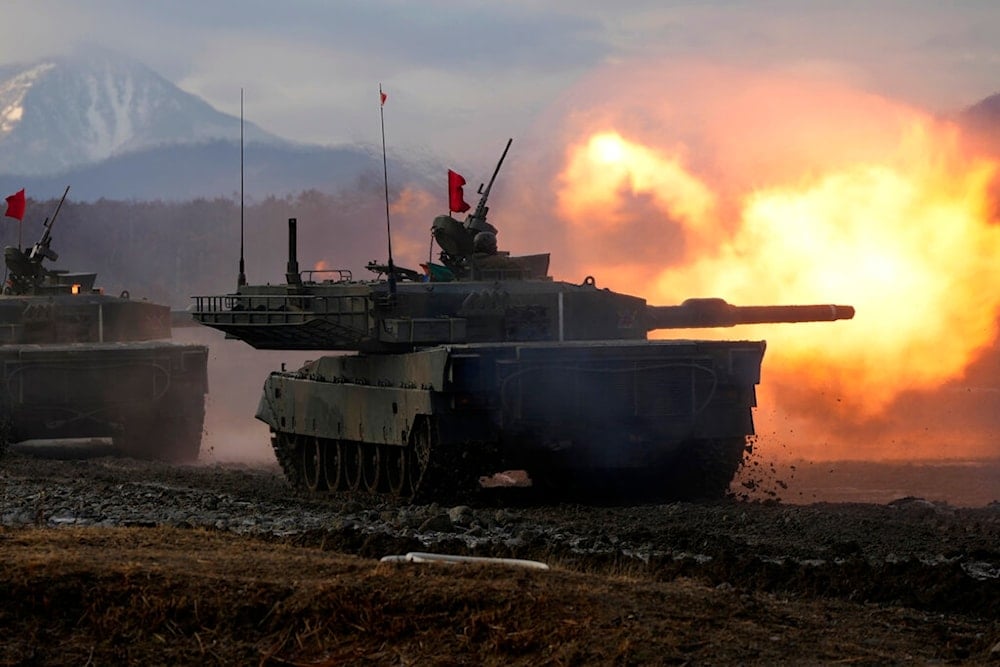
Japanese Ground-Self Defense Force (JGDDF) Type 90 tank fires its gun at a target during an annual drill exercise at the Minami Eniwa Camp in Eniwa, Japan's northern island of Hokkaido on December 7, 2021. (AP Photo/Eugene Hoshiko)
Japan is preparing to significantly ease its long-standing restrictions on weapons exports, marking a major shift in policy as global demand rises and confidence in US security commitments deteriorates, Reuters reports.
Officials told the news outlet that Japanese Prime Minister Sanae Takaichi’s government is expected to formally adopt the changes in the coming weeks, aiming to revitalize Japan’s defense industrial base and expand its role in global military supply chains.
The move represents one of the most substantial departures from Japan’s post-World War II pacifist framework, opening the door for exports of advanced military systems, including naval vessels and missile technologies.
Global demand rises amid US supply strain
Countries from Europe to Southeast Asia are already expressing interest in Japanese defense exports, according to Reuters' interviews with Japanese officials and foreign diplomats in Tokyo.
Potential buyers include Poland and the Philippines, both undergoing military modernization amid shifting regional security dynamics. One of the first anticipated deals involves the export of used Japanese frigates to the Philippine Navy, a Japanese official told Reuters, with further discussions potentially extending to missile defense systems.
The growing interest reflects mounting pressure on US weapons supply chains, which have been strained by ongoing conflicts, including the war in Ukraine and escalating tensions linked to the US-Israeli war on Iran.
At the same time, uncertainty surrounding the policies of US President Donald Trump, including threats to reshape alliances, has accelerated efforts among US allies to diversify their defense partnerships.
Strategic diversification away from US dominance
For decades, the United States has dominated global arms supply networks, maintaining an overwhelming influence over allied military procurement.
However, delays, rising costs, and strict controls over technology transfers have led to growing frustration among partner states. Japan’s policy shift is increasingly viewed as part of a broader effort to reduce reliance on US-controlled defense ecosystems.
European and Asian officials see Tokyo’s entry into the export market as an opportunity to build alternative supply chains and enhance strategic autonomy in defense procurement.
Industrial expansion and corporate repositioning
Japanese defense contractors are already adapting to the anticipated policy changes.
Major firms such as Toshiba and Mitsubishi Electric are expanding hiring, building new production facilities, and establishing dedicated export divisions to meet rising international demand.
Executives suggest that reputational concerns historically associated with arms exports are diminishing, as geopolitical realities push companies toward greater involvement in defense manufacturing.
However, tensions remain within Japan’s corporate sector, particularly among firms with strong consumer-facing brands that remain cautious about entering global arms markets.
Read more: China blocks dual-use exports to 20 Japan military-linked firms
From postwar restraint to strategic actor
Japan’s gradual shift away from strict export controls began under former Prime Minister Shinzo Abe, but implementation remained limited due to regulatory constraints and domestic hesitation.
The current policy overhaul reflects a more assertive posture, driven by both external pressures and internal strategic recalculations. Officials involved in shaping the reforms emphasize the need to build regional defense capabilities that are less dependent on Washington.
This transformation signals Japan’s broader re-emergence as an active player in global security affairs, moving beyond decades of self-imposed restraint
Japanese offensive risk
Russia warned on Monday that Japan's shift towards militarization is accelerating at a dangerous pace. This comes as Tokyo deepens its integration into US-led military structures and expands capabilities.
A senior aide to the Russian president and chairman of the Maritime Board, Nikolai Patrushev, said that Moscow sees no indication that Japan seeks to reverse what he described as an increasingly aggressive trajectory.
"On the contrary, we predict that Tokyo will continue to build up its military potential with an emphasis on offensive actions, both alone and as part of broad coalitions including NATO countries," Patrushev said in remarks to Rossiyskaya Gazeta.
China has also repeated the risk of Japan's militarization efforts. Chinese Foreign Ministry spokesperson Mao Ning stated last November that the military buildup across Japan's southwestern island chain poses a security threat and amounts to "a deliberate attempt to escalate regional tensions and provoke military conflict."
Japan's military buildup continues as the US approved the potential sale of equipment and services towards upgrading its Hyper Velocity Gliding Projectiles (HVGP) program in late March.


