
Japan, Vietnam expand energy and supply chain cooperation
 3 Min Read
Japan and Vietnam agree to deepen energy and supply chain cooperation, focusing on security, critical minerals, and regional stability.
-
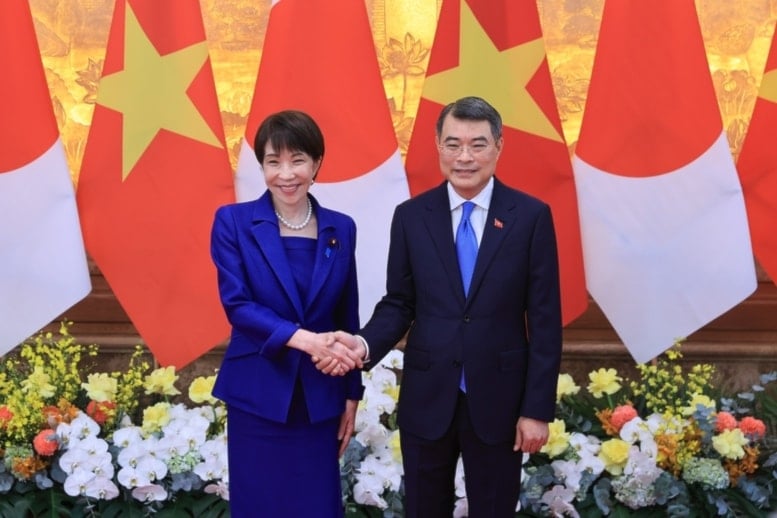
Vietnamese Prime Minister Le Minh Hung shakes hands with Japanese Prime Minister Takaichi Sanae at the Government Office, Ha Noi, May 2, 2026. (Vietnam Government Portal)
Japan and Vietnam have agreed to expand cooperation across key economic sectors, with a focus on strengthening energy security and stabilizing supply chains amid global uncertainty.
Japanese Prime Minister Sanae Takaichi announced the agreement following talks in Hanoi with her Vietnamese counterpart Le Minh Hung.
“We have agreed to deepen cooperation in such areas as energy, critical minerals, artificial intelligence, semiconductors, and space, which we consider to be new priorities for bilateral cooperation in economic security,” Takaichi said during a joint press conference.
Focus on energy security amid global instability
Energy security emerged as a central theme in the discussions, particularly in light of ongoing instability linked to the US-Israeli war on Iran.
Both sides agreed to support crude oil supplies for Vietnam’s Nghi Son refinery through financial mechanisms provided by Nippon Export and Investment Insurance (NEXI). The move aims to ensure stable energy flows while mitigating risks associated with market volatility.
The agreement reflects a shared concern over supply disruptions and price fluctuations affecting global energy markets.
Read more: Nearly 70% of Japanese want foreign policy independent of US: Poll
Expanding collaboration in advanced technologies
Beyond energy, the two countries identified several emerging sectors as priorities for deeper collaboration. These include artificial intelligence, semiconductor production, and space technologies.
Such cooperation is framed within a broader effort to enhance economic security by diversifying supply chains and reducing reliance on single sources for critical materials and technologies.
The focus on critical minerals also highlights the growing importance of securing inputs essential for high-tech industries.
Indo-Pacific strategy and regional coordination
Takaichi described stronger ties with Vietnam as an important component of Japan’s vision for a “free and open Indo-Pacific.” Both countries reaffirmed their commitment to expanding security cooperation and increasing coordination on regional issues.
The discussions also emphasized humanitarian exchanges and broader diplomatic alignment, reflecting a multi-dimensional partnership that extends beyond economic considerations.
As part of its wider regional engagement, Japan is continuing to strengthen ties with other countries in the Indo-Pacific.
Takaichi is scheduled to meet with Australian Prime Minister Anthony Albanese on May 4, where discussions are expected to focus on ensuring stable supplies of liquefied natural gas and critical minerals.
These parallel efforts indicate a broader strategy aimed at reinforcing interconnected supply networks across allied economies.
Vietnam has also sought to deepen regional ties in the region. On April 15, Vietnam's President To Lam met with Chinese President Xi Jinping to sign multiple cooperation agreements spanning trade, infrastructure, and long-term development coordination.


