
Judge orders Trump admin. to name architects of $1.8bln fund
 3 Min Read
The $1.8 billion “anti-weaponization” fund is a controversial taxpayer-funded scheme that could have benefited January 6 defendants and other alleged victims of "lawfare".
-
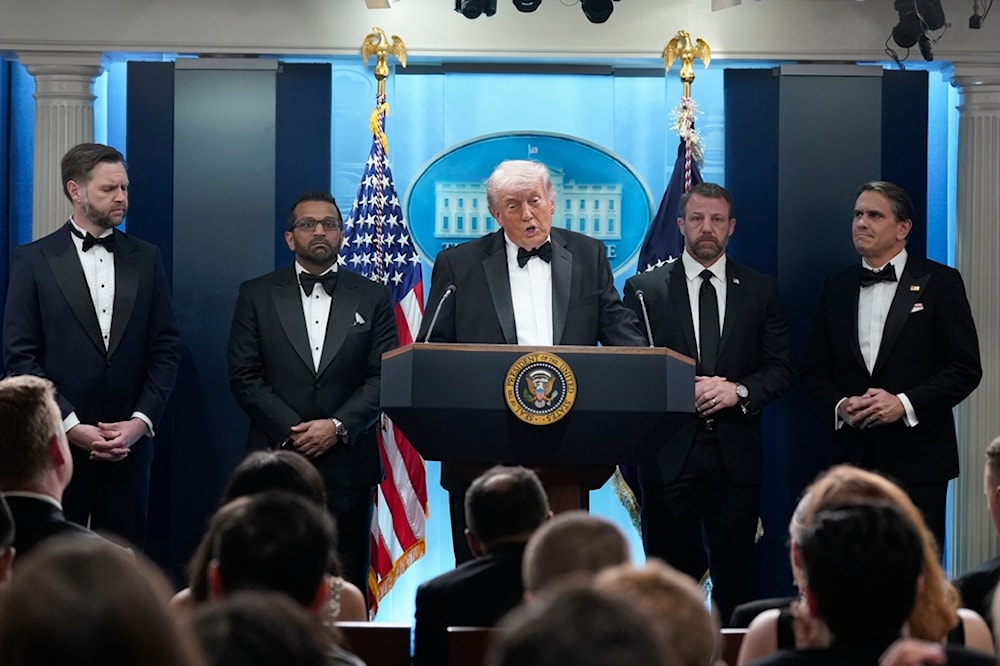
US President Donald Trump speaks in the James Brady Press Briefing Room at the White House after an unspecified threat at the annual White House Correspondents' Association Dinner in Washington, Saturday, April 25, 2026, as Vice President JD Vance, FBI director Kash Patel, Homeland Security Secretary Markwayne Mullin, and acting Attorney General Todd Blanche listen (AP)
A federal judge has ordered the Trump administration to disclose who designed a nearly $1.8 billion compensation scheme created under a settlement involving US President Donald Trump, his family, and the Internal Revenue Service.
US Magistrate Judge Ivan D. Davis of the Eastern District of Virginia granted part of a request by plaintiffs seeking additional information about the so-called “anti-weaponization fund,” according to a person present in the courtroom cited by NBC News.
The ruling requires the government to reveal the identities of those responsible for developing the structure of the fund, which Attorney General Todd Blanche has since declared defunct.
“Today’s order granting discovery is a significant step in getting to the bottom of the slush fund,” Aman George, senior counsel at Democracy Forward, which represents the plaintiffs, said. “We will continue to meet the government in court until our investigation is complete and the slush fund is permanently halted.”
The Justice Department had not immediately commented on the ruling.
Fund emerged from Trump-IRS settlement
The fund was established under an agreement between Trump, two of his sons, his company, and the IRS, with roughly $1.8 billion in federal money designated for individuals claiming they had been subjected to government “weaponization and lawfare.”
The language of the arrangement was broad enough that beneficiaries could potentially include January 6 defendants convicted of violent offenses and later pardoned by Trump. The agreement also shielded Trump and several members of his family from certain IRS audits, adding another layer of controversy to the settlement.
A federal judge temporarily halted the arrangement in May after it was challenged by a former January 6 prosecutor and a law professor who had previously been sued by the Trump administration. Career IRS employees later joined the lawsuit.
Critics have described the initiative as an attempt to channel taxpayer funds toward individuals politically aligned with the administration, while the agreement has faced criticism from lawmakers from both parties.
Blanche says fund is rescinded
The controversy also complicated Blanche’s nomination as attorney general, prompting him to later declare in writing that the fund “is rescinded” and that “there is no fund.”
However, the document terminating the program was not signed by all parties to the original settlement, leaving open the possibility that provisions of the agreement could later be restored.
That issue has remained central to the legal challenge.
Trump leaves door open to compensation
Trump himself has continued to speak favorably about the underlying idea. At a Cabinet meeting this summer, Trump said the fund “is dead, but you know, I wish it weren’t,” while arguing that “people were horribly treated.”
Trump has also declined to rule out compensating January 6 defendants.
This week, Treniss Evans III, a January 6 defendant seeking $1 million from the federal government, posted a photograph showing himself inside Blanche’s office. A person familiar with the matter told NBC News, however, that Evans did not meet with the attorney general.
Evans had previously been sentenced to 20 days in prison and three years of probation over his role in the January 6 storming of the US Capitol.
Read more: More US voters identify as Democrat amid falling Trump approval


