
US judge blocks Trump's $1.8 billion anti-weaponization fund
 3 Min Read
A US federal judge has temporarily halted Trump's $1.8 billion Anti-Weaponization Fund, blocking payouts pending a legal challenge over its constitutionality.
-
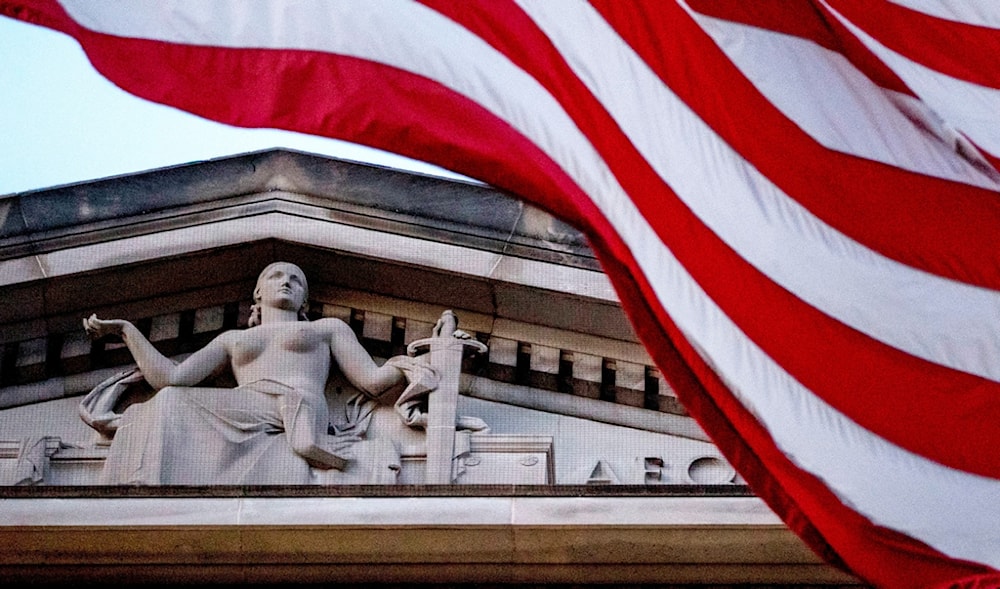
A US flag flies outside the Department of Justice in Washington, March 22, 2019. (AP Photo/Andrew Harnik, File)
A US federal judge on Friday temporarily blocked the Trump administration from establishing a nearly $1.8 billion fund intended to compensate people who claim they were targeted by government "weaponization," a term Trump uses to describe what he alleges was the politically motivated use of federal agencies against him and his allies.
The order, issued by US District Judge Leonie Brinkema of the Eastern District of Virginia, bars the Justice Department from moving forward with the fund in any capacity, including transferring money into it, accepting claims, or making payments, while a legal challenge proceeds.
A hearing is scheduled for June 12.
How it started
The fund traces back to a civil lawsuit Trump filed against the Internal Revenue Service (IRS), the US federal tax authority, over the leak of his personal tax returns. Years earlier, an IRS contractor named Charles Littlejohn had illegally passed Trump's records to news outlets. Littlejohn was convicted and imprisoned for the leak.
Trump, seeking $10 billion in damages, sued the IRS and the Treasury Department. But the case immediately drew scrutiny, since as sitting president, Trump controls the very agencies he was suing, raising questions about whether the lawsuit represented a genuine legal dispute or a staged proceeding designed to produce a pre-determined outcome.
The judge overseeing the case, US District Judge Kathleen Williams, was preparing to examine whether the lawsuit met the constitutional requirement of being an actual dispute between real adversaries. Before she could, both sides moved to dismiss it.
The settlement and its fallout
In lieu of a court ruling, Acting Attorney General Todd Blanche signed a settlement agreement last week.
Under its terms, the IRS issued Trump a formal apology, agreed it could never audit him over past tax returns, and, most controversially, established the $1.776 billion Anti-Weaponization Fund, to be administered by a five-member commission yet to be named.
The fund drew immediate backlash from across the political spectrum. Critics pointed out that it was created without any act of Congress, meaning no legislative body approved the expenditure, and that its eligibility criteria were undefined.
Among the potential claimants are participants in the January 6, 2021, attack on the US Capitol, many of whom Trump had already pardoned and publicly described as victims of government overreach.
Dozens of retired federal judges filed a brief calling the settlement "a product of collusion" and a "fraud on the court."
The legal challenge
A former federal prosecutor filed a lawsuit against the fund, a professor arrested at an immigration protest, and several nonprofits. They argued the fund has "no congressional authorization, no basis in law, and no accountability."
Judge Brinkema's temporary restraining order puts the entire enterprise on hold, with no money yet transferred and no claims yet processed.


