
Labour MP says UK government failed Palestinians, calls for action
 4 Min Read
Labour MP Emily Thornberry criticises the UK government over its Palestine policy, urging stronger action on Gaza, West Bank settlements, and international law.
-
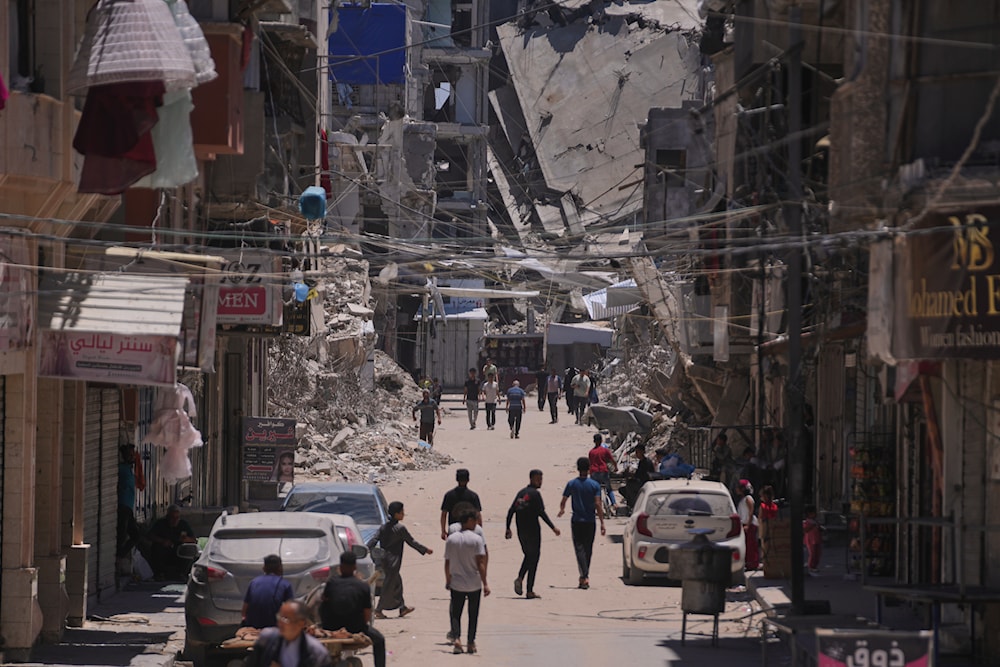
Palestinians walk along a street surrounded by buildings destroyed by Israeli military strikes in Khan Younis, southern Gaza Strip, on May 29, 2026. (AP Photo/Abdel Kareem Hana)
Labour MP and chair of the Foreign Affairs Select Committee Emily Thornberry has criticized the UK government’s approach to the Palestinian cause, arguing that it has failed to take sufficient measures to hold “Israel” accountable and support a viable two-state solution.
Speaking at a Westminster event on Tuesday, Thornberry said the UK had “let down Palestinian people” and lacked ambition in its foreign policy, particularly in relation to Gaza and the West Bank.
Thornberry accused the government of “wringing its hands” over the occupation and failing to build on its decision to recognize Palestine as a state. She said the recognition, taken more than eight months ago, should have been only the first step in a broader strategy.
Quoting her remarks, she said: "Anyone who believes that what Gazans have right now is a genuine ceasefire has to look at what the truth is. They need to look at the pictures of the children who have been bitten by rats as they sleep in displacement camps in mountains of rubble".
She added that thousands of Palestinians had been killed, and said violence continued despite what she described as a so-called ceasefire.
Trump administration and Gaza ceasefire
Thornberry also criticized the international response to Gaza, arguing that political declarations had not translated into meaningful protection for civilians.
She said, "This is what Trump does. He publishes a piece of paper. He calls it a great victory. He calls it ‘the greatest peace from the greatest president ever’, then he calls it a day, and then he walks away".
Thornberry argued that despite the announcement of a ceasefire, violence in Gaza had continued and international attention had waned.
Turning to the West Bank, Thornberry warned that settlement expansion and impunity were undermining the prospects for peace, citing Israeli Prime Minister Benjamin Netanyahu’s statement that “Israel” intended to take over 70% of Gaza, calling it evidence of escalating tensions and a lack of accountability.
Thornberry also referenced the International Court of Justice advisory opinion on the legality of the occupation of Palestinian territory, noting that the UK government had still not issued a formal response.
She said that if the ICJ opinion was taken seriously, it should lead to concrete policy actions, including:
- banning imports of goods from illegal settlements
- imposing sanctions on individuals involved in settlement activity
- restricting the involvement of British companies in settlement-linked operations
- taking stronger measures against financial and insurance networks supporting settlements
She argued that without such steps, settlement expansion would continue unchecked.
Calls for stronger UK foreign policy leadership
Thornberry said the UK must move beyond symbolic statements and take a more active diplomatic role. She called for renewed international coordination among states that support Palestinian recognition, arguing that economic and diplomatic pressure could make settlement expansion “untenable”.
“The tragedy of Gaza is a lesson of what happens when we do too little, too late", she said, warning that the West Bank could face a similar trajectory if stronger action was not taken.
Her remarks reflect growing criticism within parts of the UK political establishment over government policy on the Palestinian issue, arguing that Britain’s historic commitment to international law has not been matched by its actions on Gaza and the West Bank, and urging a more assertive diplomatic strategy to prevent further escalation.


