
Latin American leaders warn US action in Venezuela is splitting region
 3 Min Read
Latin American leaders meeting in Panama warned that US intervention in Venezuela and rising ideological polarization are deepening divisions in the region and paralysing collective bodies such as CELAC.
-
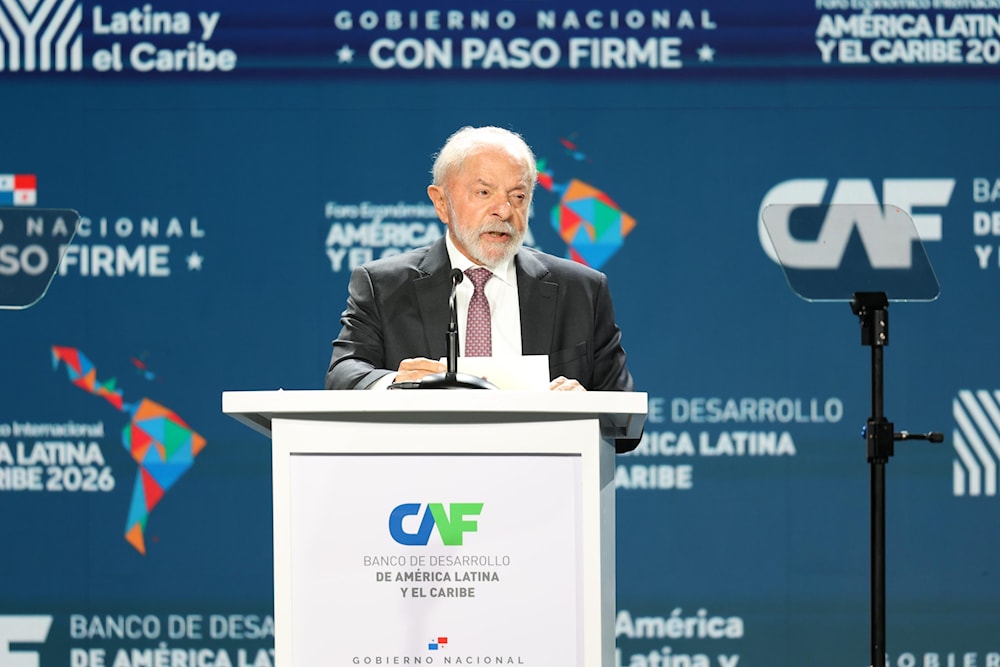
Luiz Inácio Lula da Silva addresses the CAF–Development Bank of Latin America and the Caribbean forum in Panama City on January 29, 2026. (X, @AgendaCAF)
Latin American leaders meeting at a regional development forum in Panama on Wednesday warned that political polarization and recent US aggression in Venezuela have further weakened regional cohesion, exposing deep divisions within multilateral bodies meant to defend sovereignty and collective diplomacy.
Speaking at the CAF-Development Bank of Latin America and the Caribbean forum in Panama City, Brazilian President Luiz Inácio Lula da Silva lamented the growing inability of regional institutions to respond to what he described as illegal foreign military actions.
"It has not been capable of producing even a single declaration against illegal military interventions that affect our region," Lula said, referring to the Community of Latin American and Caribbean States (CELAC), the only regional body that includes all Latin American and Caribbean governments. "We’re experiencing one of the moments of greatest deterioration in the area of integration," he added.
🇧🇷 El presidente de Brasil, @LulaOficial, inicia su discurso en el Foro Económico Internacional América Latina y el Caribe 2026.
— CAF (@AgendaCAF) January 28, 2026
En sus palabras iniciales, saludó al presidente ejecutivo de CAF, @sergiodigra, agradeció la invitación al Foro y felicitó su reelección al frente de… pic.twitter.com/51tw9hfwPA
While Lula avoided naming the United States directly, his comments came amid renewed controversy following a US military operation in Venezuela that resulted in air strikes over Caracas and the abduction of President Nicolás Maduro. Washington has framed the operation as a law-enforcement action based on drug-related allegations, a justification widely refuted by legal experts and several governments in the region.
Colombian President Gustavo Petro was more explicit, condemning the "bombing" over Caracas and rejecting the legitimacy of external coercion as a substitute for legal due process. Petro argued that accountability for Venezuela’s leadership should be determined either domestically or through a regional judicial mechanism, proposing what he termed a "Three Americas Tribunal."
Mi intervención en el Foro Económico Internacional América Latina y el Caribe 2026.
— Gustavo Petro (@petrogustavo) January 28, 2026
Si queremos rehacernos, miremos a América Latina y el Caribe como una civilización. Hagamos un pacto entre nosotros, juntemos regiones, no países fragmentados.
Entonces seremos lo que somos:… pic.twitter.com/bhfTfWmxkZ
Fragmented Latin America
The absence of a unified response reflects persistent ideological fractures across Latin America, where governments remain divided over relations with Washington and how to address Venezuela’s political crisis. CELAC’s failure to issue a statement has become emblematic of that paralysis, with consensus blocked by competing alignments and external pressure.
These divisions are evident in how Latin American governments reacted to the US operation. Argentina’s President Javier Milei publicly welcomed Maduro’s abduction and praised the action as a step toward democracy and freedom, while Chile’s president-elect José Antonio Kast described the event as “great news for the region.” In contrast, Brazil, Colombia, Mexico, and Uruguay, along with Spain, in a joint statement, rejected the US military aggression, saying it violated international law and posed risks to peace and civilian safety.
Other governments beyond Latin America have also strongly criticised the US action. China and Russia condemned it as a blatant violation of international law and Venezuela’s sovereignty, and the United Nations expressed deep alarm, warning that the strikes and capture could have violated the UN Charter and set a dangerous precedent. European Union officials similarly urged respect for international law and restraint.
Leaders from Ecuador, Bolivia, and Guatemala attended the Panama forum, alongside Chile’s president-elect Kast. Discussions focused on development and regional cooperation, but the fallout from Venezuela loomed large, reinforcing concerns that unilateral military actions by external powers continue to undermine Latin America’s ability to act collectively.
Read more: CIA quietly working to secure lasting US footprint in Venezuela: CNN


