
Lebanese army chief meets US general amid ongoing Israeli aggression
 3 Min Read
A high-level meeting between Rodolphe Haikal and the US head of the Mechanism Committee comes amid Israeli aggression on Lebanon, concentrated in the South.
-
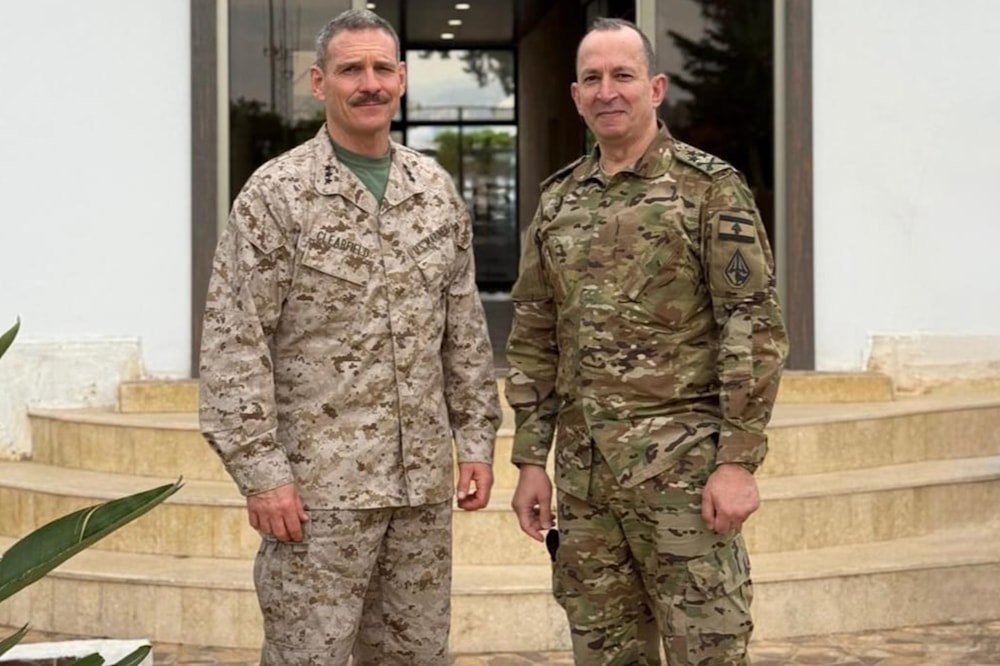
Lebanese Army Commander Rodolphe Haykal meets US General Joseph Clearfield at Beirut Air Base during an exceptional visit (X, @LebarmyOfficial)
Lebanese Army Commander Rodolphe Haykal held an exceptional meeting with US General Joseph Clairfield, head of the Mechanism Committee, during a brief visit to Lebanon, the Lebanese Army Command announced on Saturday.
According to the Army’s statement, discussions focused on the country’s security situation and broader regional developments. The meeting comes as Israeli attacks persist across southern Lebanon, targeting villages, civilian homes, and agricultural land.
The talks also stressed the central role of the Lebanese Armed Forces and the need to sustain support for the institution during the current phase. The US is involved in coordination efforts linked to ceasefire arrangements in southern Lebanon, primarily through support to the Lebanese Army and engagement with UN-led mechanisms.
عقد قائد الجيش العماد رودولف هيكل ورئيس لجنة الإشراف على اتفاق وقف الأعمال العدائية - الميكانيزم الجنرال الأميركي Joseph Clearfield اجتماعًا استثنائيًّا في قاعدة بيروت الجوية.
— الجيش اللبناني (@LebarmyOfficial) May 2, 2026
الاجتماع الاستثنائي، جاء نتيجة زيارة سريعة قام بها كليرفيلد، وتناول الوضع الأمني في لبنان والتطورات على… pic.twitter.com/xYjEsLm8Jw
Structural imbalance and external influence
The meeting reflects a deeper contradiction in the regional security architecture. While Washington presents itself as a stabilizing actor through coordination with the Lebanese Army, it remains the primary military backer of "Israel", whose aggression continues to intensify by the day.
US policy has long focused on building the Lebanese Armed Forces as a domestic stabilizing institution, rather than a force capable of confronting "Israel". Since 2006, US assistance has centered on border security, counterterrorism, and internal stability, without altering the regional balance of power.
At the same time, US law and policy are designed to preserve "Israel’s" qualitative military edge, ensuring its superiority over neighboring states. This framework has shaped the scale and nature of support provided to Lebanon, effectively limiting the army’s capabilities to defensive and internal roles.
Critics argue this creates a dual dynamic in which the United States backs "Israel’s" military aggression while also supporting Lebanese state institutions tasked with containing its consequences.
Army under pressure
The Lebanese Armed Forces operate under significant constraints. Heavily dependent on external assistance, particularly from Washington, the army has been structured to prioritize internal stability and avoid direct confrontation, even as Israeli attacks continue.
This dynamic has been evident in recent political interactions. In February, Lindsey Graham abruptly ended a meeting with Haykal after the Lebanese commander refused to classify Hezbollah as a “terrorist” organization, stating it was not viewed as such “in the context of Lebanon.” The episode reflected ongoing US pressure on Lebanese institutions to align with Washington’s political framing, even as Hezbollah remains a central actor in the country’s security landscape.
This places the institution in a difficult position: expected to manage security risks and uphold state authority, while lacking the means, and often the political mandate, to respond to external military pressure.
Necessary counterweight
Moreover, the current escalation cannot be understood without the role of Hezbollah, which evolved from a resistance force into a central deterrent actor against "Israel" following the 2006 July war on Lebanon.
Since 2006, a deterrence balance had prevailed, but the current escalation has already evolved into a full-scale war, marked by sustained Israeli strikes on Lebanon and ongoing Hezbollah retaliation despite intermittent ceasefires.
Hezbollah’s role has been framed by its supporters as a necessary counterweight to Israeli military power, particularly in light of the limitations placed on the Lebanese state’s armed forces.
Read more: US sends 6,500 tons of weapons to 'Israel' amid war on Iran, Lebanon


