
Lebanese paramedics say 'Israel' targeted them directly: The Guardian
 6 Min Read
Healthcare workers in southern Lebanon describe deadly attacks, as doctors and paramedics say they were directly targeted while treating the wounded.
-
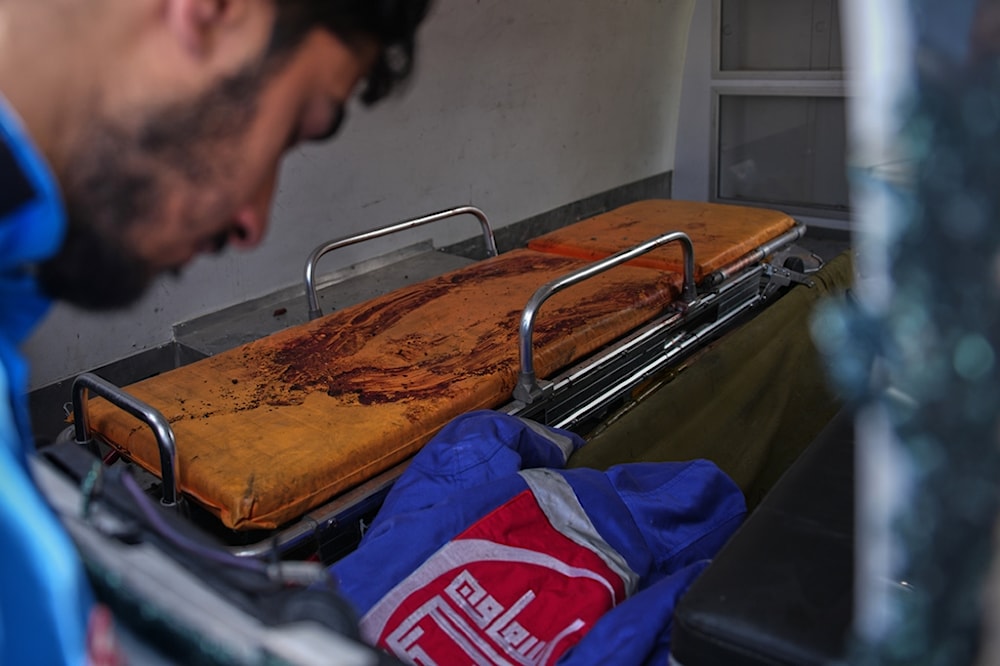
A member of the Nabatieh Emergency Services looks inside a damaged ambulance stained with the blood of his colleague, who was martyred during a rescue mission in an Israeli airstrike, Nabatieh, South Lebanon, Friday, April 17, 2026. (AP/Hassan Ammar)
Healthcare workers in southern Lebanon have described a war in which treating the wounded increasingly meant putting their own lives at risk, with doctors and paramedics saying they faced direct Israeli attacks while carrying out their duties, according to a report by The Guardian.
For Moustapha Hamze, a 66-year-old surgeon at the Nabih Berri governmental hospital in Nabatieh, the war has turned the hospital into both his workplace and his home.
"Hamze could see his house in the hillside village of Kfarrouman from the hospital, which is only around a five-minute drive away. Yet he has been unable to return home despite the ceasefire. During the war, an Israeli drone attacked him when he attempted to reach the house, first dropping a stun grenade before releasing a bomb roughly 10 meters away," wrote The Guardian.
“I have a room here, but I no longer have any clothes. The last time I went home, I took my clothes with me. I didn’t realise that I might not be able to return to the house,” Hamze told The Guardian.
His daily routine has since revolved around the hospital. He sleeps in a small surgery room, walks through the reception area and spends his working hours treating people arriving at the emergency department, as per The Guardian.
When "Israel" launched an invasion and the ensuing war after March 2, Hamze closed his private clinic and began volunteering at the public hospital. He remained there throughout almost five months of fighting, taking only four days away from work after a ceasefire was reached in June.
Doctors and paramedics were under direct fire
Hamze's experience reflects the risks faced by thousands of healthcare workers across Lebanon, many of whom continued providing emergency care while their own colleagues and facilities came under attack, wrote The Guardian.
According to the Lebanese Health Ministry, at least 135 healthcare workers have been martyred by the Israeli occupation since March 2. The Guardian reported that many of the deaths occurred in what are known as "double-tap" attacks.
The Israeli occupation has claimed that ambulances were used to transport weapons for Hezbollah. However, human rights organizations, including Amnesty International, have said they found no evidence supporting the claim, according to the report.
Hamze, who also worked as a volunteer during the 2024 war, said the latest war had been unlike anything he had previously experienced.
“The Israeli bombardment was worse. I saw greater injustice and bodies in unnatural, horrifying conditions. When they burned people alive in Nabatieh, the sight was terrifying.
“I saw bodies with the entire upper part of the head missing. Previously, you would see something like that only in films.”
The surgeon said the war also changed his perception of the risks faced by medical workers. For the first time, he believed that he and his colleagues themselves had become targets.
“I would see paramedics leave in an ambulance and return dead. That was psychologically very difficult; it creates mental exhaustion,” Hamze said.
Among those martyred was Mahdi Abu Zeid, a paramedic Hamze had come to know during the war.
“He was a polite, decent young man. What upset me was that I had to come to know him,” says Hamze. “Sometimes, I wish I had not known him, because then his death might have hurt less.”
Paramedics say fear changed how they worked
The danger extended beyond the hospital. Mohammed Suleiman, the 44-year-old chief paramedic for Nabatieh emergency services, has spent his career working through three wars.
In previous war, nearby airstrikes had affected paramedics from the independent rescue organization where he worked. But Suleiman said the latest war marked a fundamental shift in how medical crews viewed their safety.
“We worked on the assumption that we might be caught in an attack, but not that we would be targeted directly. But in this war, no – they targeted us directly,” Suleiman told The Guardian.
Three paramedics were directly martyred in Israeli airstrikes, including Suleiman's 16-year-old son, Joud. He was killed alongside another young paramedic, Ali, in March while the two were delivering food to residents who had remained in Nabatieh. They were wearing paramedic uniforms when a drone struck them.
The deaths profoundly affected Suleiman's work. As the person responsible for dispatching ambulances, he said he began to question whether sending crews into certain areas could put them in danger.
“Before the attacks, I would dispatch the teams without hesitation. But after these incidents, I would make a hundred calculations before sending out a vehicle,” Suleiman said.
He also described the psychological strain of being separated from the crews while they were operating in dangerous areas.
“When you are at the centre, away from the crews, you are more stressed than the people who are actually on the ground. I have no way of knowing whether they are about to target him or not. Only when they came back to the centre could we relax.”
Ceasefire fails to end attacks on medical crews
For other paramedics, the uncertainty surrounding the attacks became an additional source of fear. Hassan Boussi, a paramedic and assistant director of the Islamic Health Society for Tyre, said he eventually stopped trying to identify patterns that might explain why some medical workers were killed.
He said crews had considered whether certain areas were too dangerous to enter and whether leaving more time between attacks might reduce the risk. But Boussi said such calculations ultimately proved futile.
“There are many justifications offered by the Israelis, but the reality is one: they did not want ambulance and rescue teams to operate,” says Boussi.
The ceasefire reached in June has not brought a complete halt to Israeli attacks in Lebanon. Although the pace of bombardment has decreased, violence has continued, particularly around Nabatieh.
Medical workers remain exposed to the danger. According to The Guardian, an ambulance was struck by an Israeli drone in the village of Nabatieh al-Fawqa last Thursday.
For healthcare workers such as Hamze and Suleiman, the experience of the war has left them continuing to work under the same threat they have spent months trying to survive.


