
Lebanon-'Israel' deal shields perpetrators, betrays war crimes victims
 7 Min Read
Rights and press freedom groups warned that the "Israel"-Lebanon framework agreement risks prolonging the forced displacement of residents from southern Lebanon.
-
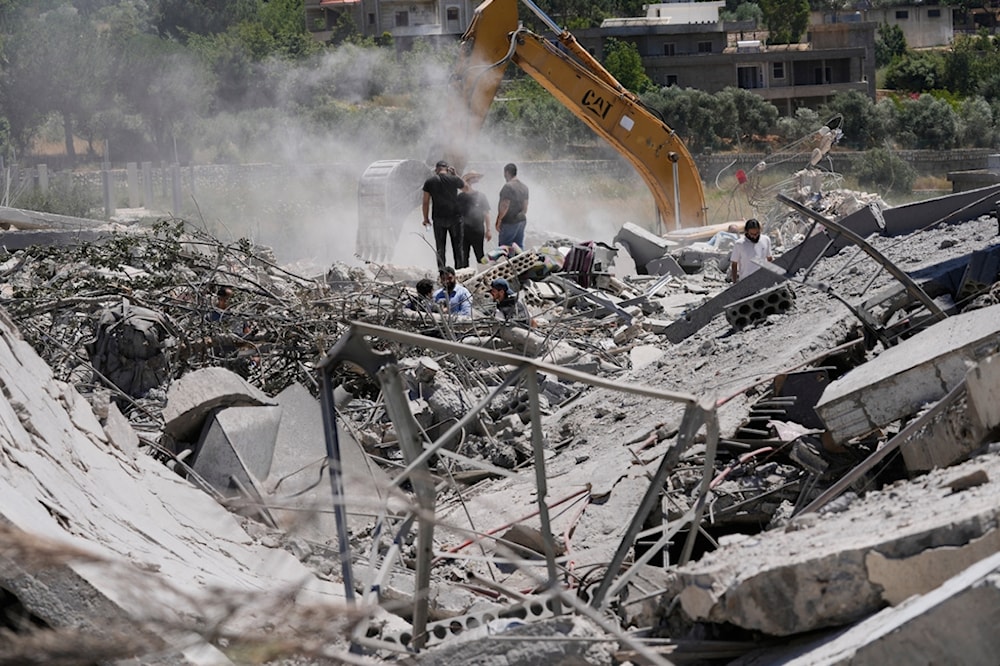
People who returned to their village following the announcement of an initial ceasefire agreement between the United States and Iran use an excavator as they search for dead bodies under the wreckage of a destroyed house in the southern village of Touline, Lebanon, Tuesday, June 16, 2026 (AP)
Amnesty International and several human rights and press freedom organizations warned that the “Israel”-Lebanon framework agreement signed in Washington on June 26 risks denying justice to war crimes victims in Lebanon and prolonging the displacement of residents from occupied areas in the South.
In a joint statement on Friday, the organizations raised concern over Clause 13, which commits Lebanon and “Israel” to end “all hostile or adverse actions in international political or legal fora.” They warned that, if interpreted as preventing either side from turning to international courts, including the International Criminal Court or the International Court of Justice, the clause would contradict international legal obligations to pursue accountability for serious crimes committed on their territories.
The groups also noted that the agreement does not appear to require “Israel” to halt initiatives in international forums against Hezbollah, raising concerns over an imbalance in how international legal mechanisms could be used.
Clause 3 of the agreement under fire
Meanwhile, Amnesty International Secretary General Agnès Callamard said civilians in Lebanon have repeatedly paid the price for cycles of conflict without accountability.
“Time and time again, we have seen civilians in Lebanon pay the price for successive cycles of conflict and serious violations and crimes under international law with no accountability,” Callamard said. “Victims of war crimes and other violations deserve justice. Any agreement that fails to center their rights to justice, accountability and reparations will falter underneath the very impunity it builds. The past few years have made it abundantly clear – rampant impunity comes at a cost to us all. States that claim to uphold the international legal order must speak out: justice, reparation and respect for international law in Lebanon and beyond are non-negotiable.”
The organizations also criticized Clause 3 of the agreement, saying it risks allowing the indefinite displacement of tens of thousands of Lebanese civilians from border areas currently occupied by Israeli forces. The clause conditions the return of residents to specified zones along the border on the “successful disarmament of non-state armed groups and dismantlement of their infrastructure.”
Under international humanitarian law, the groups said, displaced people must be allowed to return once hostilities have ended or once the reasons for their displacement no longer exist.
Documented violations and civilian harm
The statement comes after months of hostilities that killed thousands of civilians and resulted in mass destruction in Lebanon. Since 2023, rights groups have documented repeated Israeli violations of the laws of war, including apparent direct attacks on civilians and civilian infrastructure, indiscriminate attacks, and other unlawful strikes that killed medical personnel, journalists, and entire families.
The groups also cited the unlawful use of white phosphorus over residential areas, which can cause severe burns and long-term harm to civilians.
Amnesty International said its recent findings concluded that the Israeli military forcibly displaced tens of thousands of Lebanese civilians, amounting to the war crime of unlawful transfer, while continuing the large-scale destruction of civilian property and infrastructure across southern Lebanon.
Human Rights Watch Program Director Lama Fakih said the agreement risks placing political considerations above victims’ rights.
“Not only does this agreement risk further entrenching impunity, but it includes a clause that signals that political expediency outweighs the fundamental rights of those who have suffered atrocious violations,” Fakih said. “It risks denying justice to victims at a time when mounting evidence points to repeated unlawful Israeli attacks causing extensive civilian harm and widespread destruction.”
Displacement and denial of return
According to Lebanon’s Health Ministry, more than 8,700 people have been killed in Lebanon since October 8, 2023, including at least 569 children and 357 medical workers. Reporters Without Borders said Israeli forces have repeatedly targeted and killed identifiable journalists covering the war.
The groups said hundreds of thousands of people remain displaced in Lebanon following Israeli displacement orders, while Israeli forces continue to occupy nearly 600 square kilometers of Lebanese border villages and prevent residents from returning.
Although the agreement states that Lebanon and “Israel” recognize the importance of the safe return of southern Lebanon’s civilian population, the organizations warned that it effectively makes return and reconstruction conditional on requirements subject to confirmation. They said the text makes no mention of justice or reparations for victims of serious violations, including those forcibly displaced or whose homes and agricultural lands were destroyed.
Elsy Moufarrej, President of the Union of Journalists in Lebanon, said the Lebanese government cannot surrender victims’ right to accountability.
“The Lebanese government has conceded a right that is not its right: the right of the victims to pursue and hold the perpetrators accountable,” Moufarrej said. “This is the right of the people who lost their loved ones, whose homes and memories were destroyed. This is the right of those who performed their duties despite the dangers, like journalists and emergency medical workers.”
Lebanon urged to grant ICC jurisdiction
The organizations called on Lebanese authorities to take urgent steps to pursue accountability, including acceding to the Rome Statute of the International Criminal Court and filing a declaration under Article 12(3) accepting ICC jurisdiction over crimes committed on Lebanese territory since at least October 7, 2023.
Yet the call to grant ICC jurisdiction also raises concerns among Resistance-aligned forces and their supporters, who view international criminal justice as vulnerable to Western political pressure and selective enforcement. Under the Rome Statute, the ICC prosecutes individuals rather than states or movements, meaning any investigation opened on Lebanese territory could theoretically examine conduct by all parties, including Israeli officials and members of Lebanese armed factions.
They also urged Lebanon’s parliament to adopt legislation criminalizing war crimes and other crimes under international law in line with international standards.
“It is imperative that Lebanon promptly provides the ICC with the jurisdiction to investigate and prosecute such crimes,” said Wadih Al Asmar, President of CLDH. “Any delay amounts to tolerance of impunity and further injustice for victims.”
The groups noted that a UN Office of the High Commissioner for Human Rights assessment team is already deployed in Lebanon at the request of Lebanese authorities to document violations of international humanitarian law and human rights violations and abuses committed since March 2.
Under the agreed terms of reference, the UN team is tasked with examining accountability options and working to preserve information for possible future legal processes.
Rights groups warn against trading justice for settlement
The organizations said Lebanon and “Israel” must not implement the agreement in a way that overrides victims’ rights, stressing that Clauses 3 and 13 cannot erase international legal obligations.
They also called on governments supporting a political settlement to make clear that such support does not extend to provisions that block justice, reparations, or the return of displaced residents.
“Accountability and respect for international law are not bargaining chips,” said Ghida Frangieh, Head of Litigation at Legal Agenda. “They are legal obligations. International law is clear: States cannot waive or negotiate away their obligation to investigate and prosecute the most serious crimes of concern to the international community as a whole. Nor can states extinguish individual rights to truth, justice and reparation."
“Lebanese authorities should urgently take concrete steps to uphold their obligations under international law by pursuing every possible path to accountability, including granting jurisdiction to the International Criminal Court and pursuing reparation for international law violations. And they must secure the right of the displaced to return to their homes. There cannot be peace without justice.”
Read more: 'Israel' delayed Majdal Zoun blast until Lebanon signed deal


