
Lebanon stresses ceasefire preconditions in talks with 'Israel': Aoun
 5 Min Read
The Lebanese president reiterates Lebanon’s position that a ceasefire is a prerequisite for negotiations with “Israel” as the IOF carry a series of strikes from the South to the East.
-
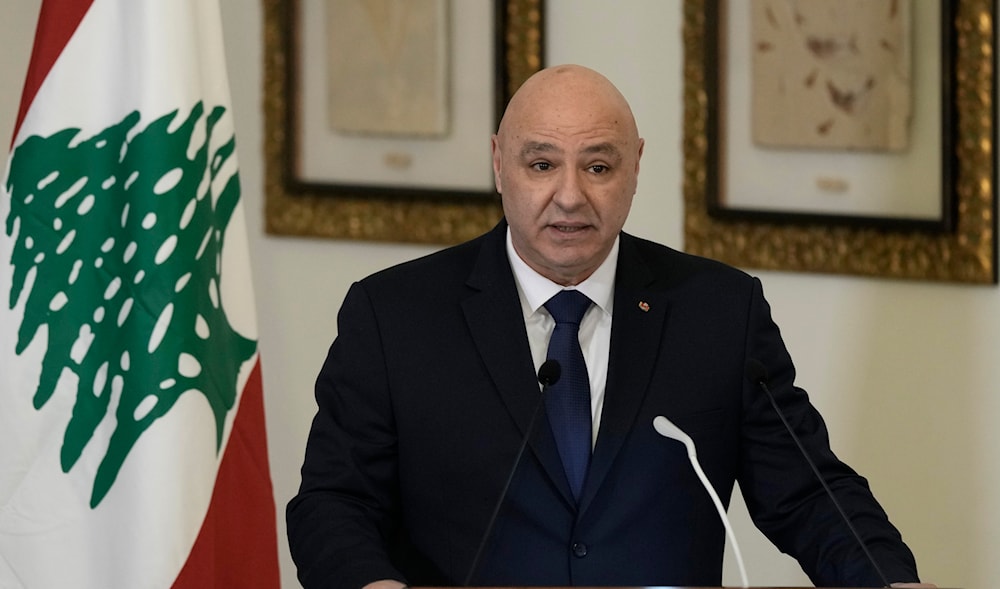
Lebanese President Joseph Aoun speaks during a joint news conference with French President Emmanuel Macron at the presidential palace in Baabda, in the east of Beirut, Lebanon, Jan. 17, 2025 (AP)
Lebanon’s position on the ongoing engagement with "Israel" remains unchanged, Lebanese President Joseph Aoun said on Monday.
Speaking to a delegation from Hasbaya and Arkoub, Aoun said, “We informed the American side, which is commendably engaged in its efforts, from the very first moment that a ceasefire is a necessary first step for any subsequent negotiations. This is what we reiterated in the two sessions held at the ambassadorial level on April 14 and 23.”
He added that this position was already reflected in a US State Department statement following the first meeting, citing a "clear commitment" that “Israel will not carry out any offensive military operations against Lebanese targets, including civilian, military, and other state targets on Lebanese territory by land, sea, and air.” This commitment has yet to crystallize, as "Israel" continues to strike South Lebanon and Bekaa.
The Israeli entity continues its aggression against #Lebanon despite the temporary ceasefire agreement.
— Al Mayadeen English (@MayadeenEnglish) April 27, 2026
On April 27, #AlMayadeen’s correspondent in southern Lebanon reported in the early morning that one person was martyred as a result of an Israeli drone strike on the town of… pic.twitter.com/Zif8RTGuHK
Aoun emphasized that this remains Lebanon’s official stance, saying, “This is the official position of the Lebanese state regarding what is happening in Lebanon or in Washington, and we are not concerned with any other statements, and there is no official Lebanese endorsement of them.”
Responding to criticism over the decision to proceed with negotiations without what some have described as national consensus, he said, “Some blame us for deciding to go to negotiations on the grounds that there is no national consensus. I ask: when you went to war, did you first obtain national consensus?”
Negotiations from a position of surrender
He also addressed accusations that Lebanon is heading into talks from a position of surrender, saying, “Before negotiations even began, some started directing accusations of betrayal and claiming that we are going to negotiations in surrender. To those people, we say: wait until negotiations begin and judge the outcome.”
On the situation in southern Lebanon, Aoun claimed that residents were paying the price for external conflicts, stating, “Until when will the people of the South continue to pay the price for others’ wars on our land, the latest being the war in support of Gaza and the war in support of Iran? Were the fought for Lebanon, we would have supported them, but when the goal of war is to serve others’ interests, I completely reject it.”
He rejected allegations of treason, saying, “What we are doing is not betrayal. Betrayal is committed by those who take their country to war to serve external interests.”
Aoun concluded by defending his approach to negotiations, saying, “My duty is to assume responsibility for my decision and lead my country on the path of salvation, within the constants I have affirmed. My goal is to end the state of war with Israel, similar to the armistice agreement. Was the armistice agreement humiliating? I will not accept reaching a humiliating agreement.”
Lebanese state rushed into humiliating concessions: Sheikh Qassem
Earlier, Hezbollah Secretary General Sheikh Naim Qassem sharply criticized the Lebanese authorities, accusing them of rushing into a “gratuitous and humiliating concession” and rejecting any direct negotiations with "Israel". He urged the government to halt direct talks, return to indirect channels, and restore governance based on national consensus under the Taif Agreement, while also reversing measures targeting the Resistance and its supporters.
He asserted that authorities must “return to governing as the authority of the entire nation,” warning that no government can endure while “forfeiting Lebanon’s rights, surrendering its land, and confronting its own resisting people.” He also reiterated that any engagement with "Israel" through direct negotiations was “null and void,” insisting that it would bring no benefit to Lebanon.
Sheikh Qassem outlined five core demands he said must be addressed before anything else: an end to Israeli land, sea, and air aggressions, "Israel’s" withdrawal from all occupied Lebanese territory, the release of detainees, the return of displaced residents, and reconstruction efforts.
He also stated that the Israeli occupation “will not remain on one inch of our occupied land,” adding, “O our people, just as we resisted together, we will rebuild it together.” He emphasized that "Israel", “backed by the American tyrant,” had failed to achieve its objectives against the Resistance despite major military escalations he referenced in 2024 and 2026, saying Resistance operations had pushed Israel into a “dead end".
Sheikh Qassem concluded by reaffirming that the Resistance would continue its role, describing its weapons as defensive in nature and vowing, “No matter the threats, we will not retreat, we will not bow, and we will not be defeated,” while stressing continued unity with allied political forces across Lebanon.


